
It’s about remaining resilient yet open at the same time. It’s about carrying around your battered heart, rather than pretending you don’t have a heart at all.
Jenny, the character I play, tells herself she doesn’t have a heart because it’s easier to be entirely unburdened by the capacity for empathy and need for connection.
David (Niwa Whatuira) is on the other end of the spectrum. He’s ready to jump in blindly, naively, into the romantic idea of love – or the fantasy of it, so he tries to fast-track his way to connection with Jenny using the 36 questions that lead to love, according to US psychologist Arthur Aron.
Most of us will have spent time at either of these extremes: scepticism at one end, primal yearning on the other. As always, the truth is probably somewhere in the middle.
When I read Thirty-Six for the first time, I didn’t like my character very much. Then I realised that when I don’t like something, it’s often alluding to some core truth or a piece of myself I’m trying to pretend doesn’t exist.
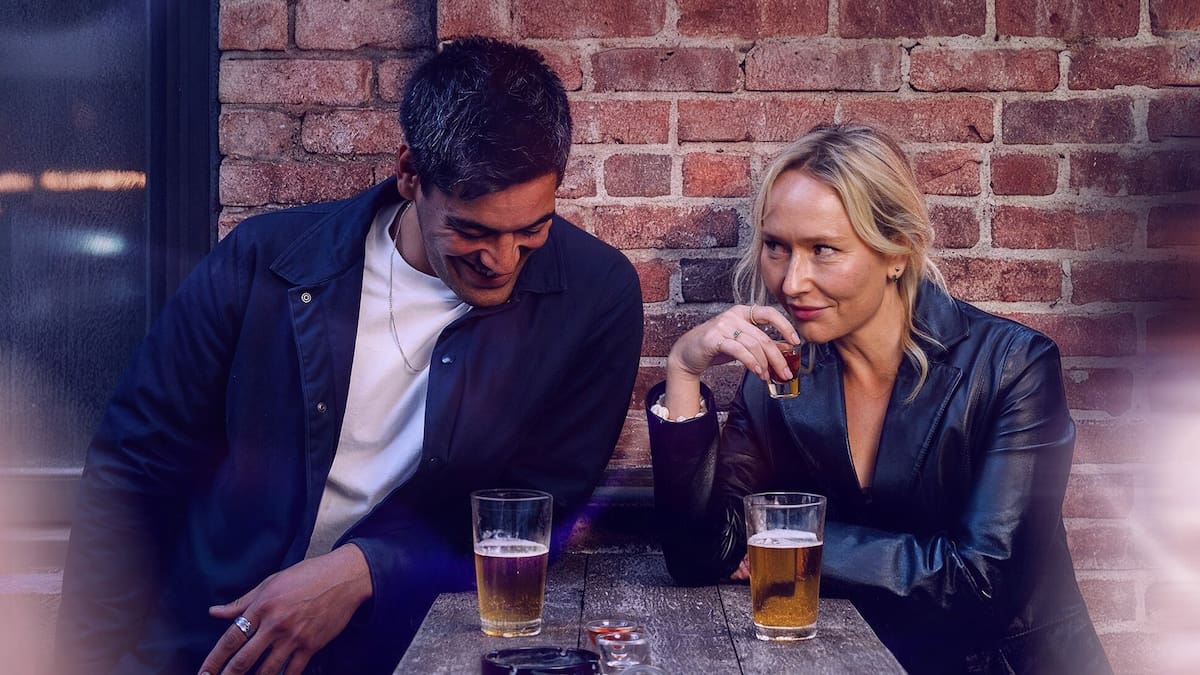
Thirty-Six throws together a romantic (Niwa Whatuira) and a cynic (Fern Sutherland) then lets the sparks fly. Photo / Mark Tantrum
After coming out of a 14-year relationship a while back, the last thing I wanted to do was date. Not only had the landscape completely changed while I was safely ensconced in a de facto existence, but after the break-up (which napalmed my entire life), I was too miserable to do anything other than drink wine and party to take my mind off things.
I also cannot do small talk to save my life, so I’ve never used dating apps. Social media, however, does provide an interesting piece of the puzzle. The swiping of profile pictures (actual human beings) creates a sense of disposable and inexhaustible choice.
Taking the time to truly make room for someone new needn’t be a bother when you can hit reset and start over if things start to feel “serious”. There’s no call really for any risk, any heart hurt, any real vulnerability.
In today’s age of comparison, perhaps it’s not the fear of being alone but the fear of not being enough. Or, more accurately, the fear of allowing yourself to be truly seen and then being perceived as not enough.
In the play, Jenny’s cynical approach masks her deep hurt from a past betrayal. She’s avoiding being in a relationship because she’s afraid to feel rejected, so she opts for casual sex.
Some of us do the opposite, jumping into relationships and ignoring all red flags, high on the fumes of ideals. David is trying to show up as the easiest, most lovable version of himself, but he’s wearing a mask too.
Something I’m glad to have learned is that I have to work on myself significantly if I want a relationship where I can help someone else grow in a healthy, supportive and balanced way.
Sutherland has never used dating apps: “I cannot do small talk.” Photo / Mark Tantrum
I know how it feels to have a partner hold a gigantic mirror up to my face and not like what I see. But rather than take issue with the person in the glass, it was easier to be bitter about the person holding the mirror. That’s a lesson I learned the hard way, and boy, I wish I’d had the tools to understand myself sooner.
Still, not all the people who come in and out of our lives romantically (or as friends) are meant to stick around, and that’s okay. I think people get too sensitive when they’re dating and take everything as a personal slight and mortal wound.
Dating is just two people trying to figure out if they want to stick together or move on. But it can also become a form of therapy, whether it’s two people sheltering from a storm for a while, a moment to bolster the ego, growing together as a couple or growing apart.
Whether it’s a one-night stand, a situation-ship, a brief fling or a marriage, you could say none of it is a failure or a waste of time. Maybe you take something from each other, but also give something back. After it ends, maybe you’ll never see each other again, but the experience becomes part of who you are.
I choose to rebrand some of my more painful choices as something that reminds me I’m alive, and that beauty and pain must co-exist. A 14-year relationship isn’t a failure; it’s a success to have lasted so long. And by working on myself, hopefully I won’t make the same mistakes again.
Whether you’re single, dating, or in a relationship, it requires courage to be seen as imperfect, and even more courage to see the flaws in yourself. It also takes courage to meet someone else’s imperfections with grace.
I suspect that’s the whole point of being here, cracking open your heart to other people and loving them (with discernment, of course) and allowing yourself to be worthy of receiving love in return.
So why not just give it a hoon because – not to be a mood killer – you’ll be dead one day. That’s a non-negotiable. Oh, and congratulations on your “failures”. It means you tried.
Thirty-Six, by New York City-based playwright Leah Nanako Winkler, is on at Wellington’s Circa Theatre, March 7 to April 4.