
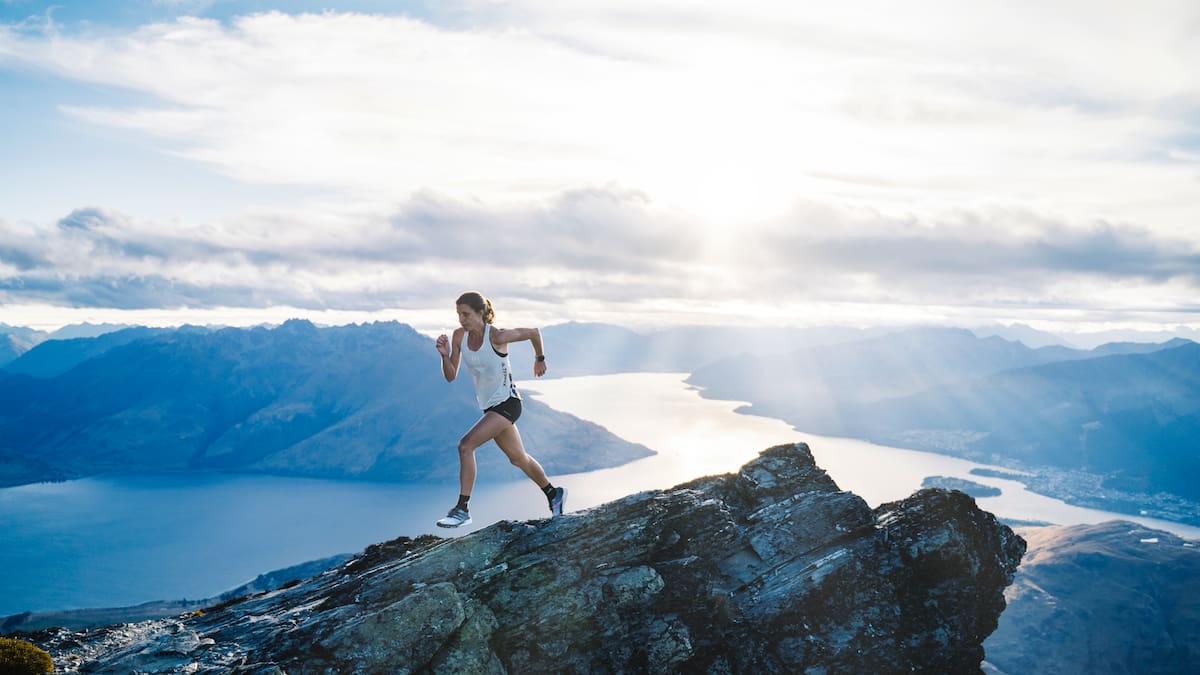
Ruth Croft made history in 2025, winning the world’s biggest race in ultra trail-running: a 174km course crossing three countries and circumnavigating Mont Blanc. She tells senior writer Derek Cheng how an annual meditation retreat helps her move through the suffering during a race, when she hits the wall.
“I
don’t really like suffering.”
It’s a curious admission from Ruth Croft, the West Coaster who won the world’s most prestigious ultra trail race last year: 174km of undulating terrain through roughly 10,000m of elevation. The Ultra Trail du Mont Blanc (UTMB) derives its name from the mountain it circumnavigates, while crossing France, Italy and Switzerland.
Croft beat a field that included three-time winner Courtney Dauwalter, widely considered the sport’s Goat (Greatest Of All Time), in a time that would fit almost anyone’s definition of suffering: just under 23 hours.
Suffering is also relative, Croft adds, and her threshold is unusually high due to particular life experiences, including the types of races she does, how often (about five per year), and the countless hours of training it demands.
She has also overcome a history of bulimia, which contributed to several stress fractures while on a university athletics scholarship in the US.
And she’s a regular attendee of 10-day Vipassana meditation retreats, which would also fit most people’s definition of suffering: 10 hours of practice a day, 100 hours in your own head, in total silence, while trying to quiet your inner monologue.
“I was just feeling really stuck, really flat,” she says of deciding to attend her first retreat, in 2018, in a remote part of Sri Lanka.
“You know when you’re in a bit of a funk with life? I felt like I needed to really disrupt things.”
One of Vipassana’s key lessons, taken from Buddhism, is to ground yourself in the present moment by observing your bodily sensations. This then forms the basis for a blanket of impenetrable equanimity.
“I came out of it and just felt like I was seeing life through a brighter coloured filter. I felt like in a bubble or a cloud,” says Croft, who splits her time between Europe and New Zealand.
“I had a lot more peace and calmness. I could notice things around me – even moments that might normally trigger a reaction – but instead of being pulled into them, I was able to observe them and choose not to react.”
It was one of the most challenging things she’d ever done, she said.
“But it’s also the thing that’s probably had the biggest influence on my life, the biggest shift. It gave me a sense that I’d taken control of my life again, instead of being carried along by everything around me.”
Croft might not be where she is today – at the peak of her sport – without these life experiences. Her recovery from bulimia has allowed her to fuel her body properly to meet the physical endurance demands of her sport, while meditation has helped train her mind to cope with the mental challenges.
There’s tension between Vipassana’s zen and Croft’s self-described super-competitiveness, but that doesn’t mean the former can’t be useful when the going gets tough in her ultra races.
A triumphant Ruth Croft at the UTMB finish line last year. Photo / UTMB
“Vipassana teaches you equanimity under stressful situations. Ultrarunning is a manufactured stressful situation. You volunteer for it; it’s not like I’m held at gunpoint,” she says.
“When an ultra gets hard, I always had a lot of resistance towards the state of suffering. But now I just bring my awareness to the sensations in my body. I’m no longer fighting it.
“It’s given me the ability to move through that with a lot more ease.”
The world’s biggest trail race
It’s a travesty to any New Zealander with an interest in running that Croft wasn’t nominated for sportswoman of the year for 2025, a sign perhaps that her speciality remains a niche sport.
She won four ultra-trail races out of five starts last year, failing to finish one due to hypothermia, though this would provide an invaluable lesson.
Among the victories was the sport’s holy grail. The sheer numbers involved with the UTMB boggle the mind: 174km is longer than doing the Milford Track three times, while 10,000m of vertical elevation is higher than thrice going from Mt Cook village to the summit of Aoraki.
The event is also renowned for its unique mountain landscapes, and a fanfare that borders on pandemonium. The start and finish lines in Chamonix, France – as well as the surrounding townships – are packed with thousands of supporters hooting and hollering their unwavering, energetic support.
Croft contested it for the first time in 2024, finishing second without completely emptying her tank, as she describes it – if that’s even possible after nearly 23 hours of running.
Her victory last year made her the first woman to win all three UTMB races, including the 55km OCC and the 100km CCC, an achievement that took a decade to complete.
Croft was confident in last year’s lead-up. She was physically strong, having had a training programme of power-hiking uphill with increasingly heavier packs, among other things.
On her second rodeo, she didn’t have to second-guess certain logistics, such as nutrition; she consumed an average of 90g of carbs an hour, which translates to about 360 calories, or over 8000 calories for the whole race (roughly four times the average adult’s daily needs).
Her strategy was to pace herself according to a series of splits for each section of the course, going harder and earlier than in 2024 so she’d finish with an empty tank.
But foul weather descended, exposing the runners to freezing temperatures, and at times ferocious wind and rain. Learning from her hypothermic DNF, she switched her focus to staying warm through the night.
She was third for much of the first half of the course, but as the sun rose and the weather settled the following morning, she drew closer to Dauwalter, in the lead. When she eventually took the lead, with a mere 60km to go, Dauwalter turned to her with an encouraging cry of “let’s go!”
The suffering caught up with Croft as she was trying to hold off her chasers in the latter part of the race. Part of what helped her through was her mental fortitude, built up over several years of Vipassana.
It was pre-dawn in New Zealand as Croft came down the home stretch, on a sunny afternoon in France. With the finish line just around the corner, she provided a moment of comic delight when she stopped to embrace three of her friends in full T-Rex costumes.
They’d been present throughout the course, cheering her on in different locations as she moved relentlessly onwards. They’re also a trademark of her support crew; a trio of T-Rexes had accompanied her across the finish line of the 100-mile Western States race, when she won in 2022.
And it’s her support she singles out – especially her partner Martin Gaffuri, who crewed her in the race – when she reflects on what’s memorable from her UTMB triumph.
“When I’m on my deathbed, am I going to be thinking about that moment, winning the UTMB? Definitely not. What sticks for me is those interactions, those moments with friends and family. That’s more important.”
This also speaks to her maturing relationship with the sport: from an unhealthy obsession to something she’s passionate about, but that isn’t her life, nor does it define her.
“Running was everything, when I was younger. A lot of my self-worth was tied up with it. If running was going well, I was better to be around. But when I was injured, I turned into this horrible person,” she says.
“I used to get super nervous when I was younger. Now race day, for me, is exciting. I enjoy it. I don’t get worked up. I don’t get nervous. I’m always just focusing on myself and doing what I need to do at that time.
“I have a relationship now where I love what I do, but it’s also just a race. I don’t need it to be a good person. What matters is how you show up for your friends and family, and leading with love and compassion.”
Ruth Croft cheered on by her T-Rex supporters during last year’s UTMB, the world’s biggest ultra trail race, which she won for the first time. Photo / Jess Meniere
From the West Coast to the US to Taipei
Croft, 37, was a gifted runner from a young age.
She grew up in Stillwater, inland from Greymouth with a population of fewer than 100, and went to boarding school in Christchurch, when she represented New Zealand in athletics and cross country.
This led to an athletics scholarship at the University of Portland, in the US, but it was there her body started breaking down, following years of bulimia and RED-S (Relative Energy Deficiency in Sport).
RED-S is not uncommon among elite athletes. If you’re lighter, then the same amount of power and strength will make you go faster and further. But if you aren’t fuelling yourself with enough calories and nutrition, there can be longer-term impacts on, for example, bone health.
“I had pretty much four years of stress fractures,” Croft says.
Ruth Croft at the Tarawera Ultramarathon in Rotorua. Photo / File
Injured and with her racing mojo depleted, she gave up running and moved to Taipei, Taiwan, to a job teaching English.
The bustling city with more than 2 million people was a stark contrast to Stillwater.
“It was just so different to everything I knew growing up on the West Coast. I loved it. Everything was so new.”
She stayed for more than five years, eventually returning to running as a way to get healthy again after too much partying.
But her running mojo also returned, and she started travelling around Asia for mountain-running races. In 2014, she won one of the first ultra trail races she entered – a 50km event with 3200m in vertical elevation.
The following year, she won the UTMB’s 100km CCC race, and by the time she returned to New Zealand, in 2017, she had a few sponsors backing her to compete on the world’s ultra circuit.
Ruth Croft at the finish line in 2022 after winning the Western States 100.2-mile (161km) race, just ahead of her trio of T-Rex supporters. Photo / Scott Rokis.
In 2018, when she also had her first Vipassana experience, she won her first 55km OCC title in Chamonix, and then her second the following year.
This was also around the time she had enough sponsorship support to run fulltime, allowing her to drop her various jobs, for example as a cleaner or laundry van driver.
It was a life she’d never even dared to dream of, having worked since she was 10, when she started helping at the family trucking company.
“I’ve always worked. I never envisioned that I would get paid to run fulltime. I never envisioned the life I have now.”
‘A deep reset of the nervous system’
An essential part of that life is a regular pilgrimage to a Vipassana centre.
“It’s a deep reset of your whole nervous system. It gives me a moment to strip away all the distractions and reflect on what’s important.
“That feeling does slowly fade, so I go back every year.”
Croft has even dabbled in darkness meditation: confined to a room totally void of any light for 10 days, interrupted only twice a day for a smoothie to be delivered.
The prolonged period of darkness can stimulate visions. During her time, Croft saw flashing lights, herself sitting in a cave, and in a cathedral.
When she emerged, she lacked the lightness that Vipassana usually gives her.
“But, again, it’s the things that are important in life that come forward. It’s a necessary grounding. It’s really important that we have space to reflect on how we’re moving through the world.”
She is studying naturopathy to prepare for a life after running, but for now she’s at the peak of her ultra powers, having been injury-free for eight years, her bulimia-related troubles well behind her.
She’s won eight of her last 10 races on the ultra-trail circuit over the last two and a half years, including the last two New Zealand Tarawera 100km events. She is hoping for a third consecutive title today.
She’s keeping her cards close to her chest on whether she will return to the UTMB this year, but it’s exactly the kind of race that drew her to the sport in the first place.
“Ultra has always been what excites me, and I think I would have always fallen into the UTMB at some point. It’s like no other race, the uniqueness of the course, circumnavigating Mont Blanc. It’s pretty epic.”
She’s also attracted to what it can teach her by making her step out of her comfort zone. But this doesn’t mean she likes to suffer.
“I don’t really like suffering a lot. I don’t run ultras to suffer – that’s not my end goal.
“I’ve had to work really hard to get my relationship with the sport I have now. I still have the joy for it. I’ll just keep riding that, until the time comes.”
Derek Cheng is a senior journalist who started at the Herald in 2004. He has worked several stints in the press gallery team and is a former deputy political editor.
SaveShare this article
Reminder, this is a Premium article and requires a subscription to read.
Copy LinkEmailFacebookTwitter/XLinkedInReddit