
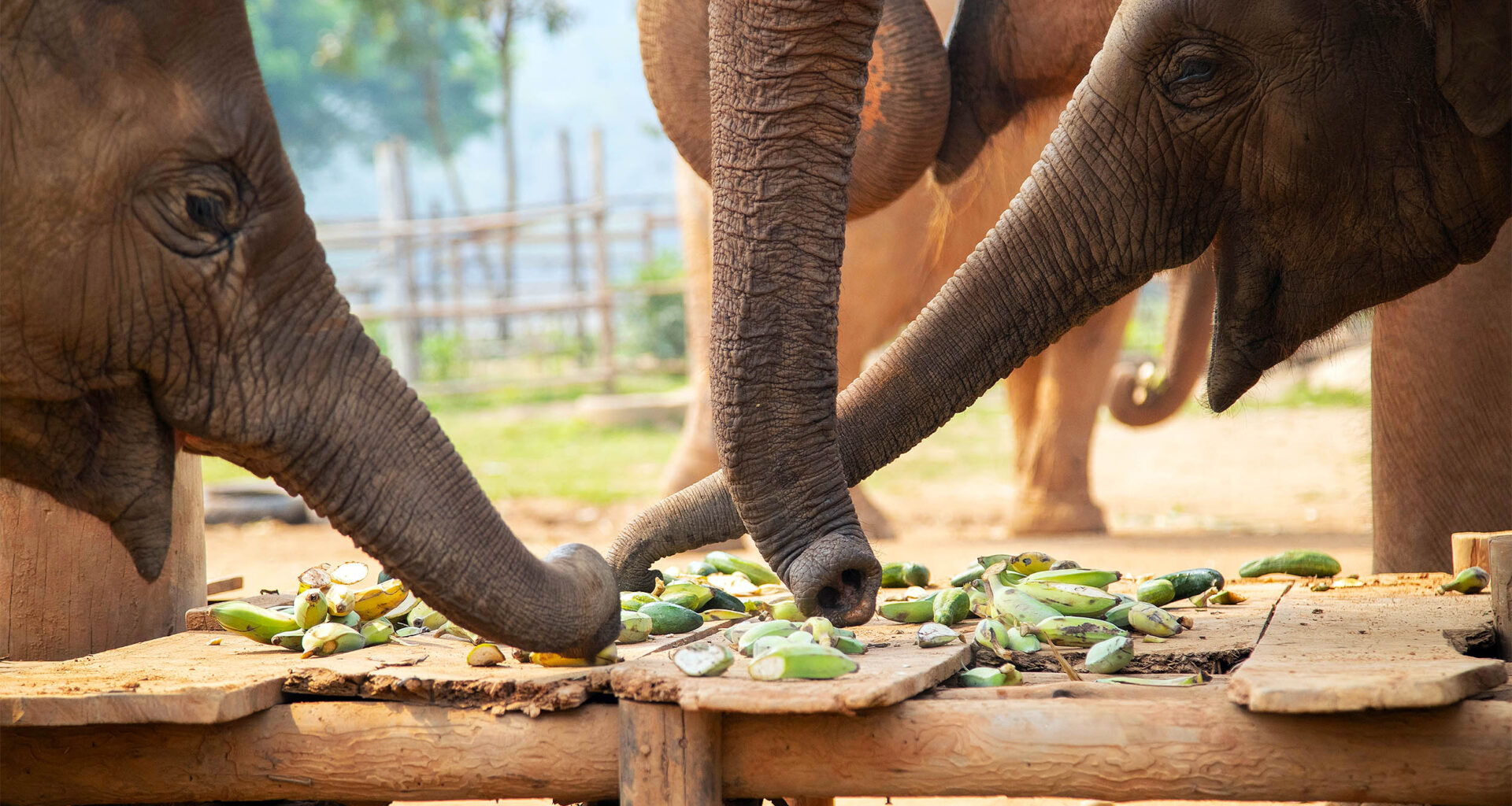
Elephants can lift a heavy log and, moments later, pick up something as fragile as a tortilla chip without crushing it.
A new study suggests part of that finesse comes from a surprising feature: tiny whiskers on the trunk that are built to “tell” the animal exactly where contact happens, even when its skin is thick and its eyesight isn’t great.

The research was led by a German interdisciplinary collaboration headed by the Haptic Intelligence Department at the Max Planck Institute for Intelligent Systems (MPI-IS).
The team reports that roughly 1,000 whiskers covering the elephant trunk have unusual material properties that help encode touch along each whisker’s length, giving elephants a remarkably informative sense of contact.
Hard and soft elephant whiskers
At the center of the study is a design feature the researchers call a “functional gradient.” Instead of having the same stiffness from base to tip, elephant whiskers start stiff and become progressively softer toward the end.
The team found the same kind of gradient in domestic cat whiskers. That’s different from rat and mouse whiskers, which are described as more uniformly stiff.
This stiff-to-soft transition seems to do several useful things at once. It lets the whiskers brush past objects more gently, reduces the chance of breakage, and – most importantly for elephants – appears to provide a built-in way to sense where along the whisker contact occurs.
With around 1,000 whiskers spread across the trunk, that could translate into a rich, detailed “touch map” that helps guide delicate movements.
The researchers think this is one reason elephants can precisely grab small items like peanuts, or handle brittle foods without snapping them.
The team also says these insights could be valuable for robotics, where engineers are constantly trying to build touch sensors that are both sensitive and robust.
How the project began
The work was led by postdoctoral researcher Andrew K. Schulz and Katherine J. Kuchenbecker at MPI-IS, alongside neuroscientists from Humboldt University of Berlin and materials scientists from the University of Stuttgart.
The project started with a natural overlap between biomechanics and robotics. Schulz, the lead author of the study, described that starting point.
“I came to Germany as an elephant biomechanics expert who wanted to learn about robotics and sensing,” said Schultz.
“My mentor, Professor Kuchenbecker, is an expert on haptics and tactile robotics, so a natural bridge was for us to work together on touch sensing through the lens of elephant whiskers.”
From there, the team used a mix of biological imaging, materials testing, and engineering analysis. They examined five-centimeter-long whiskers from elephants and cats at incredibly fine scales, down to the nanometer level.
Whiskers that are built to last
At first, the researchers assumed elephant whiskers would resemble the tapered whiskers of rats and mice: circular in cross-section, solid, and roughly uniform in stiffness. Instead, imaging revealed something much more complex.
Using micro-CT scanning, the team mapped the 3D structure of the whiskers and found they are thick and blade-like with a flattened cross-section.
The base is hollow, and the inside contains long channels – features that resemble the structures of sheep horns and horse hooves more than typical whiskers.
This porous internal architecture reduces weight and helps with impact resistance, which makes sense for an animal that spends much of its day pushing, pulling, and feeding.
That durability matters because, as the study notes, these trunk whiskers don’t grow back. So the structure needs to survive constant daily wear.
The “stiffness gradient” puzzle
To measure material stiffness, the team used nanoindentation with a tiny diamond cube indenter – about the size of a single cell – pressing into the whisker walls at different points. That’s where the “functional gradient” became unmistakable.
Indentation at the base and tip showed a transition from a stiff, plastic-like base to a soft, rubber-like tip. The tip also showed resilience, meaning it couldn’t be permanently indented the way stiffer material can.
They compared trunk whiskers with elephant body hair, expecting similar behavior. Instead, body hair behaved the way the team originally predicted – stiff all the way through.
“The hairs on the head, body, and tail of Asian elephants are stiff from base to tip, which is what we were expecting when we found the surprising stiffness gradient of elephant trunk whiskers,” Schultz said.
At that point, the big question was obvious. Why would changing stiffness along a whisker help with sensing?
A 3D-printed whisker wand
Schulz and colleagues created a scaled-up prototype: a 3D-printed whisker with a stiff, dark base and a soft, transparent tip. This “whisker wand” let them physically test what the gradient might feel like during contact.
Then came the moment that made the idea click. Kuchenbecker walked through the institute holding the wand and lightly tapping railings and columns.
“I noticed that tapping the railing with different parts of the whisker wand felt distinct – soft and gentle at the tip, and sharp and strong at the base. I didn’t need to look to know where the contact was happening; I could just feel it,” she said.
That simple experience suggested a powerful principle: stiffness differences can create distinct tactile signatures, effectively telling you where contact is occurring along the length of the “whisker.”
Simulations confirm the logic
To test that idea more rigorously, the researchers developed a computational modeling toolkit. They used it to explore how the whiskers’ geometry, porosity, and stiffness gradient shape the way the whisker bends and transmits forces when it touches something.
The simulations supported their hypothesis. The stiff-to-soft transition makes it easier to detect where contact occurs along the whisker, helping the animal respond appropriately and handle delicate objects without over-gripping.
Schulz summed up the result with visible excitement: “It’s pretty amazing! The stiffness gradient provides a map to allow elephants to detect where contact occurs along each whisker.”
“This property helps them know how close or how far their trunk is from an object…all baked into the geometry, porosity, and stiffness of the whisker. Engineers call this natural phenomenon embodied intelligence.”
Notably, the team found that domestic cats show the same general stiffness gradient, hinting that this strategy may be useful across very different animals for slightly different reasons.
From elephants to robots
The researchers say the findings aren’t just a fun animal story. They could also inspire new designs for robotic touch sensing, especially approaches that rely less on heavy computation and more on smart physical design.
Neuroscientists involved in the project also see promising openings. Dr. Lena V. Kaufmann highlighted how the work connects physical structure to perception.
“Our findings contribute to our understanding of the tactile perception of these fascinating animals and open up exciting opportunities to further study the relation of whisker material properties and neuronal computation,” she noted.
And looking back on the collaboration itself, Kuchenbecker emphasized what the team achieved by crossing disciplines: “I’m so proud of what we were able to figure out by working together across disciplines.”
“Andrew pulled together an amazing team of engineers, materials scientists, and neuroscientists from five different research groups and led us on an exhilarating three-year-long journey to discover the secrets behind the powerful elephant’s gentle sense of touch.”
The study is published in the journal Science.
—–
Like what you read? Subscribe to our newsletter for engaging articles, exclusive content, and the latest updates.
Check us out on EarthSnap, a free app brought to you by Eric Ralls and Earth.com.
—–