
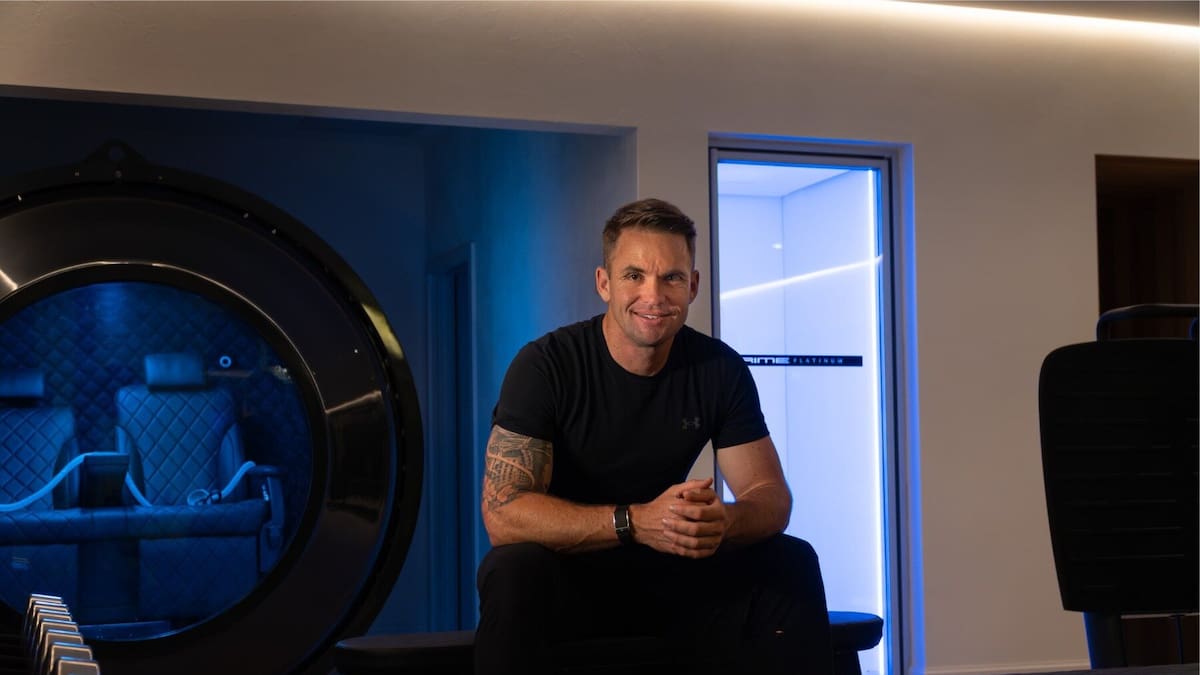
My own body has spent only 10 more years on this planet, but standing next to his that morning, it felt more like 100. I was glad no one else was there to see it.
I had come to find out about the fast-growing longevity industry, within which he has quickly established himself as one of New Zealand’s leaders, developing and supplying a range of extraordinarily expensive life-extending equipment to the rich and famous.
Telomeres, biological age, biohacking: these are words that have entered mainstream use in recent years, thanks in part to the publicity generated by the extreme things people are doing to their bodies in the hopes of living forever or something close to it.
American tech billionaire turned longevity guru Bryan Johnson has spent millions of dollars trying to reduce his biological age – with some disconcerting results.
Probably the best known among these people is American Bryan Johnson, who has devoted the latter part of his life to never losing that life. His philosophy, catchphrase, and the title of his book is Don’t Die. Although he’s 48, compared to most people his age, Johnson looks a lot younger and stranger.
Johnson has experimented with many expensive therapies, exercises, supplements and tests in his pursuit of not dying. His extreme approach has contributed to at least some of the scepticism around the industry. In an article published in the Conversation in September last year, three Australian public health researchers wrote: “The hype around many unfounded longevity claims distracts us from what we already know works: regular exercise, healthy food, sound sleep, meaningful relationships and fair access to evidence-based medical treatment.”
Kersten is aware of many of the objections to longevity treatments and counters by seasoning his conversation with many facts, figures and terms like “research-backed”. He has been described as New Zealand’s answer to Johnson, but although both use their bodies as testing grounds, he’s quick to dismiss the comparison. While Johnson takes everything to the extreme, Kersten says his approach is to be more relatable and accessible.
Josh Kersten with his photobiomodulation bed.
So, while Kersten tracks his bone density with Dexa scans, has comprehensive imaging of his organs and tissue with full body MRI, and monitors his ability to utilize oxygen during exercise with a VO2 max testing device, he also follows what he calls the 80-20 rule, whereby he maintains a disciplined regime during the week while leaving room for pizza with his sons at the weekend. Combined with his truck-driving background and non-obsessional nature, he’s more Kiwi everyman and less character from an episode of Black Mirror.
For most of his working life, Kersten was a truck driver with a side interest in buying, repairing and selling things for a profit. One day he came across a broken laser machine for sale, repaired it, and his girlfriend used it to start a home-based business providing laser hair removal and skin treatments. The business took off and their lives changed. When he began hearing about longevity treatments, he saw a gap in the market and began working with manufacturers to produce his own range. His list of clients now includes high-end gym chains both here and overseas, NBA team the Brooklyn Nets, NFL team the Washington Commanders. He says he’s also in discussion with several Formula 1 teams. He says he recently had three NFL stars ask about getting full home longevity set-ups from him.
The gym is New Zealand’s ground zero for the longevity industry. It looks a lot like a standard gym except that it has a cryotherapy chamber, hyperbaric chamber and photobiomodulation bed. Kersten talked me through the benefits of each: a long list including reducing inflammation, accelerating recovery, oxygenating blood, enhancing cellular energy, increasing mental clarity and promoting stem cell growth.
Josh Kersten’s Prime Platinum home gym.
Before my arrival, I had imagined all these devices being functional and ugly, but I couldn’t have been more wrong. I immediately saw Kersten’s business masterstroke was to have made them beautiful.
The cryotherapy chamber looked like a shower from the future. Its glass door revealed an interior bathed in blue light and was bordered by a neon strip that changes colour to show how long you’ve been inside.
Kersten told me it would be -120C and handed me ear warmers, a mask and gloves to prevent frostbite, but presumably not terror, then ushered me inside. I turned to face the glass door and he almost immediately started taking photos of me.
It was instantly and obviously cold and I noticed little particles flying around. I thought they were bits of paper but then realised they were ice. The temperature was initially not unbearable, but at the two-minute mark, I noticed a burning sensation on my arms and became frightened about frostbite and I was very happy to leave after three minutes, although I later did 20 minutes in the 75C sauna and two minutes in the 10C plunge pool and found both more challenging.
Josh Kersten’s hyperbaric chamber.
From the moment at the end of the day when I stepped into the hyperbaric chamber, it was obvious it was the star of the show. I could see that Kersten had poured an enormous amount of love, energy and time into it.
It looked like a deep-sea submersible, or a futuristic diving bell, or something from an H.G. Wells novel, or a piece of extreme steampunk, or a prototype of Air New Zealand’s first-class cabin in 2055. It looked like nothing I had ever seen, nor imagined. Its front was almost entirely transparent and the entirety of the inside from floor to ceiling was covered in an opulent, diamond-stitched, deep blue leather.
The seats were electronically controlled and could be reclined and moved around six ways from Tuesday. It was impossibly comfortable. Once I was inside, Kersten pushed some buttons and the door locked and the pressure began increasing. I felt my ears pop a number of times as if I was on a plane, but after that it just felt normal.
After the brutality of the cold and hot treatments, it was almost disappointingly easy. Kersten told me about how studies had shown it could reduce inflammation and lengthen telomeres – the protective caps on the ends of chromosomes which are believed to reduce the risk of disease and tissue degradation – by more than 20%. And maybe it could.
But I couldn’t feel any of those things happening in my body. What I could feel was the extreme sense of satisfaction that comes from being sealed in a leather-lined cabin, laid back on a leather recliner sucking on air that’s scientifically superior to that being breathed by everyone else, thinking about the troubles of the world roiling out there beyond the glass and knowing that, for the moment at least, they couldn’t touch me.
Throughout the day, Kersten had subjected me to a battery of tests, with mixed results. My V02 max was 44 (“good for your age,” he said, although my own research later revealed I was only just above the range for “sedentary adult”), my grip strength, which correlates with muscular health and brain function was also good for my age, and so was my ability to hang from a bar (70 seconds).
I wondered if he would try to sell me a cryotherapy booth and hyperbaric chamber, or maybe a red light therapy bed, but he didn’t. No doubt part of the reason was the fact he’d seen my car was a long way down from a Lamborghini, but I think it also reflected his values.
He suggested I focus on low-impact cardio exercise on a bike or similar, eat a good diet with plenty of protein, and ensure I sleep well. A cold shower every now and again wouldn’t hurt either. None of this is going to make me live forever, but it was going to cost me hundreds of thousands of dollars less than the alternative, and that was a tradeoff I was happy to make.