
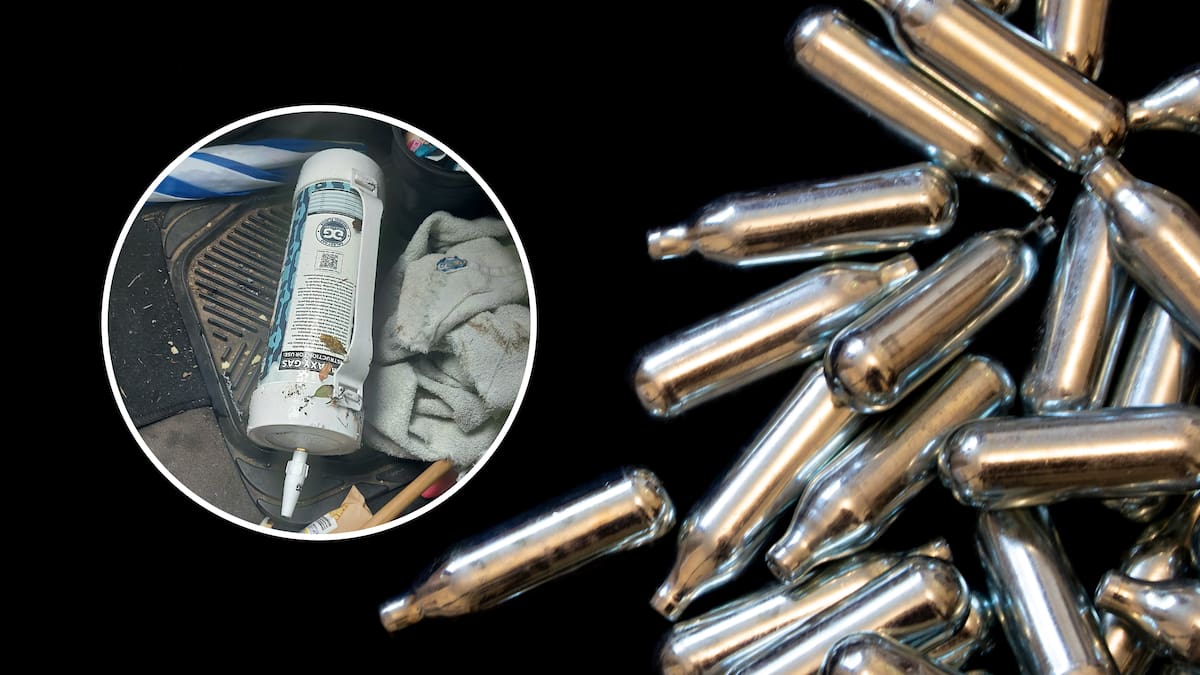
Whangārei District councillor Nicholas Connop, who runs the Love Whangārei Monthly Clean Up, said dumped nang canisters had grown in size in the past two years. Before, the smaller 8g nangs littered streets.
He found them in Te Kāmo – including a large 3.3L canister on Fairway Drive – and in Waipu.
Connop believed the “graffiti-style imagery” on the canisters made them more appealing recreationally than commercially.
Whangārei MP and former health minister, Dr Shane Reti, has seen canisters on walks around the city. He believed they had most likely been used recreationally.
“This is not something to trivialise, this is very serious and could have long-lasting health impacts,” he said.
A large canister of nitrous oxide, found dumped on Fairway Drive in Te Kamo by Whangārei District councillor Nick Connop.
Reti had spoken with clinical colleagues and GPs about nangs, saying they were worried about rising recreational use.
GPs reported being approached by families concerned about loved ones using nangs.
In 2024, Reti fronted a crackdown on the selling and distribution of nitrous oxide, that meant selling, offering or possessing nitrous oxide for recreational use could be punishable by up to two years’ imprisonment.
Companies faced fines of up to $500,000, while personal possession of the substance was punishable by a fine of up to $500.
He said Health Minister Simeon Brown was looking at further action.
Reti thought tracing the level of importing, manufacturing, retail and waste collection could help assess the size of the problem.
“We’re concerned and always have been around the recreational use, which is fundamentally harmful, on a range of levels,” he said.
Whangārei MP and former health minister, Shane Reti. Photo / Ben Dickens
Nitrous oxide canisters found dumped in Waipu.
Northland emergency doctor Gary Payinda was shocked at how easily people could buy nitrous oxide.
He was concerned teenagers still managed to purchase nangs despite websites asking people to confirm they are over 18.
“One only has to go to certain carparks at night to find 16 to 17-year-olds huffing what used to be called whippets, and are now called nangs.
“If all it takes to get toxic quantities of nitrous gas is to say that you’re using it to make whipped cream … I think we have a really big problem,” he said.
Payinda said doctors might see chronic use of nitrous oxide but it was not common.
“But it’s tragic when it does happen.”
Northland emergency doctor Gary Payinda. Photo / Denise Piper
Police currently have no data on how prevalent recreational nang use in Northland.
Mid/Far North area prevention manager Senior Sergeant Clem Armstrong said police were focused on road safety, and the risks of nitrous oxide‑impaired driving.
He said they were working closely with Health NZ to understand how to support enforcement and promote informed decision-making.
Health NZ Medical Officer of Health Dr Rebekah Jaung said there was no code specific to the recreational use of nitrous oxide.
“There were fewer than 5 hospitalisations for this broader category for Northland for the past five years.”
They had no records specific to ED presentations for recreational nang use either, she said.
Complaints relating to nitrous oxide in Whangārei decreased last year compared to 2024, Whangārei District Council (WDC) community safety officer David Palmer said.
“However, that could be a result of issues with dumped canisters not being logged with us, as opposed to a decline in use in the community.”
Palmer said the council, CitySafe and government agencies were working together to monitor the problem and deal with any anti-social behaviour.
What does nitrous oxide do?
Payinda said the harm caused by nitrous oxide had two levels: chronic and acute.
“Acutely, you get high. Your oxygen levels drop, and you get euphoric and happy.”
If a person breathes in “way too much” nitrous oxide then it displaces the oxygen in their lungs, causing people to black out, Payinda explained.
That was a concern, particularly for those huffing balloons filled with nitrous while behind the wheel, he said.
The side effects of acute use wore off quickly, lasting between seconds and minutes.
The effects were much worse for a person dependent on nitrous oxide.
Payinda said over time, the vitamin B12 in a person’s blood was depleted and that vitamin was needed by the spinal cord, nerves and brain.
Depleting the amount of B12 could cause people to lose sensation in their hands and feet, lose control of their bladder and rectum, and cause them to stagger.
“Sometimes, that’s permanent,” Payinda said. “It’s a sign of heavy abuse, and heavy damage.”
Brodie Stone covers crime and emergency for the Northern Advocate. She has spent most of her life in Whangārei and is passionate about delving into issues that matter to Northlanders and beyond.