
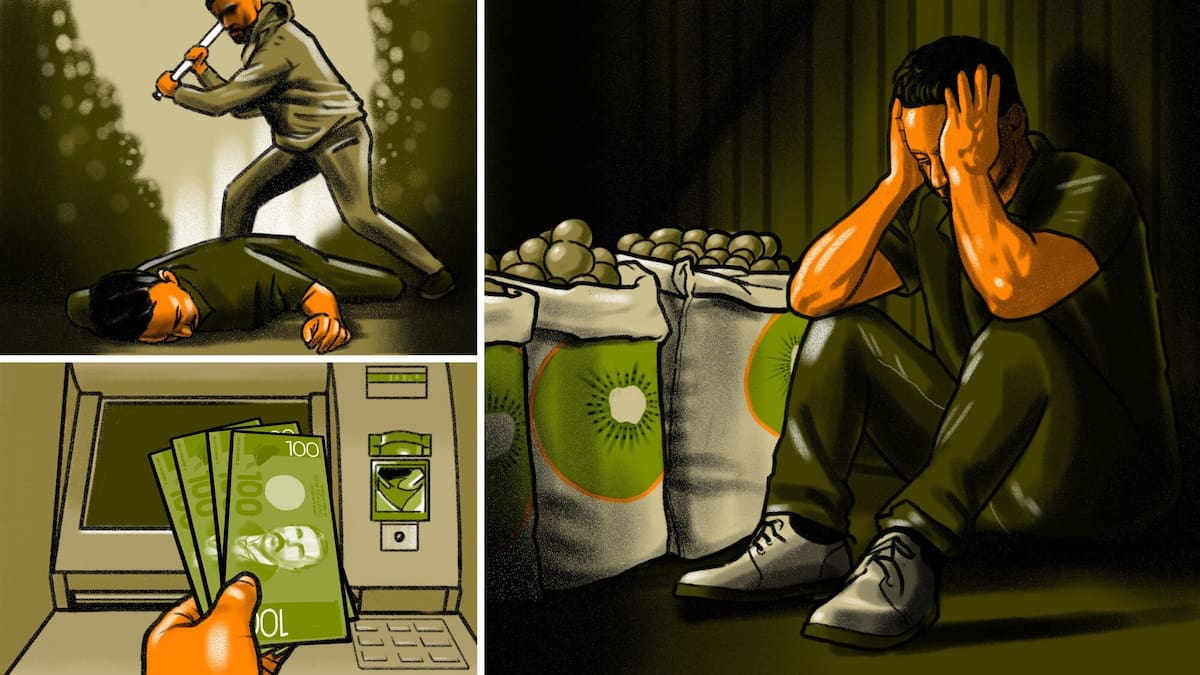
He also told them about the kidnapping and was reassured that they would refer his complaint to the police for further investigation, as Inland Revenue had a duty to report serious harm.
However, Inland Revenue did not report the alleged kidnapping.
The lack of disclosure from the tax department meant that Tauranga police only learned about the alleged kidnapping of the illegal migrant 18 months later when the Herald started asking questions about the case.
The costly delay has hindered the eventual police investigation and disappointed the alleged victim.
However, Detective Sergeant Aaron Williams this week confirmed that a 36-year-old man has been charged with wounding and kidnapping offences.
The Whakatāne resident appeared in the Tauranga District Court on Thursday where he pleaded not guilty to both offences.
He was granted interim name suppression and released on bail after surrendering his passport.
Two other men were listed on court documents as alleged co-defendants.
The Herald understands that one of the men is deceased, and the other no longer lives in New Zealand.
The arrest this week is the latest development in a long-running saga.
Just before Christmas, the Herald revealed that Inland Revenue staff failed to refer the kidnapping complaint to the police to investigate in late 2023.
Poor information-sharing between government agencies has been highlighted as the greatest barrier to New Zealand’s ability to tackle organised crime, according to a panel of experts advising Cabinet ministers last year.
“This is a textbook example,” Steve Symon, the chair of the ministerial advisory group on organised crime, previously told the Herald.
“Sadly, this is almost a cliche in terms of a breakdown in communication between agencies. A situation like this needs a combined team effort between Inland Revenue, police and Immigration New Zealand…so a complainant can come forward and know they’re going to be safe.”
A spokesman for Inland Revenue declined to explain why the alleged kidnapping was not reported to police, citing clauses in New Zealand’s tax law which states “all sensitive revenue information” must be kept confidential.
“Section 18 of the Tax Administration Act prevents us from commenting on matters specific to individual taxpayers so we will not be responding to these questions.”
Tens of thousands of dollars were deposited into the bank account of the ‘money mule’ each week, then withdrawn in cash as part of an alleged tax evasion scam. Illustration / Paul Slater
Inland Revenue and the police have a memorandum of understanding which allows information to be proactively shared for the prevention, detection and investigation of serious crimes.
However, such legal frameworks are not applied consistently across government agencies, according to one of the ministerial advisory group’s reports to Cabinet Minister Casey Costello.
The expert panel heard “repeatedly” that constraints on information sharing meant law enforcement agencies could not keep pace with the rapidly evolving criminal landscape.
“As we have said before – organised crime can move at the speed of digital technology, but enforcement agencies can only move at the speed of the law,” the panel wrote in July.
“The public reasonably expects government agencies to use information that it has collected to lawfully target organised crime, both domestically and internationally. That requires the information to be proactively shared. That is not happening.
“There also appears to be a deeply rooted culture of a risk-averse approach towards proactive sharing of information.”
In particular, Inland Revenue (IR), which holds tax records that can be crucial to investigations into organised crime, was singled out for mention.
“IR has told us that it recognises the approach it has traditionally taken to information sharing may have been too conservative, and there is scope to be more pragmatic,” the expert panel wrote.
“This mirrors feedback we received from a number of other government agencies.”
Associate Police Minister Casey Costello with Police Commissioner Richard Chambers. Costello has been driving reform of how government agencies work together to tackle organised crime. Photo / Mark Mitchell
The advisory group recommended the establishment of a national plan, rather than separate ones for individual government departments, to clearly set out what information can be shared.
This national framework should be accompanied by a “data lake” – a platform, or centralised repository, to make the data easy to search.
To move away from a risk-averse culture, the panel also recommended that information-sharing benchmarks be set as performance measures for the chief executives of government departments.
Those leaders would then be held accountable for meeting those targets by a proposed government minister with a dedicated focus on organised crime.
This proposed ministerial portfolio would need to be backed up by a new oversight body, similar to how the Serious Fraud Office or Canterbury Earthquake Recovery Authority were established in response to an emerging threat.
With this support, the minister would be expected to push new laws and policy development, hold agencies to account, lead public awareness campaigns and targeted social investment in vulnerable communities.
In December, the Government released a new five-year Transnational, Serious and Organised Crime [TSOC] strategy.
One of the main priorities was to develop an effective method for existing agencies to share data.
“Basically, we need an organised government to fight organised crime, and through the action plan we are working on the best way of doing this and making full use of all of the resources, powers and information that agencies collectively possess,” Costello said.
Jared Savage covers crime and justice issues, with a particular interest in organised crime. He joined the Herald in 2006 and has won a dozen journalism awards in that time, including twice being named Reporter of the Year. He is also the author of Gangland, Gangster’s Paradise and Underworld.