
To contain him – and later others deemed too dangerous for mainstream units – the Department of Corrections created the Prisoners of Extreme Risk Unit (Peru).
Today, the Peru stands as the nation’s most secure and secretive facility, tasked with managing the most complex and high-risk offenders, including those linked to transnational organised crime.
Situated within Auckland Prison, it is run completely separately by the Prisoners of Extreme Risk Directorate (PERD).
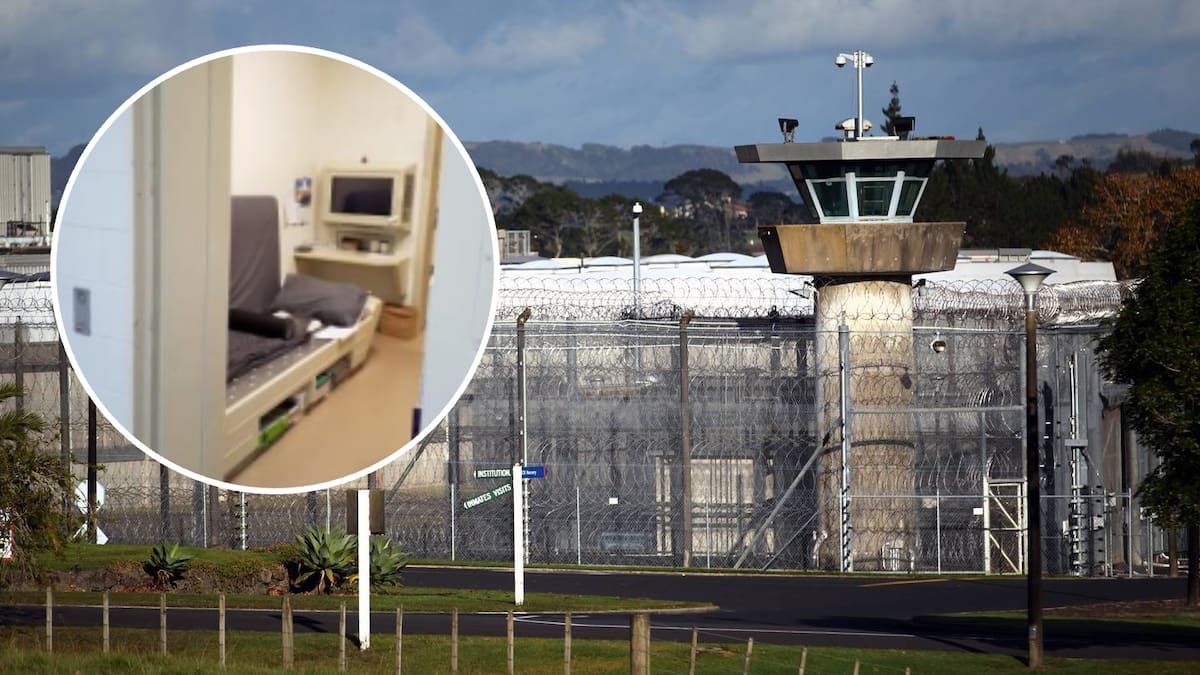
The unit lies deep within New Zealand’s toughest prison – Auckland Prison at Paremoremo. File photo / NZME
Inside the Peru, 16 men are confined, each deemed a constant threat – capable of inflicting serious harm, vulnerable to it, or wielding their influence to make others violent.
It is, by Corrections’ assessment, New Zealand’s most dangerous and unpredictable collection of prisoners.
The terrorist was sentenced to life in prison with no possibility of parole after he admitted murdering 51 people and wounding 40 others when he opened fire at two mosques during Friday prayers in March 2019.
Given the nature and circumstances of his offending, it is likely he will remain in Peru until he dies.
Other inmates include prisoners involved in sophisticated organised criminal networks, violent offenders and those who have threatened staff or other prisoners.
Life in Peru
The men in Peru never associate, congregate or engage.
Alongside the terrorist are men who have been involved in sophisticated organised criminal networks and, according to Corrections, who have the capability to “seriously compromise the safety and security” of staff and prisons.
Images from inside the Prisoners of Extreme Risk Unit (Peru) in Auckland Prison during a 2023 Inspectorate inspection. Photo / Office of the Inspectorate
Most have shown capacity for extreme violence, and some have engaged in “significantly abusive, violent, racist and sexist behaviour” towards Corrections staff – in many cases, making death threats towards them and their families.
One of the men in Peru in 2023 had murdered two other prisoners during his time in prison.
Another had sexually and violently offended against female custodial staff.
Specialist staff keep the men separate and monitor them 24/7 to ensure they cannot inflict any further harm – or be harmed.
The Peru cohort are spread across two wings, and all have their own cell equipped with single beds, shower and toilet areas and a television.
Each cell door has a window hatch that is modified to prevent prisoners from opening the hatch and seeing into the corridor.
In total, there are 20 cells in the Peru, located in the prison’s unit 10.
Eighteen cells are “residential” and the remaining two are dry cells designed to monitor prisoners “thought to be at risk of internal concealment”.
Each cell is nine square metres and has a 10-square-metre yard accessible by a sliding door that is controlled remotely by Corrections staff.
The yards are concrete-walled and totally enclosed by thick wire mesh so that the offenders cannot see any other prisoner or person – or the sky – while exercising.
In addition to the cells, the Peru also boasts a larger exercise yard, a day room, two non-contact interview rooms, a non-contact visits room, an AVL booth and a health clinic.
The outside of the cells at the Peru at Auckland Prison. Photo / Department of Corrections
The inmates routinely spend 24 hours a day confined alone and are allowed access to their private exercise yard for between three and six hours a day, depending on who they are and what rules they are governed by.
Those rules come by way of an individual management plan – developed with the inmate’s input where appropriate – which includes what items they can have in their cell, what they can read, watch and listen to, any education pathways or physical activities and who they can communicate with on the outside.
Every decision on what the inmates can and cannot do is based on an assessment by their case manager over the risk that they present to others, including staff and to the safety and security of the prison.
Cultural and spiritual support is available to each inmate, alongside primary and mental health services.
Soon after the terrorist was moved into the Peru, Corrections revealed he had “18 guards rostered to monitor him”.
“Like all people in prison, this individual receives three meals per day at times determined by the unit’s schedule,” Corrections said.
“Additionally, he is able to access television for a limited number of hours daily, has approved books to read if he chooses and has access to his exercise yard twice daily.”
A source said the officers assigned to Tarrant “see him but they don’t have a conversation with him”.
“He reads and watches the officers watching him – that’s all they do. They watch him on their monitors and take notes,” a source said.
Corrections, to date, will not provide information on how many visitors (including family) the terrorist has had and who has been writing to him.
Months after the 2019 attacks, it was revealed the offender had been exchanging letters with white supremacists.
As a result, Corrections “made changes to the management of this prisoner’s mail to ensure that our robust processes are as effective as we need them to be”.
Who’s who in Peru
While the unit was set up as a direct response to the terrorist, it has housed a number of other high-profile offenders since its inception.
Some remain in the Peru and others have been moved on or even released.
Damian Karl Wereta is a violent gang member who has repeatedly assaulted, attacked and wounded other prisoners and Corrections staff behind bars.
He is serving an indefinite sentence.
Xavier Valent – also known as Harry Whitehead – was jailed for life for manufacturing, importing, selling and possessing controlled drugs – mostly methamphetamine.
Valent was the “mastermind” behind a multi-year, multimillion-dollar international drug syndicate.
Xavier Valent, also known as Harry Whitehead, travelled the world while running an international drug syndicate before being caught in Operation Mystic.
Taniela Waitokia was 16 and under the influence of drugs when he murdered a Christchurch pensioner.
He attacked Harold Richardson, 87, with a bottle – striking him 14 times around the head.
He later admitted a violent assault on a Corrections officer while on remand at Christchurch Men’s Prison.
Sione Tupoumalohi made the Peru muster list after pleading guilty to a year-long stabbing spree behind bars.
Sione Tupoumalohi has been in and out of prison since age 13, a High Court judge was told as his existing sentence was lengthened by six years to reflect four stabbings while in prison.
When the spree began, the violent offender had been in and out of adult prisons since the age of 13 and was serving sentences of five years and five months, imposed in April 2022, and three years and nine months, imposed in October 2022, for wounding, assault with intent to rob and aggravated robbery.
Rawiri Wereta was jailed for 10-and-a-half years in 2013 over a violent aggravated robbery and other offences in Dunedin.
Months after being locked up, he nearly killed a fellow inmate in a frenzied stabbing, after which he performed a shirtless “victory parade” of the cell block.
He was later convicted of wounding with intent to cause grievous bodily harm after committing a second prison shanking.
Rawiri David Wereta, pictured appearing in the High Court at Auckland. Photo / Greg Bowker
He was later convicted of wounding with intent to cause grievous bodily harm after committing a second prison shanking.
Junior Heart – the president of the Waikato chapter of the Comancheros gang – was remanded in custody for his part in running the New Zealand branch of an international drug smuggling syndicate.
Heart and others were arrested during Operation Trojan Shield, a global investigation led by the FBI and the Australian Federal Police, described as the “sting of the century”.
Heart initially faced more than 100 charges, including importing and distributing methamphetamine, cocaine and MDMA.
Jeremy Mataira was sentenced to preventive detention after he kidnapped and assaulted a woman prison guard at Auckland Prison at Paremoremo.
During his trial, a jury heard that he barricaded himself in a storeroom with the prison guard for three hours in 2006.
The guard was blindfolded and her feet were bound.
Armed police stormed into the room, throwing stun grenades and using tear gas to disable Mataira, who had pulled the guard down in a choke hold.
Mataira was earlier convicted of sexual violation and attempting to rape another female prison guard in Christchurch’s Paparua Prison in 1991.
Steven Williams, who murdered his stepdaughter Coral Burrows in 2003. Photo / Mark Mitchell
Steven Williams was serving a life sentence for the murder of his stepdaughter Coral Burrows when he attacked and almost killed another inmate.
Williams decided he did not like fellow murderer Nikki Roper and spent a month planning his attack.
But much to the killer’s disappointment, his victim, in spite of being stabbed with a fluorescent lightbulb and then a broom handle, lived.
Williams, described as “a very disturbed individual”, was sentenced to preventive detention for the violent attack.
Mongols president Jim “J.D.” Thacker appearing in the High Court at Hamilton in 2023, where he was jailed for 22 years and four months for offending during Operation Silk. Photo / Belinda Feek
Jim David Thacker was deported from Australia in 2018 and established the first New Zealand chapter of the Mongols, an international outlaw motorcycle club with roots in the United States.
The arrival of the Mongols in Bay of Plenty, in particular, sparked a turf war with rival gangs, including a shooting where 96 rounds were fired into a house.
But Thacker had never been in prison until June 2020 when he was arrested as the main target in Operation Silk, a covert police investigation into the gang’s drug offending and violence.
Better known as J.D., Thacker was convicted of 40 charges, including unlawful possession of firearms, participating in an organised criminal group, possession of meth, cocaine and MDMA for supply and money laundering.
Siuake Lisiate – described by prosecutors as one of New Zealand’s worst violent offenders – is a long-time prisoner who took part in the murders of two fellow inmates, as well as stabbing a third man more than 40 times during a failed hit.
Siuake Lisiate. Photo / Pool
The senior Crips gang member, known in criminal circles as JFK or Just F****** Krazy, was one of four men accused of stabbing and stomping Blake John Lee to death at Auckland Prison in Paremoremo in March 2020.
Lisiate, 41, joined the Crips at 12 and has been involved in the legal system since he was 14. He was first imprisoned at 17.
Lisiate hasn’t seen the outside of a prison since 2003, when he was sentenced for an armed robbery.
The last Christmas he spent outside of prison was in 1996, the judge noted.
By 2020, he racked up 25 convictions, most while on bail or in prison, according to court documents.
Prisoners fight Peru
In April 2025, the Wereta brothers and others who were in the unit or had spent time in there sued the Attorney-General, Corrections and the head of the PERD, alleging that their detention in Peru “was and is unlawful”.
Among other things, the men argued that the Peru operational model and placements of some of them in the unit were “irrational”.
They sought a declaration from the High Court at Auckland that the Peru operating model was unlawful.
Prisoner Damian Wereta in court in 2015. Photo / Greg Bowker
They claimed the operating model was “inconsistent with freedom of expression” and that treatment in the Peru was inconsistent with Bill of Rights Act standards.
And they said they were victims of “negligent infliction of physical, psychological and psychiatric harm”.
A lawyer for the men said the Peru placements were intended to be long-term and are reviewed and confirmed on a 12-month cycle, which “unlawfully exceeds the mandatory monthly review period for directed segregation and the mandatory six-monthly review period for security classification”.
“Peru policy restricts association by default and treats association between prisoners as a reward for good behaviour, in breach of statutory segregation rules and the prison disciplinary regime,” he submitted.
“Peru operates a behaviour management regime that deprives prisoners of privileges like yard time, television use and media access, on the basis of their individual behaviour, but without any need to prove misconduct, despite the statutory prison disciplinary regime.”
The lawyer said the very nature of detention in the Peru meant placement in the unit constituted “a decision to implement prolonged solitary confinement – long-term segregation without association and with minimal out-of-cell movements”.
The application was dismissed by the High Court.
‘Inhumane’ Peru under fire
Over recent years, the Peru has been heavily criticised by Chief Ombudsman Peter Boshier.
In December 2024, he released a report which he said outlined “serious concerns about human rights abuses at the unit”.
He said Corrections “must stop the way it’s running the Peru, because the unit’s prisoners are being ill-treated”.
“The conditions and treatment in the Peru are cruel, inhuman and degrading and in breach of the United Nations Convention against Torture,” he said.
Chief Ombudsman Peter Boshier. Photo / RNZ, Dom Thomas
Boshier visited the unit four times over 18 months and said every time, he came away with “significant concerns”.
“I acknowledge there are people housed in the Peru who have committed serious crimes, and I know it may be difficult for some to understand why we should care about their treatment and conditions,” he said.
“My job is to go into places that are kept under lock and key and shine a light on how human beings are being treated by state institutions like prisons. I strongly believe that if you protect someone’s basic human rights, you are protecting society as a whole.
“In the Peru, I saw the detrimental impact of a state system operating without a clear focus on how it treats people. The treatment and conditions that I observed are not what I expect of our country … The vast majority of these men will be rejoining our families, workplaces and communities at the end of their sentences. Ill-treatment in prison does not support their rehabilitation or successful reintegration.”
Boshier said Peru inmates were subjected to “prolonged and potentially indefinite solitary confinement” as well as “oppressive living conditions”, including limited access to natural light and fresh air.
“Most people in the Peru have been there for many months, sometimes several years. They routinely spend 24 hours a day locked up alone and are denied meaningful human contact for long periods of time. This is a blatant breach of international human rights convention,” he said.
“I have also found evidence of a disproportionate use of force on prisoners, as well as excessive and unjustified instances of search and surveillance.
“At-risk prisoners are constantly watched on CCTV, even in toilet and shower areas, and checked on every 15 minutes, day and night. At night, Corrections officers shine torches through the hatches of these prisoners’ cells every 15 minutes. Conversely, camera footage and record-keeping related to incidents where use of force occurs is inadequate.”
A cell in the Peru. Photo / Department of Corrections
Boshier said since it was established, the Peru had “grown in capacity, scope and purpose”.
“The unit has been allowed to develop with seemingly little scrutiny or formal consultation,” he said.
“It is managed by a directorate made up of a small number of Corrections staff who have inappropriate autonomy and manage the unit at their own discretion … There are insufficient checks and balances in place to ensure appropriate conditions and treatment of the prisoners.
“The Peru placement process categorises all prisoners in the unit as ‘extreme risk’ and all are subjected to maximum-security conditions … despite them having distinct and varying degrees of risk.
“It is entirely inappropriate for Corrections to allow the directorate to use an oppressive, one-size-fits-all approach.
“The current operating model at the Peru does not fit with New Zealand’s values as a humane society and it has to stop.
“The fact remains that human rights are universal. These prisoners have basic rights to safe and fair treatment.”
One man who spent time in the Peru described it to a report writer for Boshier as a “human storage facility” where “everyone deteriorates”.
“You’re a non-entity, placed here and forgotten,” he said.
“There are no opportunities for betterment. A chain gang would be more constructive.
Another said Peru was “not good” for inmates – mentally or socially.
“The longer you are in Peru, the more you feel like erggghhh,” he said.
Corrections: Peru ever-evolving
The unit remains operating, and Corrections has made assurances about how inmates are being treated.
“We are committed to ensuring people in prison, including those in Peru, are treated safely and humanely,” it said in a statement following the Boshier report.
“There are robust processes in place to ensure this and there has been continuously ongoing work to further improve these processes.
“Corrections acknowledges there are ways we can refine the management of prisoners in Peru.
“The Peru model in operation today is not the same as the one in place when the unit was established, or at the time of the Ombudsman’s inspection in 2023.
“The operating model of the Peru is regularly evolving in response to the risk posed by those individuals who present an extreme threat to keep other people in prison, staff, and the wider community safe.”
Corrections said “immediately ceasing the use” of the Peu would “present an undue risk” to the people it was set up to hold – and those responsible for guarding them.
Anna Leask is a senior journalist who covers national crime and justice. She joined the Herald in 2008 and has worked as a journalist for 20 years with a particular focus on family and gender-based violence, child abuse, sexual violence, homicides, mental health and youth crime. She writes, hosts and produces the award-winning podcast A Moment In Crime, released monthly on nzherald.co.nz.