

Disclaimer: Early release articles are not considered as final versions. Any changes will be reflected in the online version in the month the article is officially released.
Author affiliation: University of Liverpool, Liverpool, UK (V.H. Sheridan, C.W. Duffy, L. Turtle, J.A. Hiscox, K.S. Subramaniam); University of Oxford, Oxford, UK (J. Dunning); Royal Liverpool University Hospital, Liverpool (L. Turtle)
Mpox is a zoonotic viral disease caused by monkeypox virus (MPXV), which is divided into clades I and II; clade II is subdivided into subclades IIa and IIb (1,2). In 2023 a new subclade of clade I, termed clade Ib, emerged in the Democratic Republic of the Congo (DRC). Since the first human case identified in August 1970 in DRC, mpox has been reported in 11 countries in Africa; in 2022 a global outbreak occurred in nonendemic areas caused by the clade IIb strain (1). More recently, the emergence of clade Ib, designated a public health emergency of international concern in August 2024 and associated with increased disease severity and mortality rate, particularly among children, posed a substantial public health threat (3). The World Health Organization recommends that persons at high risk of contracting mpox, especially during an outbreak, be vaccinated (2) with the modified vaccinia Ankara-Bavarian Nordic (MVA-BN) smallpox vaccine, a live attenuated vaccine (1).
Evidence demonstrates that vaccination with MVA-BN can generate low levels of neutralizing antibodies for clade IIb and clade Ia (4,5). In the United Kingdom, 1 dose of MVA-BN gives short-term protection of 78% against mpox, predominantly in men who have sex with men (6). Whether vaccination can also induce neutralizing antibodies for clade Ib has not been addressed. We recruited a convenience sample of healthcare workers (n = 25) vaccinated with MVA-BN for occupational exposure to mpox to measure neutralizing antibodies for clades Ib and IIb using a plaque reduction neutralization test (PRNT).
Figure
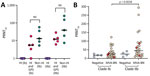
Figure. Titer results in study of monkeypox virus antibodies in healthy persons after MVA-BN vaccination, United Kingdom. PRNT50titers for participants vaccinated with 2 doses of MVA-BN vaccine demonstrated neutralizing…
The importance of complement in relation to neutralization levels has been reported for MPXV (7) and other viruses (8). To assess the contribution of complement in our cohort, we exposed serum samples to different conditions: heat inactivation (HI), HI supplemented with guinea pig serum as a complement source, and non-HI. We found, as previously reported (7), that complement is required for neutralization of MPXV in vitro (Figure, panel A). We detected no significant difference in MPXV neutralization between HI serum in the presence of a complement source and non-HI (p = 0.0625 by Wilcoxon signed-rank test). On the basis of those data, we used non-HI serum for the remainder of the experiments.
We measured neutralization of MPXV clade Ib and IIb in non-HI serum samples from 25 vaccine recipients. We included 4 persons who did not receive the MVA-BN vaccine but were immunized with another live attenuated vaccine, IMOJEV (Substipharm, https://www.substipharm.com), as controls. In the MVA-BN vaccine group, 3 participants had underlying conditions of multiple sclerosis, psoriasis, or asthma (Table). The median PRNT50, which is defined as the reciprocal of the serum dilution that results in 50% reduction in virus plaques, was 25.9 (interquartile range [IQR] 10.05–49.7) for clade Ib and 44.8 (IQR 19.55–89.4) for clade IIb. Comparisons across these samples demonstrated that 2 doses of MVA-BN generated greater neutralization of MPXV clade IIb than of clade Ib, a difference we found to be statistically significant (p = 0.0028 by Wilcoxon signed-rank test) (Figure, panel B). The difference in neutralizing antibody titers is small, and the relevance for clinical protection is uncertain. The protective threshold for MPXV neutralizing antibodies is not defined; case–control studies could define antibody-specific correlates of protection. The negative controls did exhibit low levels of nonspecific neutralization (PRNT50 18.5 for clade Ib and 25 for clade IIb), which were lower than those observed in the MVA-BN vaccine group.
Our results showed low levels of MPXV neutralization from MVA-BN vaccination, consistent with previous studies (4,5,9). We found that neutralization of clade Ib was lower than for clade IIb. Although our study is limited by relatively small sample size, we demonstrated neutralization of MPXV clade Ib in vaccine recipients without a history of mpox and compare those results with clade IIb neutralization. Moreover, given that the study cohort included healthcare workers at highest risk for exposure, evidence of vaccine-associated neutralization is relevant to determine policies regarding future vaccine rollouts.
MPXV neutralization is known to require complement (7). We observed low levels of neutralization when guinea pig serum was added to virus and when pooled human plasma was added to virus (data not shown), highlighting the nonspecific effect that foreign complement sources can have on MPXV neutralization; guinea pig serum alone exhibits neutralization activity against mumps virus compared with purified antibodies alone (10). Therefore, our approach was to use non–heat-inactivated serum to measure MPXV neutralization as described previously (9).
The low levels of neutralization we observed, particularly against MPXV clade Ib, suggest that vaccination with MVA-BN can confer moderate protection against disease caused by that clade. The durability of those responses, and whether a third dose is required to enhance protection against mpox clade Ib infections (4,5,9), were beyond the scope of our study.
Dr. Sheridan is a postdoctoral researcher in the laboratory of Julian Hiscox, University of Liverpool. Her research focuses on virus host interactions and the use of medical countermeasures.