
A University of Otago-led team of researchers have confirmed that Antarctic marine ice retreat and land-based deglaciation occur simultaneously – a discovery that has important implications for future forecasts of sea-level rise.
Scientists have long studied Antarctic ice melt as a crucial indicator of the timing of past sea‑level rise and for informing projections of future change.
To improve the accuracy of these projections, researchers have applied advanced techniques to obtain more precise estimates of Antarctic ice retreat during the mid‑Holocene – the most recent period in Earth’s history when sea levels were rising.
In Synchronous mid-Holocene marine and terrestrial deglaciation in the Ross Sea, Antarctica, published in Nature Communications, a research team led by Dr Rebecca Parker (Otago University, now based at the University of Exeter) reconciled previously conflicting marine and terrestrial records from the southwestern Ross Sea, confirming that marine ice retreat and land-based deglaciation took place simultaneously.
Biogeochemist and Te Whare Wānaka o Aoraki Lincoln University’s Dr Sebastian Naeher was involved in the project to analyse molecular fossils found in samples to gain a more precise timing of changes to the environment and climate shifts during this timeframe.
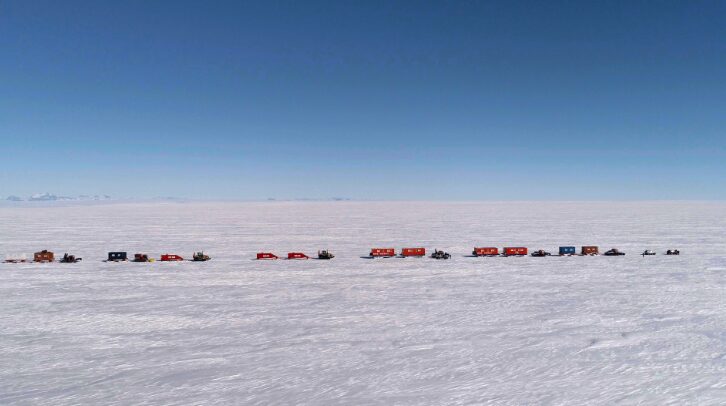 (Photo: Korea Polar Research Institute).
“The team analysed marine sediment samples taken by the Korea Polar Research Institute during 2014-2015 to establish accurate timelines for the cores,” says Dr Naeher.
“Combining our skillsets and the application of new techniques of dating organic material in these sediments enabled us to develop a more accurate method of confirming the timings of marine and terrestrial deglaciation, which found them to fit more precisely than previously thought.”
“The Ross Sea plays a significant role in global climate and sea-level dynamics. The Ross Ice Shelf is especially vulnerable to accelerated ice loss, and this is why considerable attention is given to this area to assess the effects of ocean warming on ice retreat. Its collapse could lead to the loss of inland ice sheets and rapid sea-level rising of up to 12 metres.”
Interestingly, the study found that the simultaneous retreat of marine and terrestrial ice occurred despite the considerable distance between sampling sites. Researchers found evidence that rapid thinning of glacier ice can be triggered by ice retreat more than 60 km downstream, with thinning likely peaking due to marine ice-sheet instability. These accelerated thinning phases persisted for centuries, contributing to extensive inland ice melt. However, the research found that in shallow water and areas with complex seabed topography, deglaciation slowed, delaying ice-sheet retreat by millennia. This demonstrates the role of local geography in shaping long-term ice loss.
The research team says the study provides scientists with a clearer understanding of where, when and how quickly ice loss occurred during the mid-Holocene, which is highly relevant today, as we observe extensive, rapid Antarctic ice loss due to climate change.
“Our results show that open ocean conditions formed in extensive areas in the Ross Sea that were previously covered by an ice shelf, which occurred together with large-scale retreat of glaciers on the continent between 6.9 and 5.4 calibrated thousand years before present. That’s a relatively short period of accelerated melting, resulting in rapid changes from glaciers to open ocean.”
“By resolving discrepancies in the timing of glacier retreat and marine ice melt, we now have robust data to identify the major drivers and timescales of ice loss to better understand sea level rise,” says Dr Naeher.