
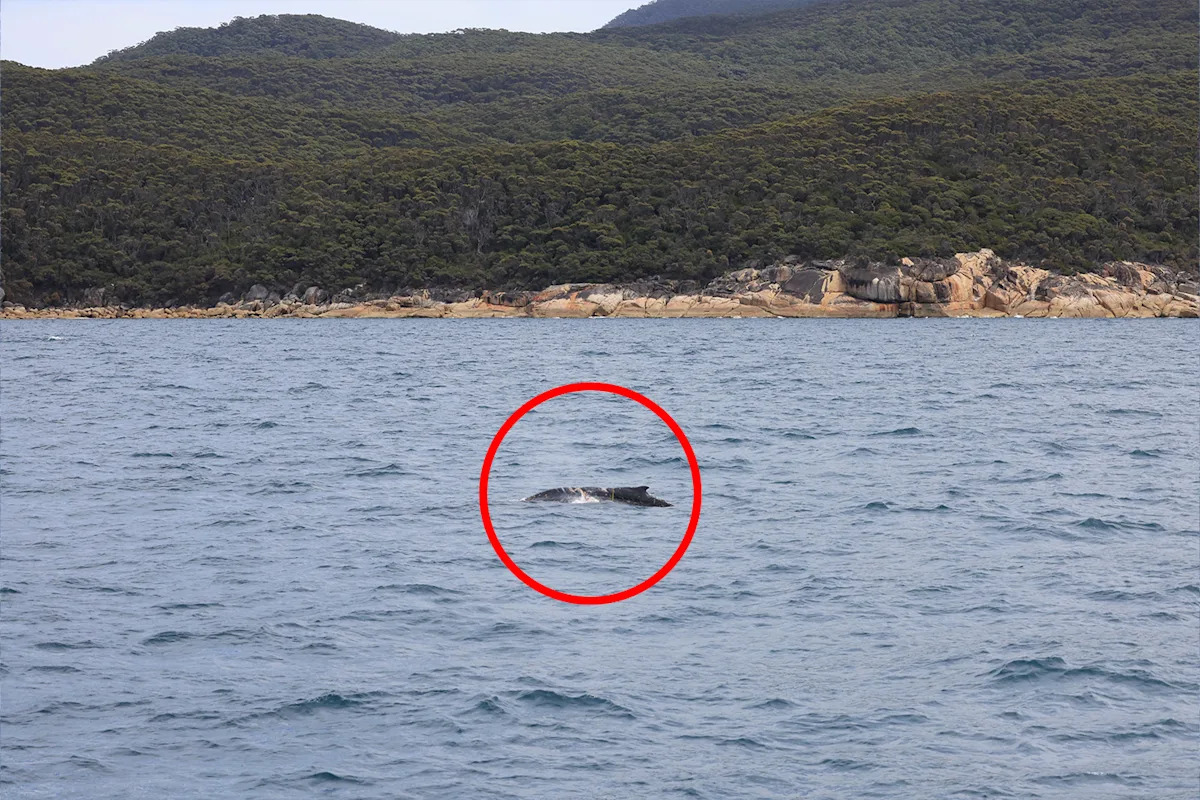
As thick cloud lifts over Australia’s south-east coast, a fixed-wing plane crew will resume their search for a juvenile humpback whale left behind during the annual migration. The animal was sighted by a tour boat off Victoria’s Wilsons Promontory on the weekend, with a thick mooring rope wrapped around the base of its dorsal fin.
It’s unusual to see humpbacks in Australia’s waters in February. When it was originally sighted on February 5 in Jervis Bay on the NSW South Coast, experts were unsure if it was migrating north or south from Antarctica.
The Organisation for the Rescue and Research of Cetaceans in Australia (ORRCA) said the recent sighting around 650km south indicates it is likely to be late returning home.
Spokesperson Craig Ryan told Yahoo News the sighting at this time is “odd” because the peak southern migration time is winter.
“Usually we start seeing numbers drop off in spring, and by the time it gets to October, we’re seeing less and less,” he said.
“But there’s no rule, they’re an animal, and they’ll just follow whatever instinct they want.”
Crew member spots whale after ‘premonition’
Graeme Burgan, a crew member and science officer at Wildlife Coast Cruises, spotted the struggling whale at Refuge Cove off Wilsons Promontory on Saturday afternoon.
“The thing about the ocean is you can never predict what’s going to happen. I always expect the unexpected,” he told Yahoo News.
Climate change has altered historical humpback migration schedules, but the weekend’s sighting of the juvenile whale is thought to be linked to its entanglement.
Since whaling for humpbacks was banned in the 1970s, numbers have increased, but so too have human threats.
In 2025, World Wide Fund for Nature (WWF) launched an interactive map highlighting where the routes of 1,400 whales collide with threats from ships, noise, fossil fuel projects, pollution, fishing and climate change.
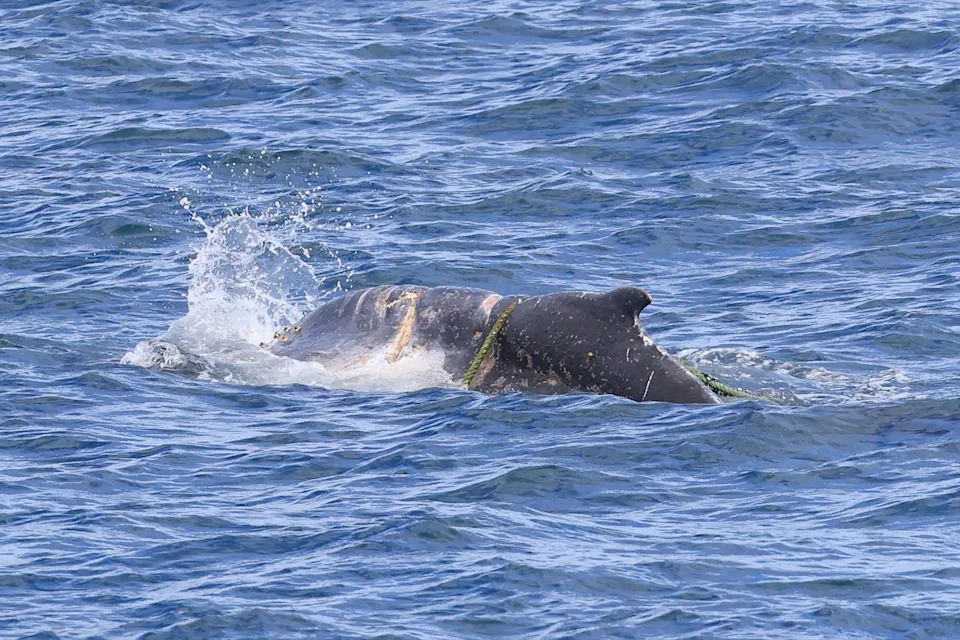
Deep lacerations of between 5 and 10cm deep were seen in the whale’s flesh. Source: Graeme Burgan/Wildlife Coast Cruises
Fear for whale’s future as search resumes
The whale swam within 100 metres of the tour boat, but strict wildlife protection regulations prevented Burgan from jumping on a paddleboard and cutting the animal free.
“I was thinking, how can I help it? But other than reporting it, I had to resist the temptation to cut it loose,” he said.
There are at least five prominent lacerations on the whale’s back, and Burgan estimates some of them are 10cm deep.
Because of its body condition and young age, he doubts it will survive.
“Ultimately, it’s going to die,” Burgan said.
“Its mother has abandoned it, so it’s probably not been able to get food. It’s losing weight, and I could see its rib cage vertebrae.”
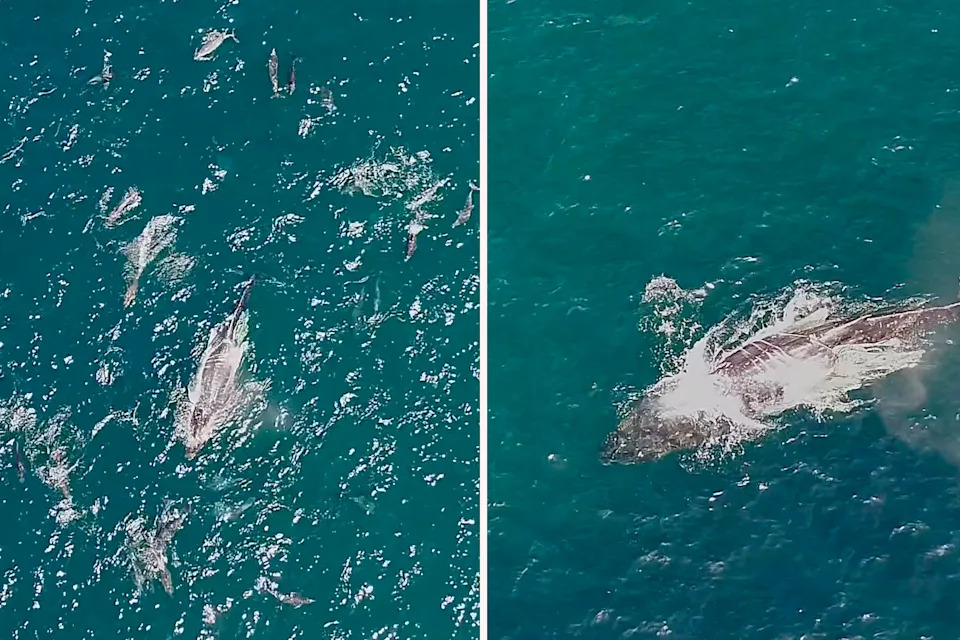
The same lacerations were clearly visible when the animal was filmed with a drone at Jervis Bay earlier in February. Source: Terry Dixon via ORRCA
Victoria’s environment department (DEECA) confirmed it was planning to send a crew to search for the whale on Monday morning.
Efforts to locate it will be concentrated around the coastline, where previous sightings have occurred.
Because of the lacerations on its back, the animal is distinctive. DEECA urged members of the public to report any sightings to its Whale and Dolphin Emergency Hotline on 1300 136 017.
Love Australia’s weird and wonderful environment? 🐊🦘😳 Get our new newsletter showcasing the week’s best stories.
