
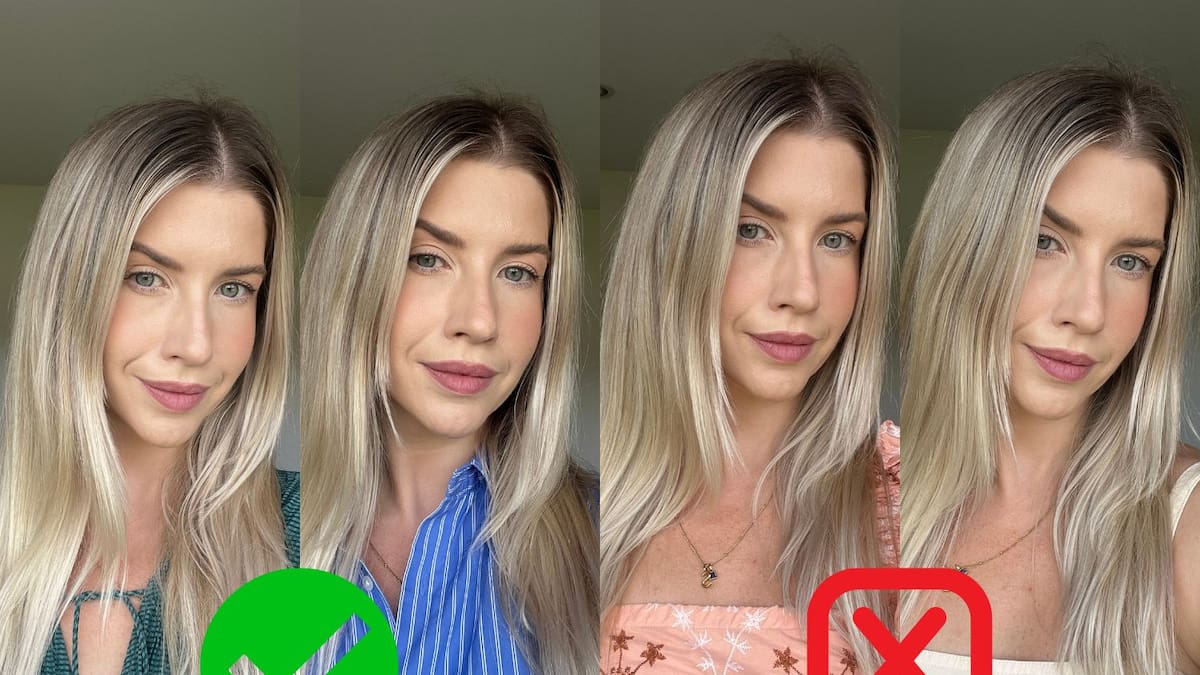
The 1980s trend of “having your colours done” is back in a major way, bringing with it new considerations when it comes to complexion and clothing. It’s exploded on social media, but is having a bot do your colours as effective as having someone prescribing in person? We found out.
There’s a difference between “That’s a beautiful top, where did you get it?” versus “Wow, you look so beautiful”.
So says Georgette Pollock-Johnston, a stylist and colour consultant who has built her business around the art of analysing which shades best complement a person’s natural colouring.
Its purpose? To demystify dressing by empowering individuals to feel confident to use colour as a tool for self-expression and clarity.
Pollock-Johnston believes wearing the right colours for your skin tone can elicit trust, which she says is why plenty of salespeople and real estate agents book with her.
“If someone’s wearing the wrong colour and it’s not in their palette, it can make [them] feel less trustworthy. But when you wear your colours, you advertise yourself in the perfect lights. People trust you, you feel approachable,” she says.
“With colour analysis, you’ll no longer have to worry about looking tired or washed out in your clothes. Instead, you’ll be able to effortlessly create stylish and flattering outfits that showcase your best self.”
Tired and washed out is exactly how I’d describe myself after what feels like 1278 days of school holidays, not helped by feeling uninspired by the current state of my wardrobe.
So, for this story and in a desperate bid to a) find something in my wardrobe I actually wanted to wear in the confidence that b) it suited me, I reached out.
Georgette Pollock-Johnston performs her colour consults at her studio in Newmarket.
In-person colour analysis
A one-hour, in-person consultation with Pollock-Johnston is priced at $449, and factors in a person’s skin tone, hair colour and eye colour, to determine their season (spring, summer, autumn, winter) and flow (cool, soft, light, neutral).
Beyond dressing, Pollock-Johnston offers insights into makeup (the best eyeshadow, blush and foundation shades to wear), personalised hair colour recommendations, plus the metals and colours for jewellery to suit your undertones.
Sure, it’s a hefty investment – but one you’ll only ever need to make once. Pollock-Johnston explains that once you have your colour palette determined correctly, it remains the same for your entire life.
“Unlike passing trends, your best colours are timeless and will always enhance your natural beauty,” she says.
“Naturally beautiful” was not something that immediately sprang to mind as Pollock-Johnston draped two white cloths around my shoulders and head. Instead, I looked like an extra from The Handmaid’s Tale.
She started by identifying whether I’m a warm or cool undertone by draping pieces of coloured fabric over me and determining which looked best. I didn’t see it straight away, but over time my eye became attuned to hers – certain colours flushed my cheeks, or highlighted imperfections, while others made me look pale.
“We always want to see you and the colour at the same time. We never want the colour to overtake you,” she says.
My cool summer colour palette. Photo / Supplied
After a thorough process of whipping fabric back and forth, and using the word “clear” no less than 50 times to describe how colours make my features pop or my eyes sparkle, she identified me as a cool summer.
This means colours like jade green, cool-toned browns, burgundy and cobalt blue work with my skin, rather than reflect or sit on top of it.
It’s not just visual. Pollock-Johnston says a person’s season gives clues about their personality, too. A winter tends to stomp up the stairs to her Newmarket studio, making their presence known before they set foot in the room. Summers are a little softer.
Dressing in my cool summer palette – shades like emerald green, mulled wine and cobalt blue have my green eyes popping and make me look more refreshed and awake.
Many New Zealanders find themselves in a sea of black, but Pollock-Johnston says the shade isn’t for everyone. While the thought of being told you don’t suit black or white feels mildly terrifying (and I’m smug to say that as a cool summer I can wear both), most feedback Pollock-Johnston gets a month after a consult is that people who don’t have black in their palette haven’t reached for it.
Some people are harder to “type” than others, but Pollock-Johnston says she’s only had one person who has had to make a repeat visit.
“She desperately didn’t want to be a cool undertone, so I had to send her away and invite her back with a different mindset. There is no ‘bad’ palette,” she says.
Dressing outside my palette in shades of peach, orange, mustard or cream accentuates my dark circles or has me looking washed out. I’ve immediately popped these pieces in my donate/sell pile.
As for makeup, I once had a retail assistant tell me I should wear foundations that suit a yellow undertone, but Pollock-Johnston immediately threw out that theory.
“I want you to try a cool-toned foundation. Pink blushes over peach, and if you wear a red lip, make it a blue-based red. If you wear an orange-based red lip, your lips are going to arrive in the room before you do,” she says. Thankfully, black mascara could stay.
Armed with a colour palette keychain and a comprehensive analysis in my inbox, my zest for dressing had returned and I was sent on my way.
I lightning-sped home to compare my keychain colour palette with items I own. Photo / Ash Cometti
Versus ChatGPT
In-person colour analysis isn’t new.
Many people might recall women “having their colours done” in the 1980s and 1990s, spearheaded at the time by trained consultants like Shelly Bell who worked with the four main seasons to prescribe palettes.
What is new is challenging AI bots with the task. TikTok filters were just the beginning. Now you can upload photos to ChatGPT or Google Gemini and have them complete a full colour analysis at the click of the button.
Sure, it’s convenient. But is it accurate?
I prompted ChatGPT to act as a professional colour analyst, requesting specifics around which season I fell into, along with tips on hair colour and makeup.
What GPT said …
A few seconds later, it spat out my results. A cool-neutral undertone, with skin that gives a soft pink or rosy cast, and very little visible yellow in my complexion.
The bot said my bright white-blonde pieces in my hair didn’t overpower me, suggesting I could handle cool or icy tones really well.
Whereas Pollock-Johnston categorised me as a cool summer, ChatGPT said soft summer, suggesting colours that fit within a cool, muted, low-to-medium contrast palette. Think cool taupe and soft navy, sage and dusty rose.
Fresh off the back of my in-person consult, I remember how these shades wore on me (still good as they fit within the scope of my home season summer, but not nearly as punchy as their cooler counterparts). My scepticism set in.
My results noted colours to avoid, including warmer shades of orange, mustard and camel, along with tomato red and neon brights. ChatGPT said to avoid stark black, whereas Pollock-Johnston said I could carry this well.
It picked up that silver was best on my complexion, but added that a soft rose gold could also work. Yellow gold near my face was a no-no.
Georgette Pollock-Johnston supplied me with an in-depth 11-page document after my consult, plus a keychain of cool summer shades to tote around in my handbag.
Which is best?
In-person, Pollock-Johnston picks out the warm starbursts in my eyes, the subtle reflects in my skin when she prescribes silver jewellery over gold (this will take a little getting used to): the minutiae that are difficult to ascertain from a photo or swatch alone.
She tried to integrate AI into her business and dabbled with the idea of developing an app. But she says there’s so much room for error – for every person AI gets right, there are five it gets wrong.
The results from my in-person consult were visually led, page upon page of photos of my face set to the backdrop of shades that suited me, a complete list of 35 precise shades to shop for, plus a keychain of swatches to carry with me (it now lives in my handbag).
ChatGPT’s analysis is text-based, with no colour swatches shared – only names of shades and styling tips to try.
It’s certainly a jump-off point, but in my opinion, nowhere near as prescriptive or informative as spending an hour in Pollock-Johnston’s chair.
In a world consumed by concerns that AI is coming for our jobs, colour analysis is one such creative pursuit where the humanity of an expert eye and a reassuring personal touch is unmatched.
Ashleigh was gifted a Colour Analysis appointment with Georgette Pollock-Johnston for this review.
More beauty
A go-to guide to party season glamour, the best new season beauty buys and more.