
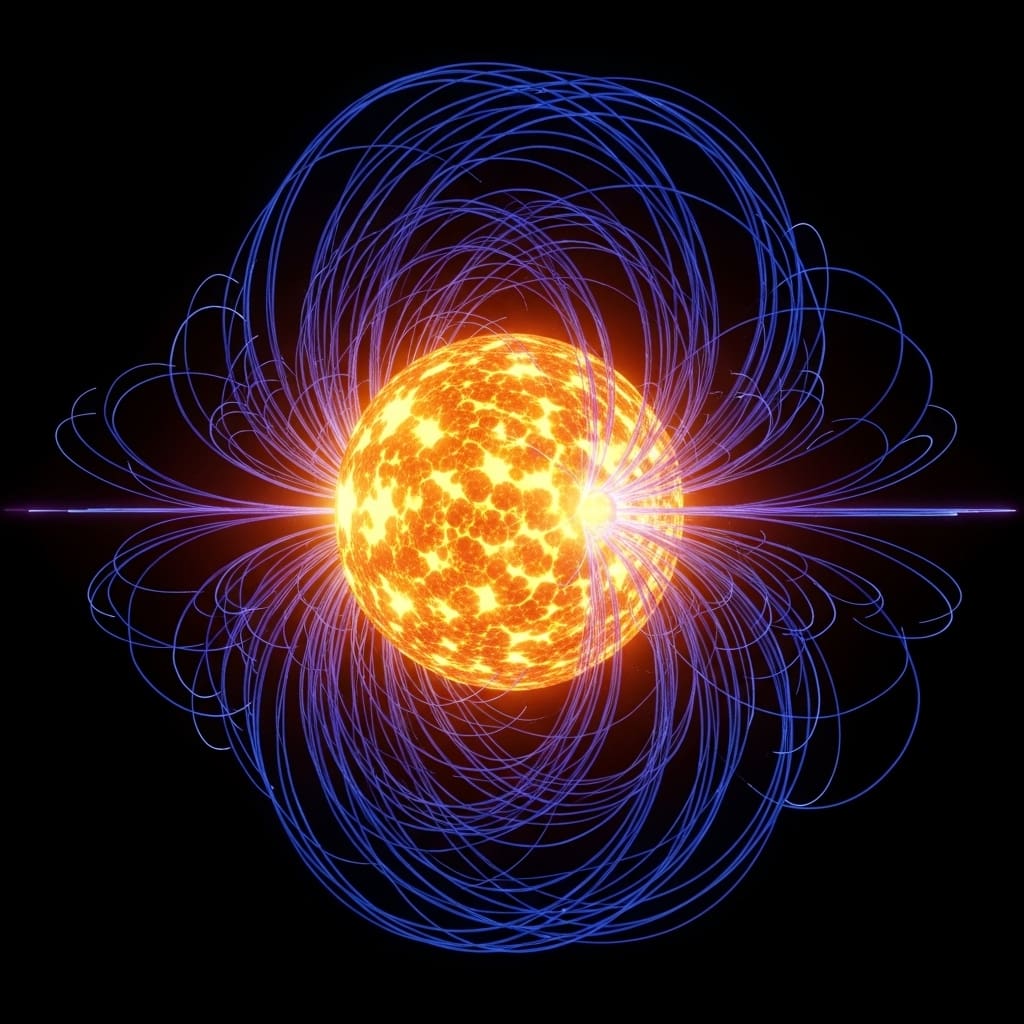
Researchers are increasingly focused on understanding the behaviour of quantum chromodynamics (QCD) matter under extreme conditions, specifically in the presence of strong magnetic fields and non-zero chemical potentials. Zhi-Ying Qin from Shaanxi Normal University, Bo Feng, and Ya-Hui Hou, also of Shaanxi Normal University, alongside Hong-Yue Song, Wen-Chao Zhang, Hua Zheng from Shaanxi Normal University, and Shi-Jun Mao working with colleagues at Xi’an Jiaotong University, have constructed a hybrid equation of state to investigate these properties. Their collaborative work reveals that key thermodynamic observables, including entropy density, pressure, and speed of sound, are significantly modified by these extreme conditions.
Scientists have developed a novel approach to modelling quantum chromodynamics (QCD) matter, the substance thought to exist at extremely high temperatures and densities. This work centres on constructing a hybrid equation of state (EoS) that accurately describes the transition between hadronic matter, composed of particles like protons and neutrons, and the quark-gluon plasma (QGP), a state where quarks and gluons are deconfined. The research demonstrates how external magnetic fields and nonzero chemical potentials significantly alter the fundamental properties of this matter, influencing quantities like entropy density, pressure, and sound speed. A hybrid equation of state (EoS) forms the basis of this work, constructed by smoothly interpolating between the hadron resonance gas (HRG) model at low temperatures and the ideal parton gas (IPG) model at high temperatures. This approach allows for the investigation of quantum chromodynamics (QCD) matter under finite magnetic fields and non-zero chemical potentials. The HRG model, employed to describe the hadronic phase, calculates the total grand canonical partition function by summing contributions from free hadrons and resonances with masses up to 2.5 GeV/c². This summation incorporates quantum statistics, distinguishing between bosons and fermions, and accounts for particle degeneracy and chemical potentials associated with baryon number, electric charge, and strangeness. To model the QGP phase, the IPG model utilizes massless gluons and massive u, d, and s quarks. The interpolation between the HRG and IPG EoS is crucial, having been previously used to study thermodynamic properties in systems with massless pions and light quarks. When a magnetic field is introduced, charged particles undergo Landau quantization, discretizing their momentum perpendicular to the field and modifying their energy levels. Neutral particles, however, retain their standard energy expression. This Landau quantization is implemented by modifying the momentum integrals within the pressure calculations for charged particles, accounting for the allowed Landau levels and spin orientations. The pressures for both neutral and charged particles are then derived from the partition function using thermodynamic differentiation. To facilitate these calculations, the logarithm of (1 + x) is expanded as an infinite series, enabling the expression of pressures in terms of modified Bessel functions of the second kind. Finally, the entropy density is calculated via differentiation of the pressure with respect to temperature, incorporating contributions from both neutral and charged particles and accounting for magnetization effects arising from the magnetic field. Entropy density calculations reveal a sensitivity to both magnetic field strength and chemical potential. At zero chemical potential, the entropy density rises with increasing temperature, exhibiting values that are suppressed by the introduction of a magnetic field at lower temperatures but enhanced at higher temperatures. As the chemical potential increases, the entropy density consistently rises across both the hadronic and quark-gluon plasma phases. Pressure measurements demonstrate a similar trend, with values suppressed at low temperatures by a magnetic field and enhanced at high temperatures, while also increasing with chemical potential. Energy density calculations follow the same pattern, responding to both chemical potential and magnetic field in a temperature-dependent manner. The trace anomaly, a key indicator of the QCD phase transition, is also affected by these parameters. Both increasing chemical potential and applying a magnetic field increase the squared speed of sound at temperatures approaching the critical temperature, but conversely reduce it at lower temperatures. This indicates a complex interplay between these two effects on the system’s compressibility. Specifically, the squared speed of sound exhibits a temperature dependence modified by the simultaneous presence of chemical potential and magnetic field, resulting in intricate changes to the thermodynamic behaviour. Comparisons with lattice QCD data for the quadratic fluctuations of conserved charges show successful reproduction of temperature dependence at magnetic field strengths of 0 and 0.04 GeV². However, at a stronger magnetic field of 0.14 GeV², the model underestimates the magnitudes of these fluctuations while still accurately capturing the overall temperature trend. This suggests the model’s limitations at higher field strengths, despite its ability to describe the qualitative behaviour. Scientists are steadily refining our understanding of the quark-gluon plasma, the extraordinarily hot and dense state of matter thought to have existed moments after the Big Bang. This latest work, modelling the plasma’s behaviour under extreme conditions of both magnetic field and chemical potential, represents a valuable step towards reconciling theoretical predictions with experimental observations from heavy-ion collision experiments. The significance lies not simply in confirming that magnetic fields and chemical potential do influence the plasma’s thermodynamic properties, but in the detail with which these influences are now being mapped. The model’s ability to reproduce lattice QCD data at lower field strengths is encouraging, suggesting a robust foundation for future investigations. However, the observed underestimation at higher magnetic fields highlights a clear limitation, pointing to the need for refinements in how strong magnetic interactions are incorporated into the equation of state. Crucially, this research opens avenues for exploring the complex interplay between magnetic field and chemical potential, and their combined effect on the plasma’s speed of sound and other critical parameters. Future work might focus on incorporating more realistic collision geometries or exploring the impact of these conditions on the formation of specific particle species. Ultimately, a more complete picture of the quark-gluon plasma will not only deepen our understanding of fundamental physics but also shed light on the evolution of the early universe and the nature of matter itself.