
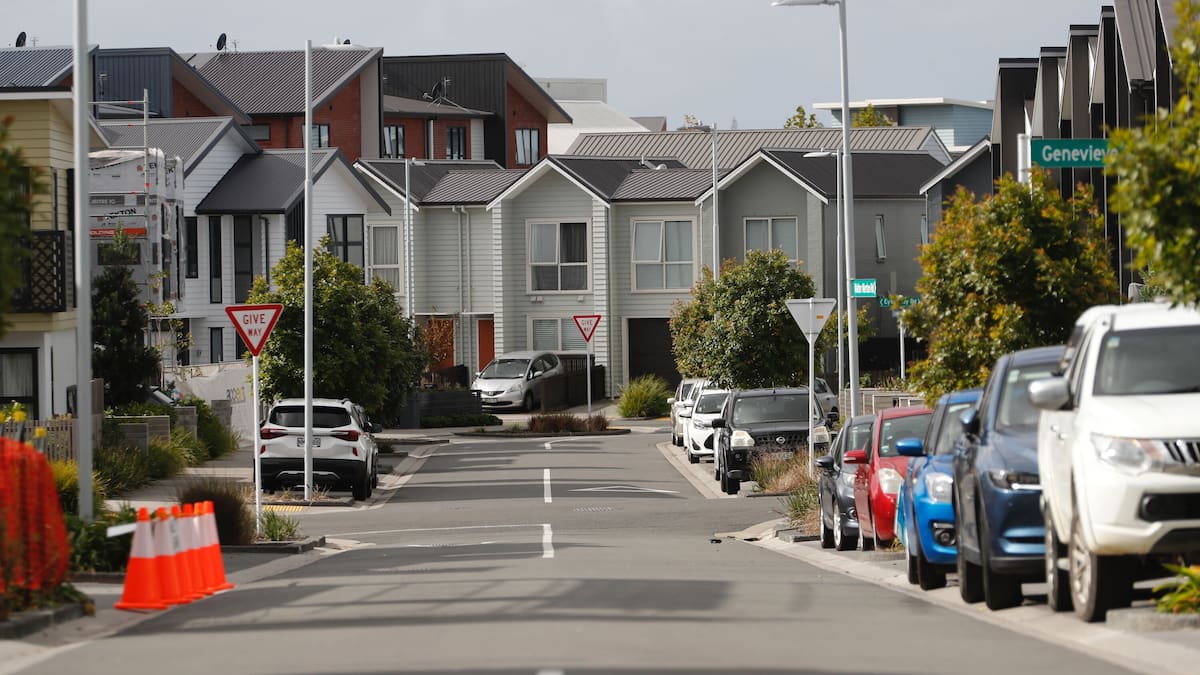
He was commenting on the need for certainty over Auckland’s planning rules as the Government scales back the controversial plan to allow for two million homes.
Wayne Brown said the rules were causing problems in places like Hobsonville.
Brealey said two of Simplicity Living’s current major projects in Mt Wellington and Morningside – both within easy walking distance of train stations and retail – range from five to 12 storeys.
But he argued that rules allowing a broad spread of three‑storey homes across suburban neighbourhoods had produced adverse outcomes.
Developers had largely sold to investors, who for more than a decade had outbid prospective home owners, he said.
“Many of these developments have few or no onsite car parks, as this approach produced a higher yielding investment than one with adequate car parking. This has led to parking and traffic congestion in the suburbs,” said Brealey.
He said that unless the transport issue was solved in tandem with the latest intensification plans for housing growth, it would only generate more problems.
“The major investment in the City Rail Link provides an opportunity to concentrate housing intensification around station nodes and mitigate against the pitfalls of parking and traffic congestion. It’s what other major cities around the world have done,” Brealey said.
Simplicity Living managing director Shane Brealey. Photo / Alex Burton
Brown pointed to developer Ockham, which has focused its projects on or near public transport corridors and train stations, saying developments in these locations offer better travel options, but many other three‑storey projects have gone up without parking well away from rapid transit, he said, adding that “Wellington keeps telling us how to live in our city, and they get it wrong. We’re fed up with it. It is a problem, I accept it’s a problem, but it wasn’t one we made”.
Bishop said only about 21,000 sites in Auckland were covered by the previous Government’s Medium Density Residential Standards (MDRS) before Plan Change 78 for them was withdrawn, and that the number of homes built under the rules was significantly lower.
He said the MDRS was well-intentioned but proved not fit for purpose and Plan Change 78 had been replaced with Plan Change 120, which focuses on adding housing near important transport routes, especially the City Rail Link.
“Even though developers often buy sites first to build homes, those homes are then sold to people who want to live there, so home owners obviously do benefit.
“There is nothing stopping developers from providing car parks, and many still do. Councils are in charge of managing on-street parking,” Bishop said.
Housing Minister Chris Bishop said developers can build car parks if they choose to. Photo / Mark Mitchell
In 2020, the previous Labour Government directed councils to abolish minimum car parking requirements in urban areas as part of a new National Policy Statement on Urban Development.
Removing the requirements was aimed at encouraging intensification, reducing emissions and car dependency.
After the Auckland Council adopted the new rules in February 2022, councillor Wayne Walker said greater intensification and the zero requirement for parking “means your home, your street, your community, your neighbourhood is going to be affected”.
The new measures landed as Auckland Transport (AT) began pushing to remove on‑street parking without consulting residents – a move the mayor at the time, Phil Goff, slammed as “bloody arrogant”.
AT was forced to pause and rethink its approach, and now develops parking plans in conjunction with communities and local boards.
Automobile Association policy director Martin Glynn said the removal of off-street parking requirements for new housing developments in urban areas, combined with denser housing development, can make sense where there is excellent public transport and walking or cycling.
However, that’s usually not the case in the suburbs, where most Aucklanders still rely on cars to meet most of their transport needs. Where people don’t have off-street parking, they tend to park on the road, he said.
Most Aucklanders still rely on cars to meet most of their transport needs, Automobile Association policy director Martin Glynn said. Photo / Alex Burton
“In locations where there has been lots of new housing, the surrounding streets can become clogged. This can make it hard or even impossible to find a park, and in some cases, even impede traffic.
“If we’re going to build more intensive housing in the suburbs, we need to find a way to do it that doesn’t make it harder for residents and visitors to access their local streets,” Glynn said.
Last month, Prime Minister Christopher Luxon and Bishop announced the Government would water down the densification rules in Plan Change 120, with Bishop saying the Government is weighing a range of options for the housing‑capacity targets.
Bishop has said that he is carefully working through any changes to Plan Change 120, which allows capacity for two million houses over the coming decades, but no Cabinet decisions have been made.
“I don’t intend to comment in advance of those decisions other than to say it is legally complicated,” Bishop said, adding that a decision was a few weeks away.
Sign up to The Daily H, a free newsletter curated by our editors and delivered straight to your inbox every weekday.