
Peter Morton has worked in predator control for over 30 years and recalls a time when much of it was little more than guess work.
“I can remember when we didn’t even understand how much of a problem stoats are for New Zealand wildlife. Whio (blue duck) and kiwi would be disappearing. We had suspicions but hadn’t done the work to prove what was going on.”
Morton leads the Department of Conservation’s predator control work nationwide and acknowledges that the sum of what is being achieved is the holding back of further extinctions, on less than a quarter of the conservation estate.
“Our starting point was, where are the best-surviving populations of New Zealand native species that are really at risk from possums, rats or stoats? That’s what’s driven the prioritisation for why we protect areas we are protecting.”
The department maintains predator control on about a fifth or 1.8 million hectares of New Zealand’s conservation land.
“The reason we’ve gone there is because those areas hold the cream, if you like, the best-surviving populations of mohua yellowhead, great spotted kiwi, orange-fronted parakeets or whatever it is, the stronghold of those critters that are only found in New Zealand and are the best places to protect them. These are species that will disappear without predator control.”
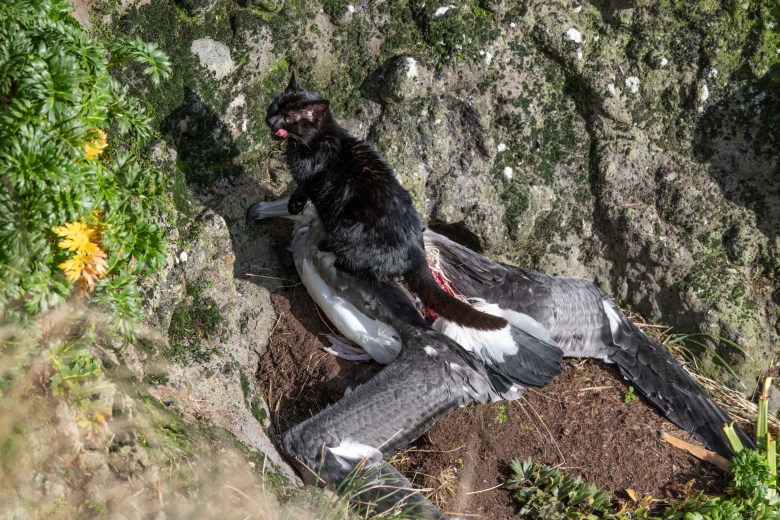 A feral cat eats a white-capped mollymawk on Auckland Island. Photo: DoC
Fortunately, vulnerable species had shown they could survive in environments that had been previously damaged by pests – both the clawed and hooved variety – as long as they were no longer being eaten by predators. If ungulates like deer and pigs remained it was still a problem but it was survivable.
The vast majority of the remaining 6.7m hectares of conservation estate, aside from open water and snowy mountain peaks, was also infested with predators but resources did not allow for its inclusion.
“It’s triage. We are stopping them [vulnerable species] falling off a cliff. We don’t have the ability to control predators everywhere, even though they are having an impact pretty much everywhere. We go to the places we absolutely don’t want to let go, ahead of the ones that are already degraded or just don’t have the same diversity of unique species.”
Money, of course, was the main barrier to extending the work.
“New Zealand has a lot of challenges and calls for public money – health, education … you name it.”
Within conservation too. Although predator control was a critical piece of the puzzle, other areas needed funding such as weed control and protecting wetlands.
Eyes in the forest
What turned things around in the success of control work – in the limited places where it was done – was the huge amount of knowledge-gathering and how that was undertaken. Advances in trapping technology and control methods were also galloping ahead, making the work more effective and cheaper.
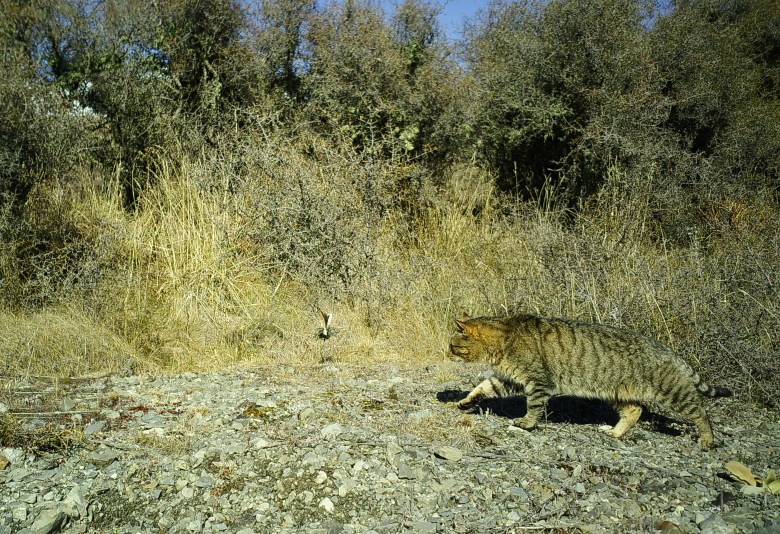 A large feral cat snapped by a trail camera during a bait trial in the St James area in Canterbury. Photo: DoC
Networks of trail cameras now allow workers to instantly see predator activity out in the field and react quickly using finely tuned gear. AI sensors allow highly automated, selective trapping, for example shutting mechanisms down if a curious kea approaches. If the sensor sees a predator, however, the trap activates, and the dead animal falls to the ground – possibly on top of the last catch or two, and the trap resets itself, logs the catch and squirts out a fresh dollop of lure.
Satellite imagery can now be analysed by AI to show where a mast event is happening and subsequent flare-up of predator numbers may occur, and other indicators of environment health.
The current wave of innovation along with public enthusiasm for predator control has been encouraged in part, Morton says, by the Predator Free 2050 initiative.
A fast-growing pest control industry now caters for urban dwellers too with demand high for things like traps with sensors that detect a domestic cat’s microchip and switch off.
The desire to protect native species cuts across all demographics with anyone from young people to senior citizens getting the gloves on and learning how to set up traps, outsmart rats, stoats and nosy possums, then deal with their carcasses.
Cost, however, is a barrier to this smaller scale work too, with many traps costing upwards of $500 each.
The deadly sausage
In remoter country an innovation using the humble snag may provide a useful new tool against opportunistic and skilled bird killers – feral cats.
Finlay Cox, DoC’s eradication workstream lead, says feral cats made a distinct contribution to the impact of predators through their ability to prey on adult birds, fledglings, seabirds, and ground-nesting species, but trials with sausages containing poison were producing good results.
“Feral cats will take both chicks and adult birds when they can catch them, including species such as tūī and bellbird. On Auckland Island, for example, cats have been documented feeding on white-capped albatross chicks at breeding colonies.”
The sausage bait being trialled was also aimed at stoats, and early results were encouraging.
Its advantage was the ability to be distributed by aircraft over large areas of rugged ground, greatly improving the chances of reaching wide-ranging target predators.
Trials have been done in Canterbury, on Auckland Island, and most recently in the Eyre Mountains in Northern Southland. Auckland Island covers 46,000ha and there, Cox says, feral cats have contributed to long-term ecosystem degradation, alongside pigs and mice.
The Eyre Mountains contained many ‘at risk declining’ gecko and skink species, a contracting and declining population of ‘nationally endangered’ rock wren – the only population outside the Southern Alps – and many other native bird species, all of which would be affected by feral cats.
Low densities of the poison bait are used, which reduced cost and the chances of interaction by native species. Seven trials have been completed so far.
“These have consistently shown that the bait can reliably reduce feral cat and stoat numbers by more than 80 percent across a range of environments,” says Cox.