
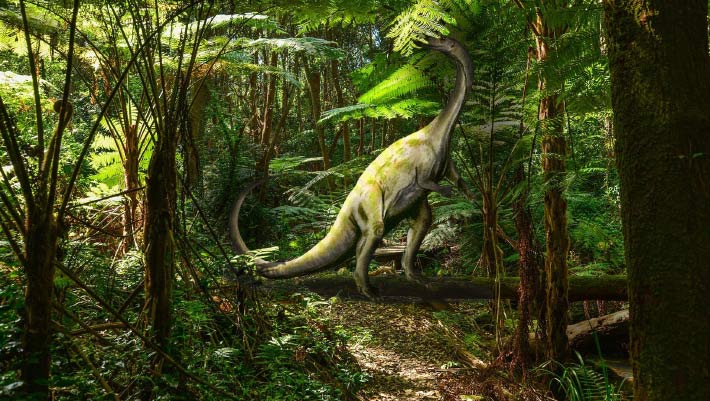
Paleontologists have unearthed fossilized bones of one of the smallest sauropodomorph dinosaurs from the Late Triassic of southern Brazil, offering fresh insights into early dinosaur development and physiology.
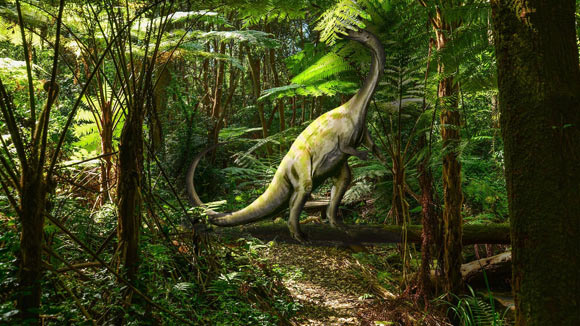
Massospondylus carinatus, a species of small sauropodomorph dinosaur from the Early Jurassic of southern Africa. Image credit: Nobu Tamura, http://spinops.blogspot.com / Patty Jansen / Sci.News.
Dr. Luciano Artemio Leal from the Universidade Estadual do Sudoeste da Bahia and colleagues collected the new dinosaur material from the Cerro da Alemoa outcrop in southern Brazil.
“The Cerro da Alemoa outcrop is a significant geologic and faunistic record of the Santa Maria Supersequence in the central portion of the state of Rio Grande do Sul,” they explained.
The material dates to the Carnian age of the Late Triassic epoch, between 237 and 227 million years ago.
It is composed of tiny bones, all smaller than 5.7 cm (2.2 inches) in length, including a partial humerus, a metatarsal, an ungual phalanx, a neural arch, and a vertebral centrum.
Phylogenetic and anatomical analyses conducted by the team places the specimen firmly within the basal sauropodomorph clade.
“The specimen is an important juvenile dinosaur,” the paleontologists said.
“A combined analysis of its morphology, osteohistology, and phylogeny positions it as a basal sauropodomorph from the Brazilian Triassic period.”
Unlike later sauropodomorphs that achieved enormous body sizes, this early form appears to have had a much smaller stature while still in development.
Crucially, the bone microstructure reveals evidence of at least one complete cycle of growth interruption with a line of arrested growth, suggesting that the individual experienced pauses in development early in life.
This pattern indicates that even at small body sizes, early sauropodomorphs may have adopted flexible growth strategies — a finding that could help explain the later emergence of gigantism in this group.
“The observed features suggest an individual still in development, having already undergone its first growth arrest and being midway through its second cycle,” the researchers said.
“These analyses suggest ontogenetic features of a juvenile sauropodomorph with a single growth arrest.”
“Our results provide evidence for novel growth strategies during the early evolution of this group, leading to the emergence of small-bodied dinosaurs in the Triassic.”
The findings will be published in the April 2026 issue of the journal Palaeoworld.
_____
Leomir Santos Campos et al. 2026. A new tiny basal Sauropodomorpha (Dinosauria: Saurischia) from the Santa Maria Supersequence, Upper Triassic of southern Brazil. Palaeoworld 35 (2): 201064; doi: 10.1016/j.palwor.2025.201064