
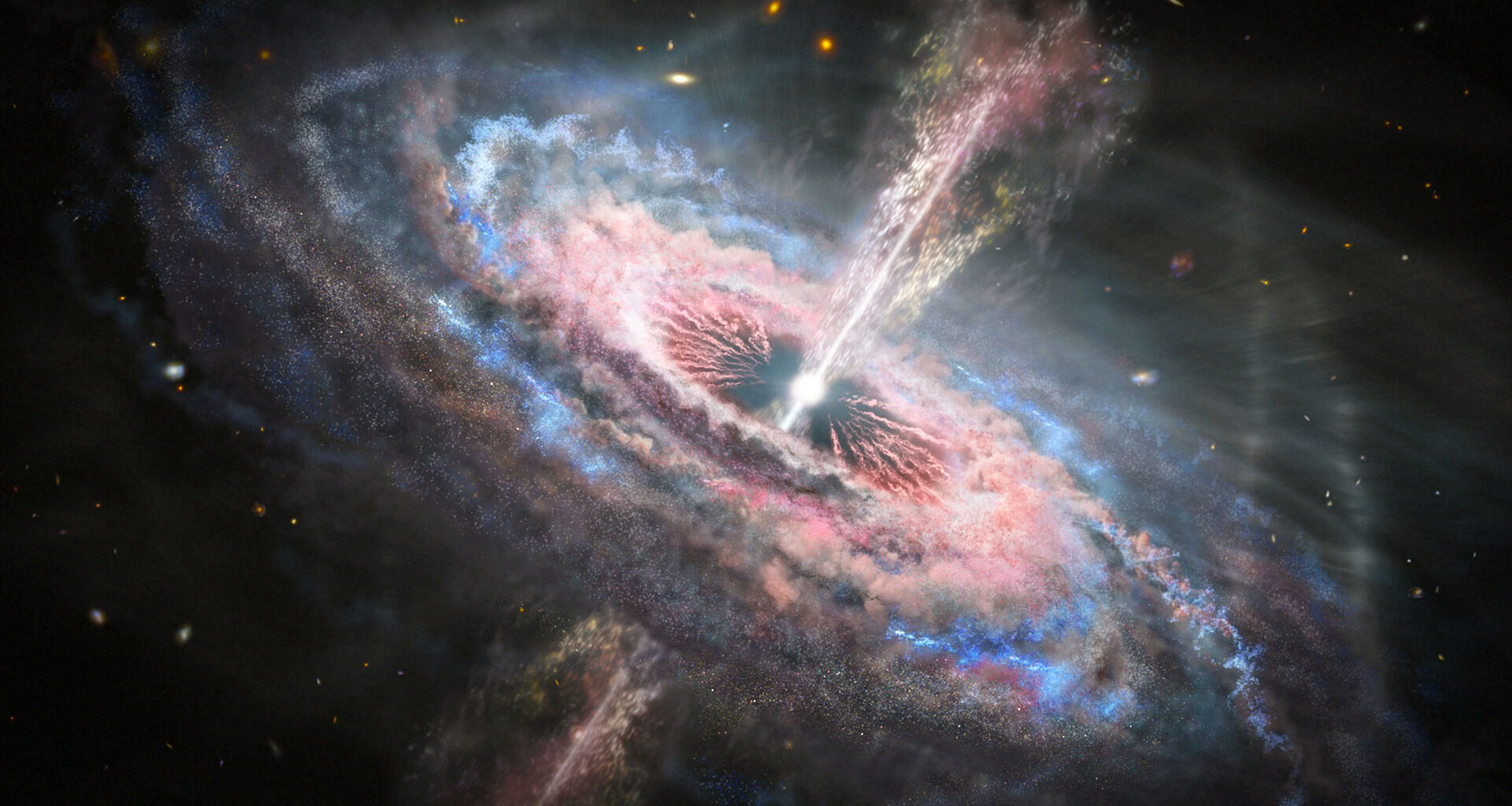
Intense radiation emitted by active supermassive black holes – thought to reside at the center of most, if not all, galaxies – can slow star growth not just in their host galaxy, but also in galaxies millions of light-years away, according to a study led by Yongda Zhu, a postdoctoral researcher at the University of Arizona Department of Astronomy and Steward Observatory.
“Traditionally, people have thought that because galaxies are so far apart, they evolve largely on their own,” said Zhu, the first author of the paper published in The Astrophysical Journal Letters. “But we found that a very active, supermassive black hole in one galaxy can affect other galaxies across millions of light-years, suggesting that galaxy evolution may be more of a group effort.”
Zhu calls this idea the “galaxy ecosystem” and compares it to the intertwined ecological systems on Earth. “An active supermassive black hole is like a hungry predator dominating the ecosystem,” he said. “Simply put, it swallows up matter and influences how stars in nearby galaxies grow.”
Since they were first predicted in the early 1900s, the destructive and ominous nature of black holes has fascinated not only scientists, but the public as well. Considered the most extreme objects found in the universe, black holes contain immense mass and gravity, capable of capturing nearby matter and even light if it ventures too close. A small subset, including the Milky Way’s central black hole, are known as “supermassive,” boasting masses millions and sometimes even billions of times that of our sun.
As their name implies, black holes per se are invisible. However, when supermassive black holes actively devour surrounding matter, they can appear as extremely bright specks in telescope images, sometimes emitting hundreds of trillions of times more energy than the sun. Astronomers refer to these cosmic monsters as quasars, a phase in a black hole’s life when gas and dust form a swirling disk that releases enormous energy as it spirals inward – often outshining the entire host galaxy.
Resolving a mystery
Early observations from the James Webb Space Telescope appeared to show fewer galaxies surrounding enormous quasars during the universe’s infancy. This result was surprising, since large galaxies are commonly found in dense clusters, rather than isolation.
“We were puzzled,” said Zhu, “Was the expensive JWST broken?” he added with a laugh. “Then we realized the galaxies might actually be there, but difficult to detect because their very recent star formation was suppressed.”
That realization led to a bold new idea: Could these very bright, supermassive black holes affect not only their own galaxies but also stifle star formation in neighboring galaxies?
To test this idea, the team studied one of the most luminous quasars ever observed: J0100+2802, which is powered by a supermassive black hole roughly 12 billion times the mass of the sun. Light from this quasar allows astronomers to see the universe when it had not yet even reached its 1-billion-year birthday.
The team of scientists used the JWST to measure emissions of a specific gas called O III, an ionized version of oxygen that traces very recent star formation in galaxies. A lower ratio of O III alludes to the disruption of ideal star-forming conditions in large clouds of cold gas. The team observed a clear distinction between galaxies within a million-light-year radius of the overpowering quasar: they showed weaker O III emission relative to their ultraviolet light, consistent with repressed, very recent star formation.
“Black holes are known to ‘eat’ a lot of stuff, but during the active eating process and in their luminous quasar form, they also emit very strong radiation,” said Zhu. “The intense heat and radiation split the molecular hydrogen that makes up vast, interstellar gas clouds, quenching its potential to accumulate and turn into new stars.”
Stars require very specific conditions to form, including large reservoirs of cold molecular hydrogen, which acts as the raw fuel for star formation. Scientists already knew that quasars, often located at the centers of young, rapidly growing galaxies, can destroy this gas within their own host galaxies, shutting down local star formation. What remained unclear, however, was whether this destructive influence extended beyond a quasar’s home galaxy. By using the JWST to observe light from a quasar that existed more than 13 billion years ago, the team found evidence of suppressed star growth on a much larger scale.
“For the first time, we have evidence that this radiation impacts the universe on an intergalactic scale,” said Zhu, “Quasars don’t just suppress stars in their host galaxies, but also in nearby galaxies within a radius of at least a million light-years.”
This discovery would have been impossible with any other telescope, according to Zhu.
This is because by the time light from objects as distant as quasar J0100+2802 reaches Earth, the expansion of the universe has stretched its wavelengths far into the infrared. Previous telescopes could not clearly detect these faint infrared signals, making JWST uniquely capable of observing early-universe phenomena.
Our galaxy, the Milky Way, likely once had its own quasar. It is not active today, but the researchers wonder how this quasar impacted the formation of our own galaxy, as well as the other galaxies in its local environment.
The team hopes to test whether the phenomenon is widespread across multiple quasar fields and better understand exactly how galaxies are affected by neighboring quasars and whether other, less obvious factors are at play, Zhu said.
“Understanding how galaxies influenced one another in the early universe helps us better understand how our own galaxy came to be,” he said. “Now we realize that supermassive black holes may have played a much larger role in galaxy evolution than we once thought – acting as cosmic predators, influencing the growth of stars in nearby galaxies during the early universe.”