

Near-Earth asteroids have close approaches with Earth with some regularity. In fact, due to their small size and, frequently, low albedo, they are typically discovered during a close approach with our planet. Once an object’s path in space is known with some accuracy, it is possible to determine when there will be new close approaches with Earth and wait for it to happen. We systematically provide such information in our close approaches list for recent and upcoming passes, where various data are given for each object and close approach as: the day and time of the event, the minimum distance, the brightness at the closest approach point, the relative velocity and an index on how frequent the close approach of such object could be expected.
We also provide such information in the dedicated page for each object under the “Close Approaches” tab, as it can be observed in the recently relevant case of 2024 YR4. We report for that asteroid 14 close approaches between 1950 and 2025, the closest of which is the one in December 2032, the one where we previously found impact probabilities with the Earth, which were later discarded. To date, there remains a 4% probability of impacting the Moon on that occasion. The close approach at discovery in December 2024 is also reported at a distance of 2.16 lunar distances.
As we already commented in this other news item, there is a significant number of large near-Earth asteroids that will have close approaches over the next few years. In that news we also included a plot providing the distance of those approaches as a function of time and a circle denoting the relative size of the related asteroid. A concentration of large objects could be clearly seen between years 2027 and 2030.
Whereas the above situation has not significantly changed in the more than two years since the publication of that news, what we can add to that plot is all the close approaches that have been observed during that period of time. This is what we actually provide in the plot below, where it can be clearly seen the swarm of close passes of objects between 2024 and the start of 2026, most of which are new NEA discoveries that the NEA discovery community has detected thanks to the above-mentioned reason. The difference is such that the ratio of detected versus foreseen approaches is around 50-fold, which highlights the importance of detecting the objects when they are passing in the vicinity of our planet.
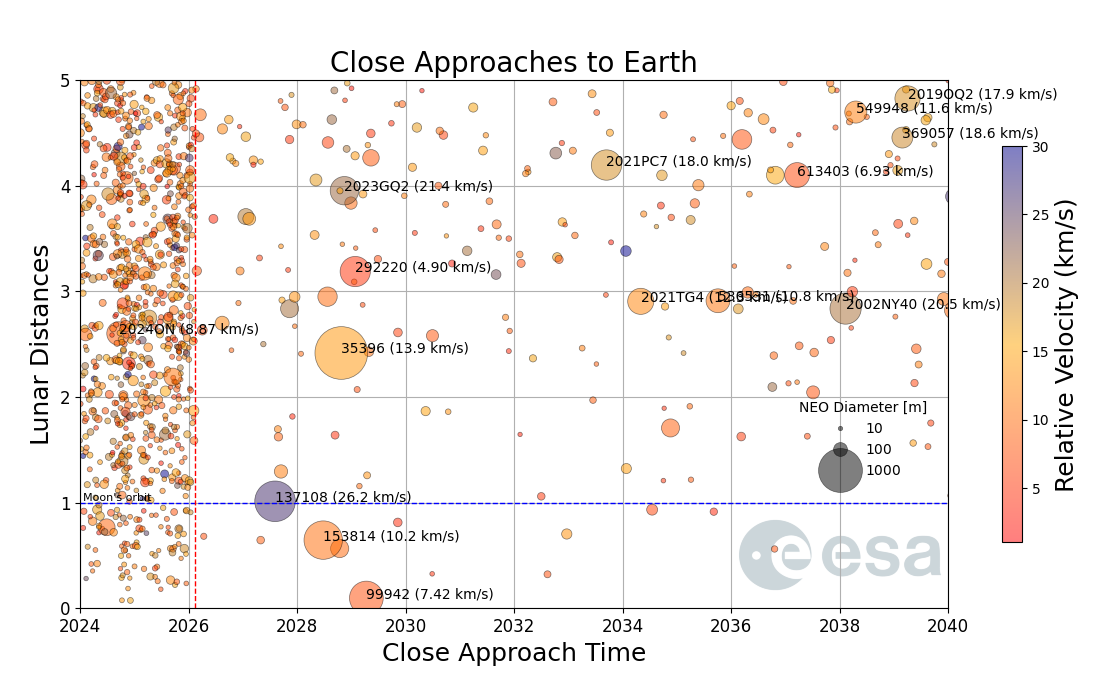
Close approach distance of known NEAs from 2024 until 2040, their relative diameter (circle size) and the close approach relative velocity (circle colour code). Credit ESA / PDO.