
Artificial intelligence appears to have achieved another landmark by setting the first Sudoku puzzle that human experts have conceded is worth their time.
Sudoku, for the uninitiated, is a number puzzle played on a grid. The most common form is nine rows and nine columns. The aim is to fill the grid so that each row, each column and each of nine smaller boxes within contains the digits 1 to 9 exactly once. No arithmetic is required. The appeal lies in deduction: you have to work out what goes where, purely by considering where the digits can (and cannot) go.
The puzzle’s modern form emerged in Japan in the 1980s; in the 2000s it became a global craze. It has since spawned a thriving subculture devoted to ever more elaborate variations.
These variant Sudokus alter or add rules. Some, for instance, place mathematical constraints on what numbers can go in neighbouring spaces; others might prevent identical digits from being placed a chess knight’s move away from themselves. Designing a good variant is harder than solving one. The creator must ensure that the puzzle has a unique solution and, ideally, that it is fun to complete.
According to Simon Anthony, a former member of Britain’s national Sudoku team and a co-creator of a popular YouTube channel dedicated to the puzzles, AI has now achieved this.
“I am fairly blown away,” Anthony said after tackling the AI-generated variant.
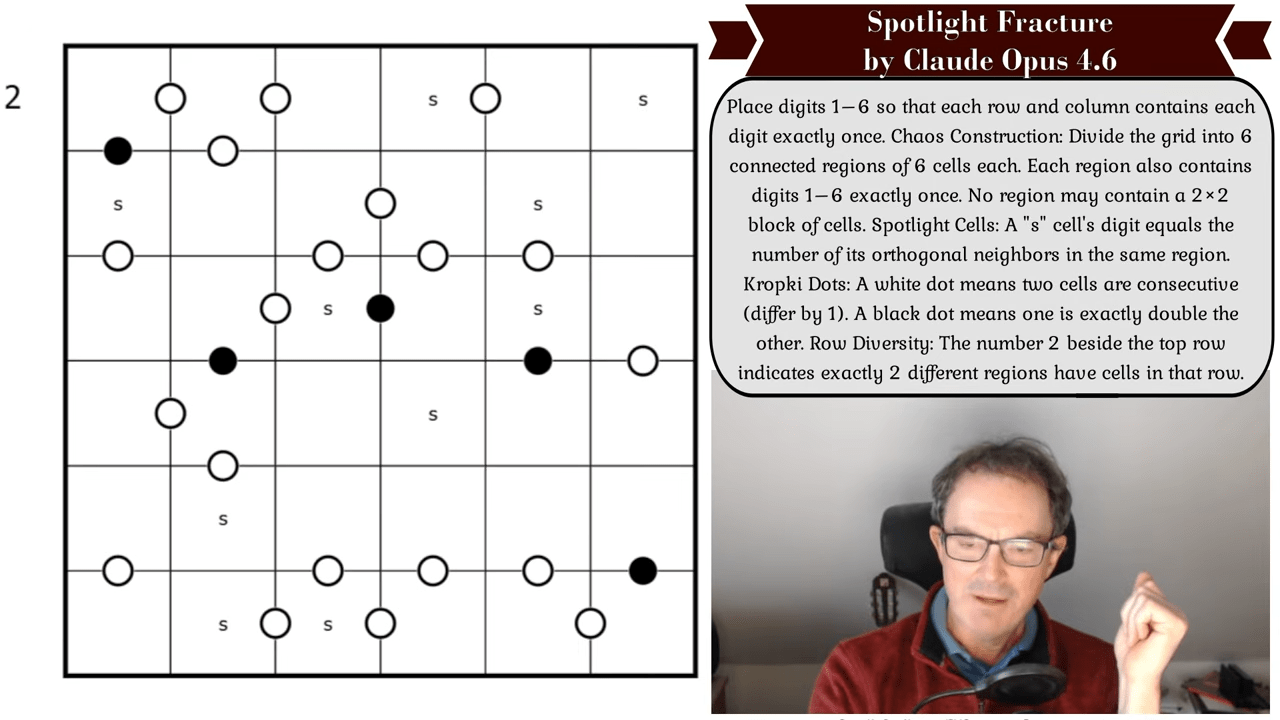
Simon Anthony tackled Spotlight Fracture on his YouTube channel. Scroll to the end of the article to try it for yourself
Computer software has been used to generate standard puzzles for decades. But, as far as Anthony is aware, AI has “never set a successful variant Sudoku without extensive human involvement and repeated prompting and modifications”.
Mick Hodgkin, puzzles editor at The Times and The Sunday Times, said: “Standard Sudokus have long been computer-generated, but the kind of complex variant seen here normally requires the personal touch.
“Most of our puzzles are handmade by humans, but if AI is coming for craft Sudoku, what next? The cryptic crossword could be the last holdout of human puzzling ingenuity.”
The human who asked the bot to create the new variant Sudoku is Vincent Abruzzo, an independent AI-safety researcher who sets puzzles under the name Thoughtbyte. He asked Claude Opus 4.6 — a large language model AI, recently released by the technology company Anthropic — to invent a new variant of Sudoku that could be solved logically by a human. He did this by entering a short, single prompt.
The model duly generated a puzzle it called Spotlight Fracture. Instead of the standard 9×9 grid, it used a smaller 6×6 one. No numbers were filled in at the start.
Players must work out how the grid should be divided into six irregular “regions”, each of which must contain the digits 1 to 6 with no repetition.
Additional markings between certain squares impose extra rules: some adjoining squares must contain consecutive numbers; others require the number in one square to be double the other. A further rule ties the value of particular squares to how many neighbouring squares belonged to the same “region”.
To test the resulting puzzle, Abruzzo sent it to Cracking the Cryptic, the biggest Sudoku channel on YouTube. Its presenters, Anthony and Mark Goodliffe — another former member of Britain’s national Sudoku team — have built an audience of almost 700,000 subscribers by solving two “handmade” puzzles each day.
Anthony has long maintained that experienced solvers can sense whether a puzzle has been set by a human. With Spotlight Fracture, however, he was suddenly not sure. “I do think this is quite, quite remarkable,” he said after working on the puzzle.
Would he have guessed it had been set by a machine? “I might have just thought it was a relatively new human constructor, because there was some nice logic in there — there really was. Maybe the computer found it by luck.”
Have a go at Spotlight Fracture