
A Vulture series in which artists judge the best and worst of their own careers.
“That’s just my weird, lovely hippie life, and I wouldn’t change one second of it.”
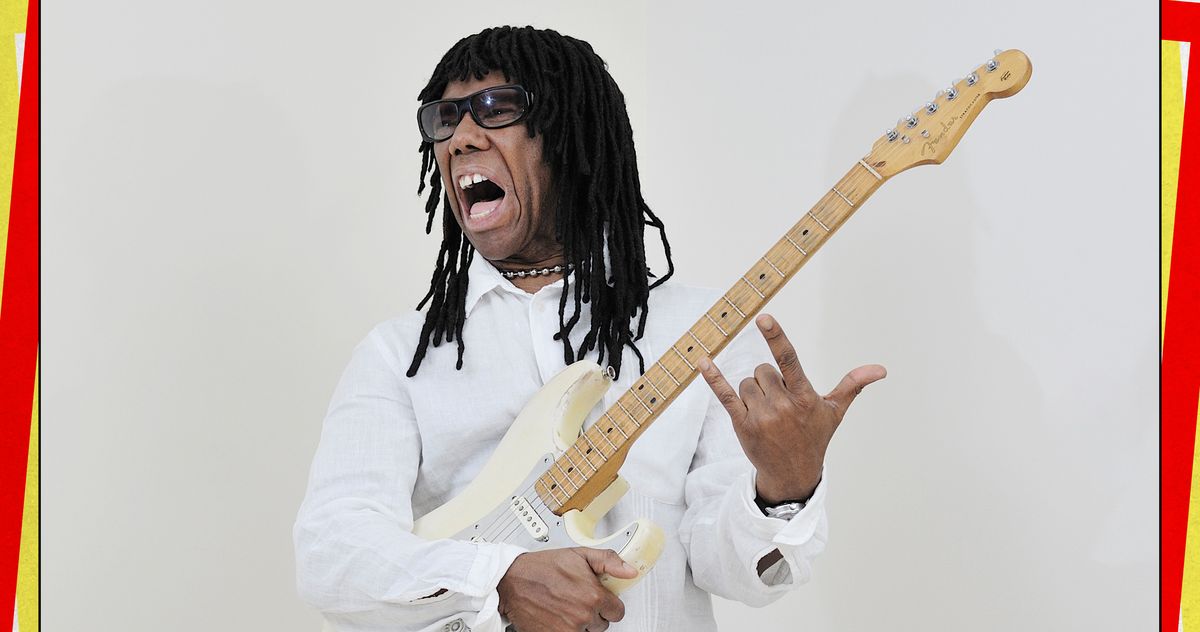
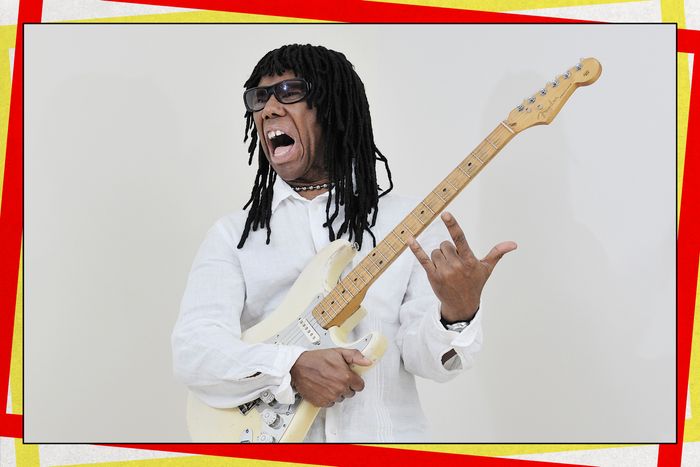
Photo-Illustration: Vulture; Photo: Joby Sessions/Guitarist Magazine/Future via Getty Images
Nile Rodgers is the first to acknowledge that his background looks a little ridiculous. He’s taking our video call right in the heart of his Connecticut studio, where the walls are festooned with way too many gold plaques to attempt to count. But can you blame the guy for wanting to show off some of that glitter? When he possesses that résumé? “I remember the first time I went to Michael Bolton and Quincy Jones’s houses and I was like, ‘Guys, I know you won all that shit. I don’t have to see it all,’” he recalls with a laugh. “But once I started bringing artists here to record, they actually liked it. They would be like, ‘Wow, you did that album? I didn’t know. That’s my favorite.’ And I would say, ‘Well, that means you didn’t turn it over and look at the back.’” To be fair, the musician, producer, and songwriter estimates he’s credited on over 1,000 records — but even he can’t remember all of them. “I found a cassette the other day and I realized that I played one song with Liza Minnelli,” Rodgers says. “The things we rediscover in the basement.”
It’s not an exaggeration to assert that Rodgers, who co-founded Chic with Bernard Edwards in 1972, has been one of the strongest and most exuberant guiding forces the music industry has ever seen. Chic hits aside — we’re talking about “Le Freak,” “Good Times,” and “I Want Your Love” — Rodgers’s skill at ceding the spotlight in favor of producing generational talents led to a roster that includes Madonna, Diana Ross, Sister Sledge, Duran Duran, and David Bowie. (That list further expanded into the new millennium with Daft Punk and Beyoncé.) Later this month, he’ll be performing as Nile Rodgers & Chic at the Montreux Jazz Festival Miami, reminding the audience just how unparalleled he is in front of his own microphone with a guitar — a set that doubles as a greatest ass-shaking hits revue. (You bet he fits “Material Girl” in there.) “I would’ve never believed,” Rodgers says, “that songs I wrote 50 years ago would still mean something to people today.”
“Everybody Dance,” which is the first song I ever wrote as a pop song. Prior to it, I wrote most of my compositions as jazz songs. This was the time of fusion jazz, a lot of which were very danceable — like from my heroes Roy Ayers and Herbie Hancock, who were still getting hit records with jazz-based songs. I began writing this song with a crazy chorus and chord changes, and somehow Bernard Edwards, as he always did, walked in and gave me notes. He would color songs down and make them a little more simple. We were battling each other with our instruments. I was like, “This doesn’t work.” I had to be totally subordinate to the most genius bass player ever. And this moment was the most important thing that ever changed my life, because I thought I was just a writer. I didn’t know I was a producer. Bernand looked at me and said, “Now what do we do?” And I said, “Oh, I was working on this melody. ‘Everybody dance, do do do, clap your hands, clap your hands.’”
We had a record that was about ten minutes long, but it had no verse. It was just a groove with chord changes. The clubs would play it almost on a loop. The big release came when you heard “Everybody dance.” We would watch people dance and go bananas. But we couldn’t get a record deal, because there was no lead vocal.
That issue fueled our next song, “Dance, Dance, Dance (Yowsah, Yowsah, Yowsah),” which was based on the Jane Fonda film They Shoot Horses, Don’t They? The film was about the Great Depression and dance marathons where people would dance until they dropped — even sometimes died. It was very Romanesque. Let’s watch these people suffer. The reason why we thought of that is because during the ’70s, it was the first great recession since the Great Depression. People who had cars would have alternate days to get gas. It was rationing, but of course I didn’t have a car. I could barely afford the subway. Those two first singles I almost think of as the same, because they were back-to-back and made me have faith in the fact that I could have a winning formula by mixing harmonic complexity with simple melodies. People tend to think my work is all about simple little cute melodies. No, dude.
David Bowie is probably the most important. You have put these things in context. We talk about all of those Let’s Dance songs now, but 40 years ago, David was dropped from his record label because the ugly truth is, people don’t like to hear that rock and roll is a business and David wasn’t selling any records in America. We now act like it was all hip and fantastic, but it wasn’t. He wasn’t killing it. He had just put out Scary Monsters, which I thought was a really hip record. I loved records that didn’t necessarily sell but had interesting ideas. Most of the time you spend trying to unwind it and figure out, What’s this person trying to tell me? I grew up in a fear-based childhood — my parents were heroin addicts — so Scary Monsters spoke to me on a lot of levels. I met David by complete accident at a club. I was going into this club with an engineer that I was working with, and Billy Idol just happened to be walking in at the same time. We would go out together almost every night. So we hook up, look inside, and there was David sitting all the way in the back of the club all by himself with a glass of orange juice.
Billy couldn’t believe it. He went, “Bloody hell, that’s David fucking Bowie!” We got the nerve to walk over to his table. My opening line to him was, “You live in the same building with my friends Luther Vandross and Carlos Alomar. It’s like a commune, you guys took over the building.” We started talking and we never spoke at all that night about rock and roll. We only spoke about avant-garde jazz. We were competing for each other’s sense of cool. But at the end of the day, for some reason, I touched his artistic soul. I don’t remember much of the night because I used to get really high every single day. I don’t even remember giving him my phone number. My place was being renovated and he would call every day. The construction people, who were pretty hardcore Italian dudes, finally told me after a week, “Mr. Rodgers, some fucking cocksucker calls up every day saying he’s David Bowie.” I was like, “What do you mean every day? Oh my God, that’s actually him!”
We had the most magical time doing Let’s Dance, because I did that whole album in two days. We spent most of our preproduction in libraries, going around looking at different artistic concepts. I’ve always wanted to do that with another artist, to get to know who they were as a person through their taste in art and exchange albums. I actually tried this once with John Mayer, and it went totally sour. He turned me onto his favorite record, which was Coldplay’s first album, Parachutes. I thought it was cool, but I gave him the Rolling Stones’ Their Satanic Majesties Request, which I think is the most underrated rock-and-roll album of all time. It didn’t work with John. It’s weird, too, because John might be one of the smartest people that’s ever walked this Earth. Those first two days we got along like brothers, but then after we did the album thing, it was like, This isn’t happening.
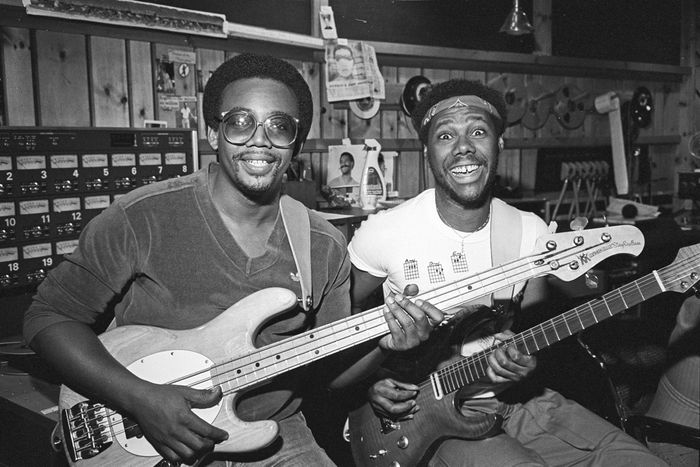
Bernard Edwards (left) and Nile Rodgers (right) striking a pose in the studio during their Chic years.
Photo: Allan Tannenbaum//Getty Images
Nobody. No way, man. If I ever believed that, it would mean I’m walking into the studio and thinking, You can make a record better than me. And nobody can make a record better than me. Please don’t take this in an egotistical way. Who have I made records with? Herbie Hancock, Stevie Wonder, Al Jarreau, the London Symphony Orchestra. I’m not intimidated. I’m here to have fun. I’m here to become part of your band. The one thing that’s super important is to make an artist know that I have their best interests at heart. That’s all I care about. My legacy is pretty much written.
I saw the Jeff Beck Group when I was around 16 years old. Years later, I got a job with Jeff Beck. Of course, what am I going to try and do? I want to get the Jeff Beck Group back together. So I’m telling Jeff, “We need to get Rod Stewart, man.” He kept saying, “No way that will ever happen.” Long story short, we wound up getting a Grammy for Flash, and Rod sang on a cover of “People Getting Ready.” I’ve had a ton of moments like that — working with people who I admired from my teen years. And not only that, but working as the producer from a place of power who’s in charge of delivering the album. It also happens a lot with live performances. Just a few weeks ago, I brought Jimmie Vaughan out onstage with me at a show. I sometimes played with him at this joint called the Bitter End when I was a teenager. We had a huge snowfall and I couldn’t get my amplifier home, so one night we wound up playing with Jimi Hendrix at a club called the Generation, which he wound up buying and turning into Electric Lady. Talk about a full-circle memory.
None. I always say that if I can’t improve upon it, I’m the wrong producer to call. So when you call me, you already know that I can make it a little better. It doesn’t make any difference whether it’s with the New York Philharmonic or the New York Dolls. The only thing I can think of that was close to that, and it’s because I did it for free, was the head of the Grammys, Harvey Mason Jr., called me up and said, “My dad is making a record. Do you mind playing on it?” He sent me the track, I played on it, and I never heard anything back from him. Who knows, maybe they thought my guitar part sucked.
Diana Ross’s label didn’t want to put out “I’m Coming Out.” Then they found out it was a gay anthem. It’s funny, I came up with the song title because I was at a predominantly gay club and I happened to go into the bathroom. On either side of me, there were at least eight to ten deep Diana Ross impersonators. I just went, What! It was like a Fellini movie. Diana was the first star I ever worked with. I couldn’t even brag to these impersonators and go, “Yo, guess what guys? I’m working with Diana Ross!,” because the music was so loud and you couldn’t hear anything inside.
I ran outside and called Bernard, whose life was totally different than mine. He had a wife and kids. I said, “Dude, wake up and listen to this idea.” And he said, “What the fuck you saying, man?” And I went, “I’m in here with all these Diana Ross impersonators. If we do a song called ‘I’m Coming Out,’ we’re going to sell a million records to the gay community alone.” It took a few minutes for Bernard’s cobwebs to clear. He went, “I don’t understand. Diana’s not gay.” And I responded, “It doesn’t make any difference. She’s got a huge gay following. Can you imagine how powerful it would be to the LGBTQ community?”
A lot of my songs have brought in a lot of money from sampling, but the most lucrative ones have been placed in films. The only reason why I know that this one made a fortune was because of the length of the cue: There’s a film called The Birdcage from the mid-’90s, starring Robins Williams, that took place at a queer club in Miami. It opens with a camera going across South Beach and then the shot goes straight into a club where “We Are Family” is being performed by a group of drag performers. It’s a very long music cue. And then “We Are Family” is played several more times later in the film. My bank account was happy to see that deposit.
Another one was from the film Shrek 2. At this point, Shrek was going to marry his girlfriend, so she wanted to take him home to meet the parents. The film originally had the Gap Band’s “Burn Rubber (Why You Wanna Hurt Me)” as the cue when Shrek and his girlfriend take off in the car and their friends are behind and watching their house. Or is it a cart? What do ogres drive? But apparently it wasn’t getting enough laughs when the studio was trying it out on the test audiences. Right before Shrek 2 locked, and I really mean an hour or so before, I got a call asking if they could try “Le Freak.” I said, “Sure, cool.” So Shrek turns around and his friends are partying like crazy to “Le Freak.” It was clear that the song made the joke work. It’s a teeny, tiny cue, and I made a fortune.
Miles Davis and I did a fashion shoot together for Issey Miyake, and that’s how we met. We wound up finding out that we lived right next door to each other, back to back. He lived on 79th and Fifth Avenue and I lived on 80th and Fifth Avenue across from the Metropolitan Museum of Art. We used to look into each other’s back windows. He’d love to go out with me for some reason. He would always say, “All right, tonight call me after nine o’clock. And if a woman answers, ask for Millie.” So I’d call up and if his wife answered, I would say, “Excuse me. Can I speak to Millie please?” And Miles would get on the phone and go, “All right, man, I’ll meet you at the Vanguard.” At some point during our many outings he said, “I need you to write me a motherfucking ‘Good Times.’”
I thought that it was a joke, because everybody knows about the harsh style of Miles’s personality. Weirdly, I never saw it. All these people have such bad stories about him, and I never had one weird night with Miles. Even with Rick James. He was so respectful and fun. Mike Tyson? I adore him. He treats me like I’m an English lord. People will hate to hear this one, but O.J. Simpson and I would sit in a café almost every night. He was the next-door neighbor of one of my best friends. He was in so much pain. He was heartbroken because his wife used to be sort of a little mean to him. He would sit around and go, “Man, I just don’t understand.” He would be crying. I’m like, “Dude, you’re O.J. Simpson.” I treat stuff like the water off a duck’s back. I can’t stay angry for longer than a second or two. Listen, I’m 31 and a half years sober. Which sounds like a really long time, but guess what? I was using for 31 years before then. I started getting high at 11 years old. I took the SATs on acid and got almost every question right. That’s just my weird, lovely hippie life, and I wouldn’t change one second of it.