
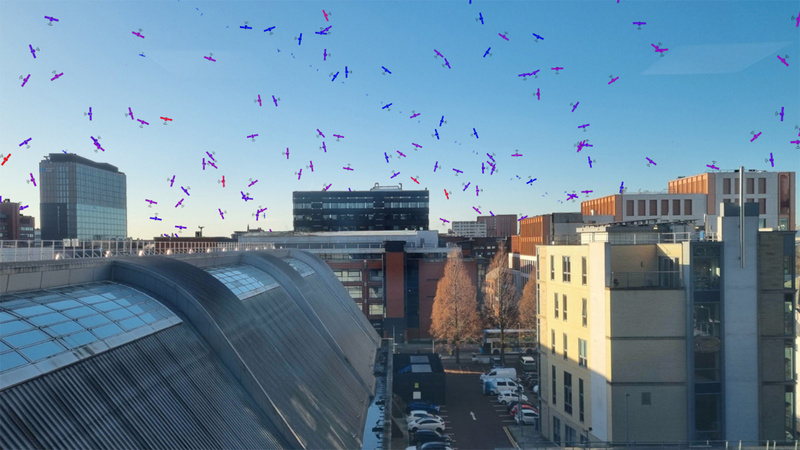
Earth-observation satellites deliver data that is critical in monitoring the progress of climate change, but they are increasingly at risk as the upper atmosphere becomes more congested.
Now, University of Manchester researchers have developed a way to design Earth-observation satellite missions that could help to protect the space environment and minimise the risk of satellites being struck by space debris.
There are currently around 11,800 active satellites in orbit, with some predictions suggesting that this could rise to more than 100,000 by the end of the decade. This would raise the risk of collisions exponentially, further increasing the amount of debris in orbit.
Lead author John Mackintosh, PhD researcher at the University of Manchester, said: “Our research addresses what is described as a ‘space sustainability paradox’, the risk that using satellites to solve environmental and social challenges on Earth could ultimately undermine the long-term sustainability of space itself.
“By integrating collision risk into early mission design, we ensure Earth-observation missions can be planned more responsibly, balancing data quality with the need to protect the orbital environment.”
The modelling framework allows satellite performance requirements and collision risk to be considered together during mission design, rather than being assessed separately or late in development. It links mission requirements, such as image resolution and coverage, with estimates of satellite size, mass, the number of satellites in a constellation and the level of debris present in different regions of low Earth orbit. This allows designers to explore how different mission choices affect data quality and collision risk.
Dr Ciara McGrath, lecturer in aerospace systems at the University of Manchester, said: “Our method offers a practical way to ensure that space remains safe, sustainable and usable for generations to come.”
Using the model, the researchers found that collision risk does not just peak where debris is most concentrated; satellite size also plays a major role. For example, for a satellite designed to deliver 0.5 metre resolution imagery, collision probability was highest between 850 and 950km above Earth – about 50km higher than the highest density of debris.
The study also found that while higher orbits require fewer satellites to achieve coverage, those satellites carry a greater individual collision risk because they are much larger. Lower orbits need more satellites, but each one can be smaller and therefore less hazardous.
“As satellite use continues to grow, our method offers a practical way to ensure that space remains safe, sustainable and usable for generations to come, while still delivering the data needed to address the world’s most pressing challenges,” said McGrath.
A recent report found that failure to effectively address the problem of space debris could cost the space industry up to $42.3bn over the next decade.