
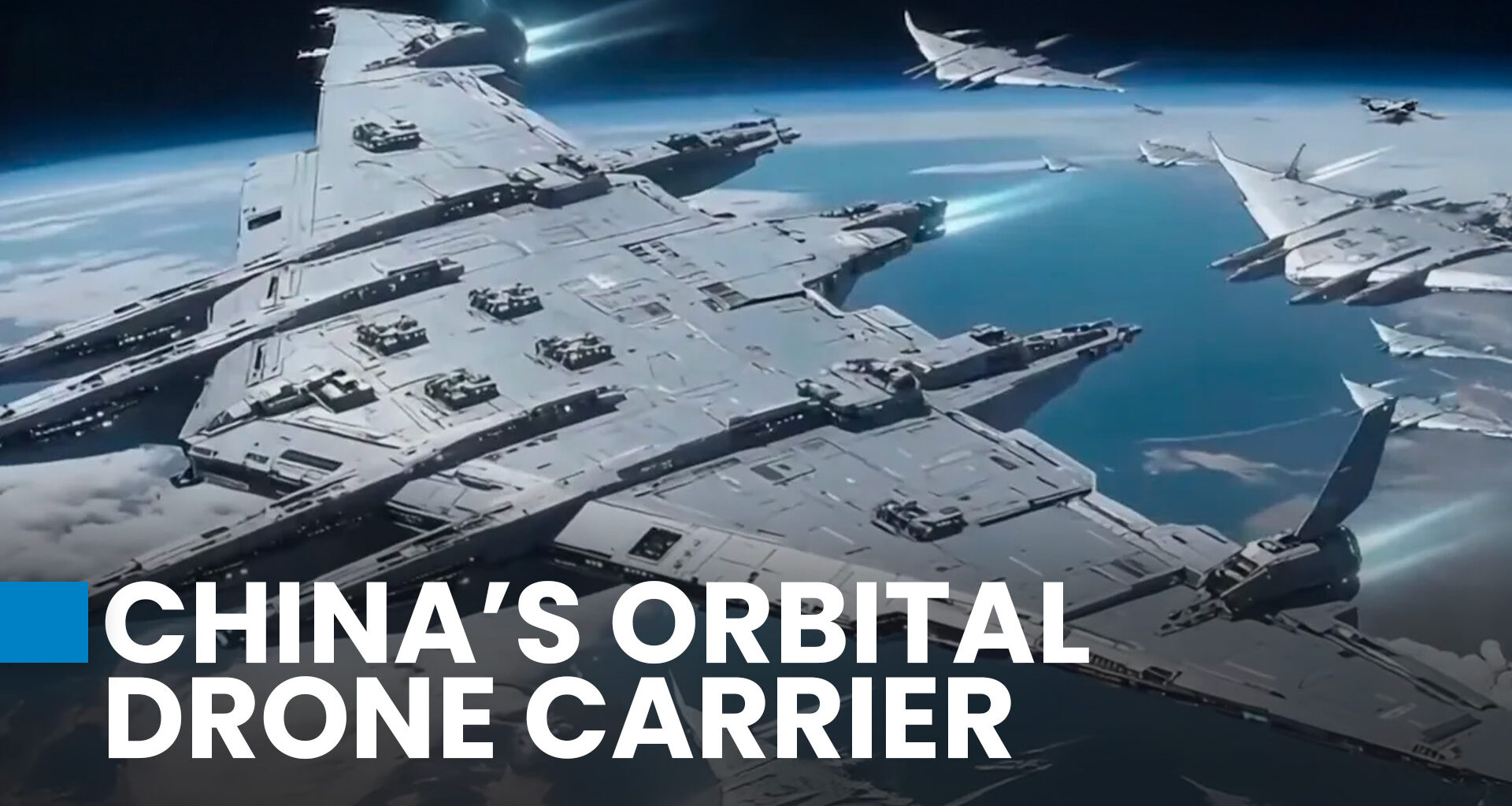
The carrier is described as capable of deploying dozens of autonomous “Xuan Nu” fighter drones intended for operations in upper atmospheric or near-space environments.
China has outlined a conceptual design for a large orbital drone carrier spacecraft known as Luanniao, envisioned as part of its broader long-term aerospace ambitions. The proposed platform is designed to operate near the edge of Earth’s atmosphere and serve as a host for multiple autonomous combat drones.
Visuals released by state media depict a large triangular craft projected to be roughly 800 feet long and more than 2,200 feet wide, with an estimated mass of around 120,000 tonnes.
In concept form, the carrier is described as capable of deploying dozens of autonomous “Xuan Nu” fighter drones intended for operations in upper atmospheric or near-space environments. Reports suggest these drones could support extended-range missions and potentially carry advanced weapon systems, enhancing aerial and near-space operational reach.
The Luanniao concept is linked to China’s proposed Nantianmen Project, which focuses on integrating air, space, and hypersonic technologies into future aerospace systems. Officials have indicated that such a platform, if pursued, would be a long-term objective, with timelines discussed in the range of several decades.
However, analysts emphasize that the propulsion systems, structural materials, and supporting technologies required for a spacecraft of this scale are not currently available. As a result, Luanniao is widely viewed as a conceptual vision rather than an active or near-term deployment program, reflecting strategic aspirations in advanced aerospace development.