
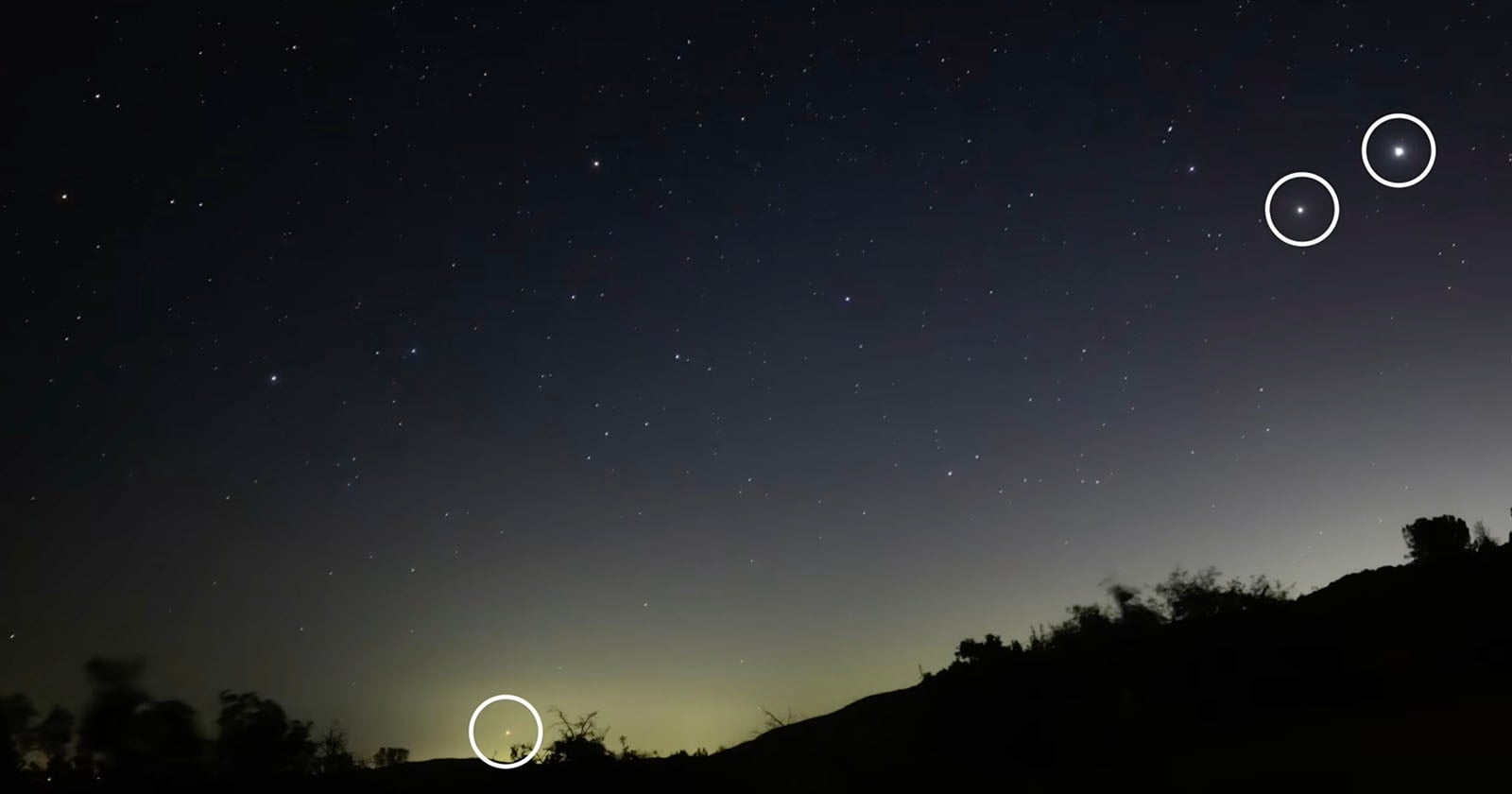
On February 28, there will be six planets visible in the evening sky, a full-blown planetary parade, at least for those with some special equipment and a bit of luck. However, some online discussions about the planetary parade are extremely misleading.
As NASA explains, shortly after sunset on February 28, Mercury, Venus, Neptune, Saturn, Uranus, and Jupiter will all be visible in the night sky. However, there are some caveats to consider. Uranus and Neptune will require some form of optical assistance to view, whether that’s a telescope, binoculars, or a specialized camera setup.
Unfortunately, some online analysts are making very bold, misleading claims about the upcoming planetary parade that could lead to unrealistic expectations, as seen in the post on X (formerly Twitter) below.
🚨: The most important sky events of this decade is occurring on February 28th. 🌌 ✨
Six planets will align and put on a show of our lifetime. Mercury, Venus, Jupiter and Saturn will be visible to the naked eye from almost anywhere.
Uranus and Neptune will be visible to naked… pic.twitter.com/oBhcwUu8aT
— All day Astronomy (@forallcurious) February 16, 2026
That is not what it will look like. As NASA’s video at the top of this story shows, the planets will not be in a line like that, nor will they be anywhere near that bright. This is not what a realistic photo of any planetary alignment looks like.
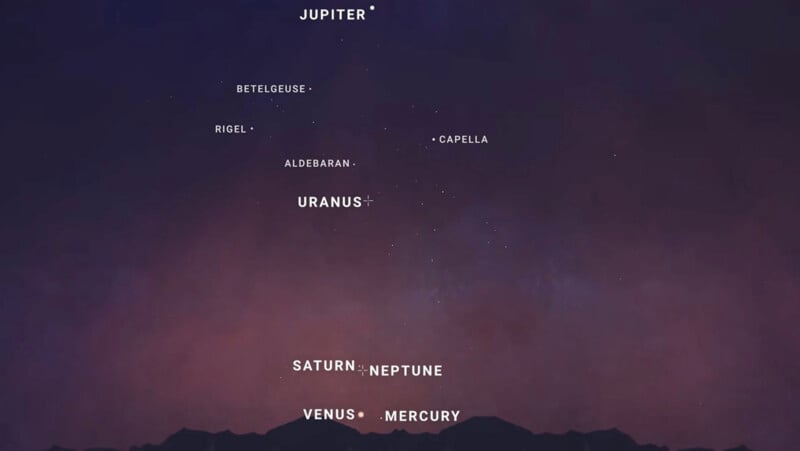 This is an accurate look at the planetary alignment on February 28. However, again, seeing all six planets at once will require luck and tools. | Credit: NASA
Saturn, Neptune, Mercury, and Venus will all be clustered together in the night sky near the horizon, while Jupiter and Uranus will be much higher in the sky, and only Jupiter will be visible unaided. As Space.com explains, seeing more than three planets at once could be challenging. For skywatchers and photographers to give themselves the best chance at seeing a bunch of planets on February 28, they will need a clear view of the western sky, a long lens, and favorable seeing conditions. The darker and clearer the sky, the better. And as always, tracking down evasive cosmic objects is made much easier by apps like PhotoPills.
As astrophotographer Josh Dury showed last year when there were a whopping seven planets visible in the night sky, getting all the visible planets in a single shot requires serious photographic chops and post-processing. The different planets have varying magnitudes (brightness), so they can rarely be captured in a single frame.
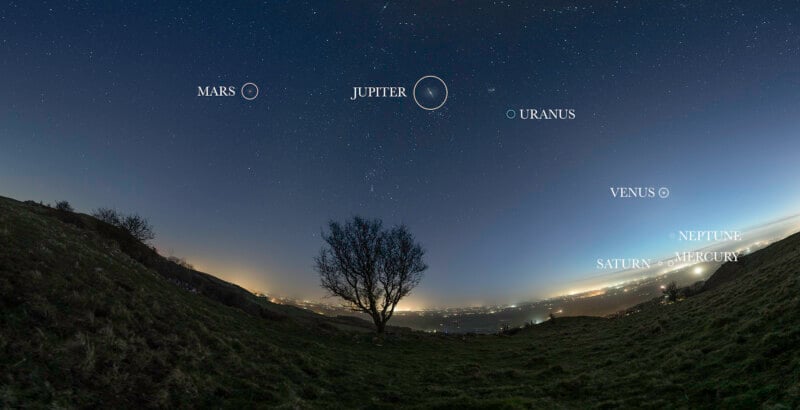 Photographer Josh Dury had to work hard to capture all seven planets. The photographer stitched multiple photos at different exposures together to create this ultra-wide panorama. It is a beautiful shot that any photographer would love to add to their portfolio. | Credit: Josh Dury
Dury’s shot is stunning, and a realistic example of a best-case scenario for photographing a planetary alignment.
Although some of the claims surrounding the February 28 “planetary parade” are misleading, they provide good cause to discuss viewing planets more generally. 2026 is poised to be a dynamite year for seeing and photographing planets. Mars will be visible just before sunrise starting in April, while Venus will be the third-brightest object in the sky by the end of March, dimmer than only the Sun and Moon.
As Jamie Carter at Space says, June 9 is a date for astrophotographers to circle, as that is when Venus and Jupiter will be in a very close conjunction in the evening sky with Mercury playing third wheel nearby.
“We will be treated to another special planetary event this year when the two brightest planets in the sky — Venus and Jupiter — will appear only a pinky finger apart in June. No telescopes will be required for this one!” NASA writes about the June 8-9 Venus-Jupiter conjunction.
Other Major Astronomical Events in 2026
Beyond the Planetary Parade later this month and the Venus and Jupiter conjunction in early June, there are many other exciting astronomical events on tap for this year.
On March 3, a total lunar eclipse will be visible for many people in North America, with those on the West Coast getting the best view.
The annual Perseids meteor shower returns on August 12 and 13, and this year the meteor shower coincides with a New Moon, meaning that viewing conditions could be especially fantastic, weather permitting, of course.
Another annual meteor shower, the Geminids, arrives on December 13 and 14.
Skywatchers will get a special holiday present this year, as there will be a Supermoon on Christmas Eve.