
“In Kyiv, they have four hours of electricity per day and now it’s minus 20 degrees. Even the toilet water is freezing. A lot of people are leaving Ukraine or moving to the west. Most of them don’t have any money so people stay and try to survive. People are really tired.
“Every time I call my parents, sometimes they are crying, sometimes they’re saying they have enough. I’m trying to do something for them and take them away from it but they are 60 years old and they tell me it’s their place, their ground and they don’t want to go anywhere.
“Every day, drones and missiles are flying over their house. Every day, the Russians bomb our cities.”
Rugby is Shashero’s lifeline. From 8 years old, he followed his older brother into the sport. Both brothers debuted for Ukraine aged 18 but to pursue his professional dream, Shashero had to move abroad.
Eight years ago, he left for Poland, where he played for RC Arka Gdynia and also featured for Georgian club Batumi RC.
While he lives and plays in Poland, a serious knee injury opened the door to coaching. After his exposure to playing European nations following a one-week camp, Shashero approached the Ukraine Rugby Union to address its void of age-grade teams.
“I knew if we didn’t have that, we wouldn’t grow Ukraine rugby. We went to the union with my friend Maksym and said ‘we want to create the Under-16 team’. They said ‘yes but we don’t have any funds’ so we have solved everything by ourselves.”
One week later, a foundation in Los Angeles provided funding for the first gathering – and they have now held six camps outside Ukraine.
“This year we plan to make 10 camps. We want to prepare the Under-16 side for five years for a place in the European Championship and we hope we will win this.”
Ukraine has a five-team national rugby competition involving sides from Kyiv, Lviv, Dnipro, Odessa and Kharkiv, with the season running from May to September due to the cold winters.
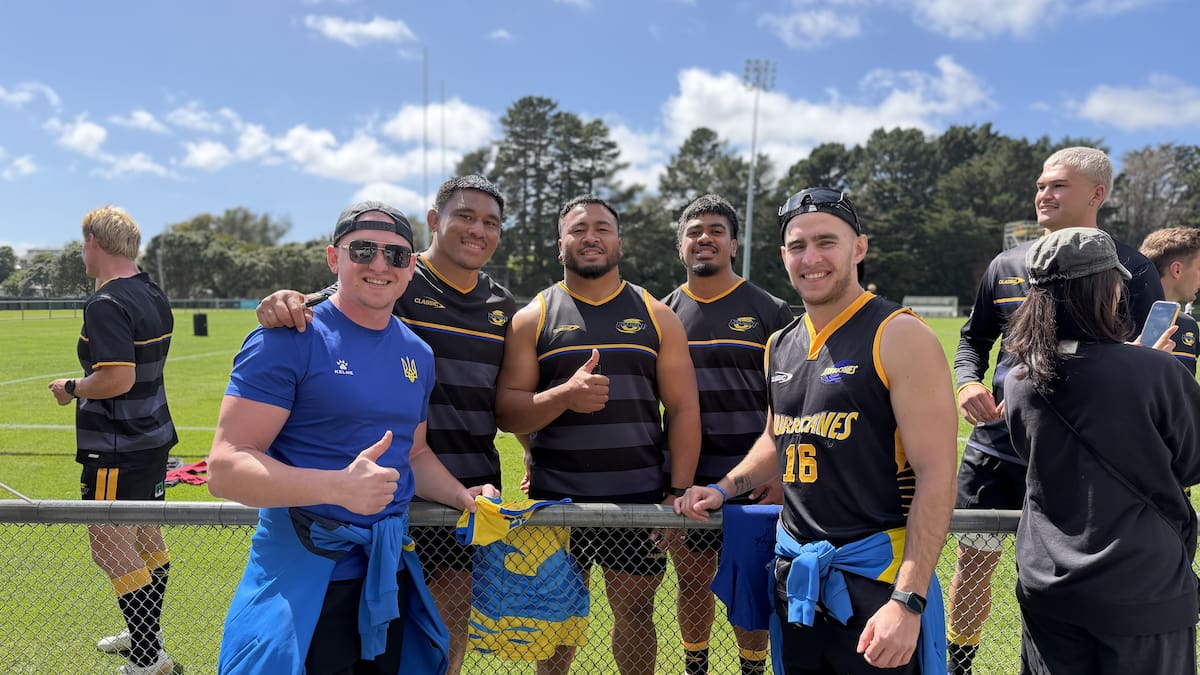
Ukraine coaches Anton Shashero and Maksym Dulia with All Blacks and Hurricanes loose forward Du’Plessis Kirifi.
Maintaining playing numbers is, however, challenging amid the backdrop of the ongoing war.
“When the war first began, rugby started going down because a lot of players went to the army, a lot of players died, a lot of young players left Ukraine, so we started losing our rugby potential,” Shashero said.
“Now it’s started growing again. Last year, the Ukraine Ministry of Sport started a project called Rugby Five in every school, so it’s got a second life now.
“When I was a kid, I had a dream to play in the Olympics. But as soon as I became older, I realised how difficult that would be for me at that stage because of the war, because we don’t have enough older players.
“That’s why we’ve started with players as young as 14, so we can grow them. We have a dream to get them to the Olympics. First, we must win the Europe Championship because there’s only one place. We must beat France or England. After that, we can go to the Olympics. I hope one day we will be there with our guys.”
Venturing to New Zealand emerged after initial discussions with Henry one year ago. Shashero also had an online session with former Black Ferns head coach Alan Bunting.
Former New Zealand Rugby chairman Brent Impey and Iranz managing director Wayne Taylor facilitated the trip. A vision to bring 80 young Ukraine players and 10 coaches to Iranz for intensive training was scaled back due to the war.
“The rebuild of Ukraine will be enormous. What can New Zealand offer? One area is sport and the role it can play,” Impey said. “Rugby is an established sport in Ukraine and there is no reason why it can’t grow hugely. They are fine athletes. And in Iranz, there is the ideal facility to assist.”
During a 10-day stint in New Zealand, Shashero and Dulia travelled to Waiheke Island to spend time with Henry. They then ventured to Wellington to stay at Iranz and watch the Hurricanes train at their base in Upper Hutt, meeting All Blacks Jordie Barrett, Du’Plessis Kirifi, Asafo Aumua and others.
“It was our dream to come to New Zealand and learn from the best,” Shashero said. ”Graham gave us a lot of advice about how we should work with our players. It was amazing to hear about his 30 years of experience from one of the best coaches in the world.
“Our rugby will grow much faster and we will be able to share all our experience that we are learning here with the Under-16 players. It’s been unreal.
“I’m hugely grateful for everything New Zealand people do for Ukraine. They help us, support us, open doors for us. It has a huge impact on our nation and our rugby.
“Our Under-16 guys see where we are, who we’re with, and they’re inspired more and more. They realise people here are helping us grow. In a few years New Zealand will see the huge impact it’s had.”
Liam Napier is a Senior Sports Journalist and Rugby Correspondent for the New Zealand Herald. He is a co-host of the Rugby Direct podcast.