
Scientists from The University of Texas at Austin, Sandia National Laboratories, and two other U.S. national labs have unveiled a 3D printing technique capable of producing objects with highly varied mechanical and optical properties on a fine, pixel-level scale. The method relies on widely available materials and affordable 3D printers, opening possibilities for applications such as realistic anatomical models for medical training and innovative personal protective equipment.
“We can control molecular level order in three-dimensional space, and in doing so, completely change the mechanical and optical properties of a material,” said Zak Page, a UT associate professor of chemistry and author on the paper. “And we can do that all from a really simple, inexpensive feedstock by just changing the light intensity. It’s the simplicity at the heart of it that’s really exciting.”
Funding for this work came from the U.S. Department of Energy, the National Science Foundation, and the Robert A. Welch Foundation.
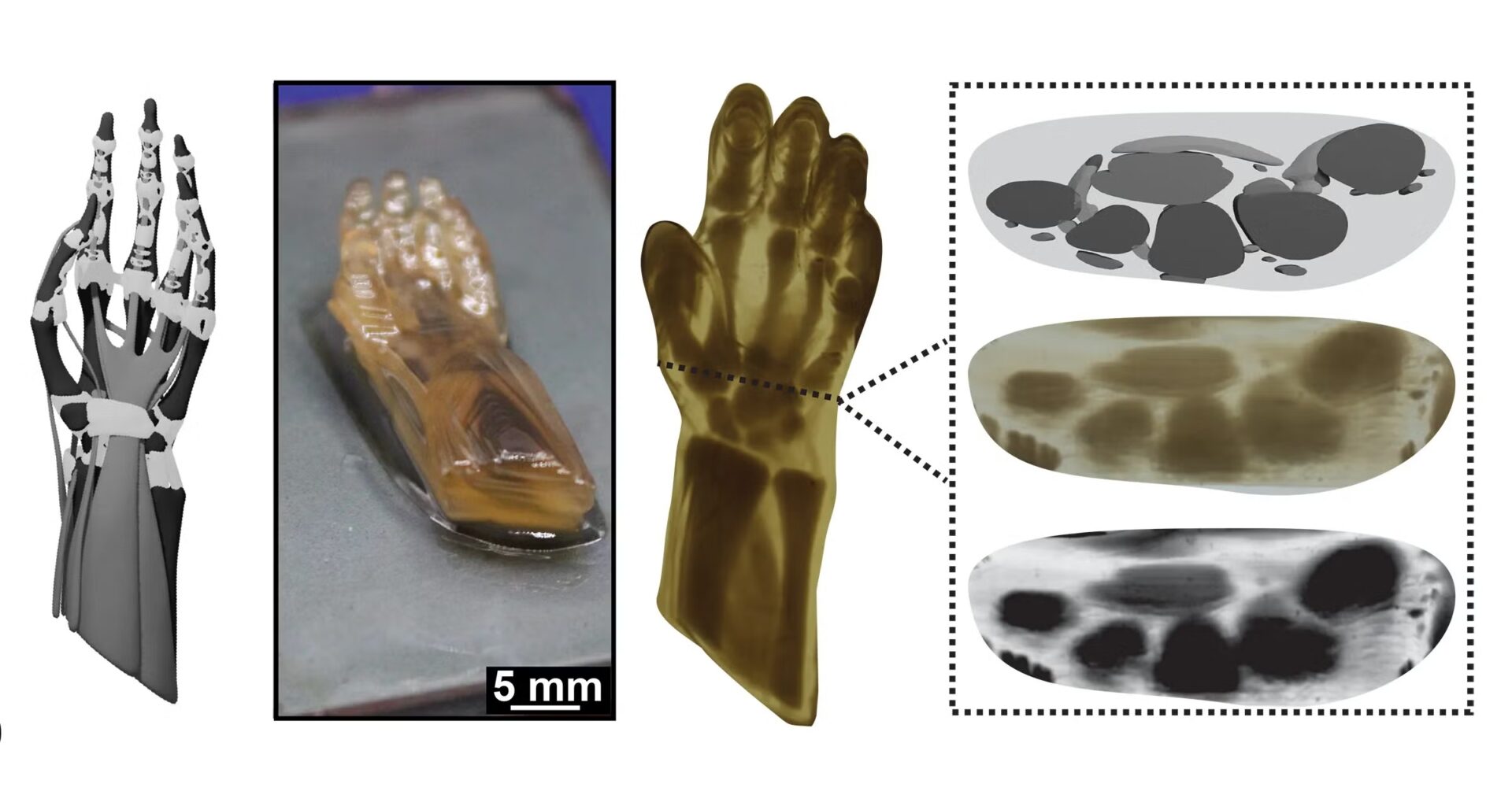
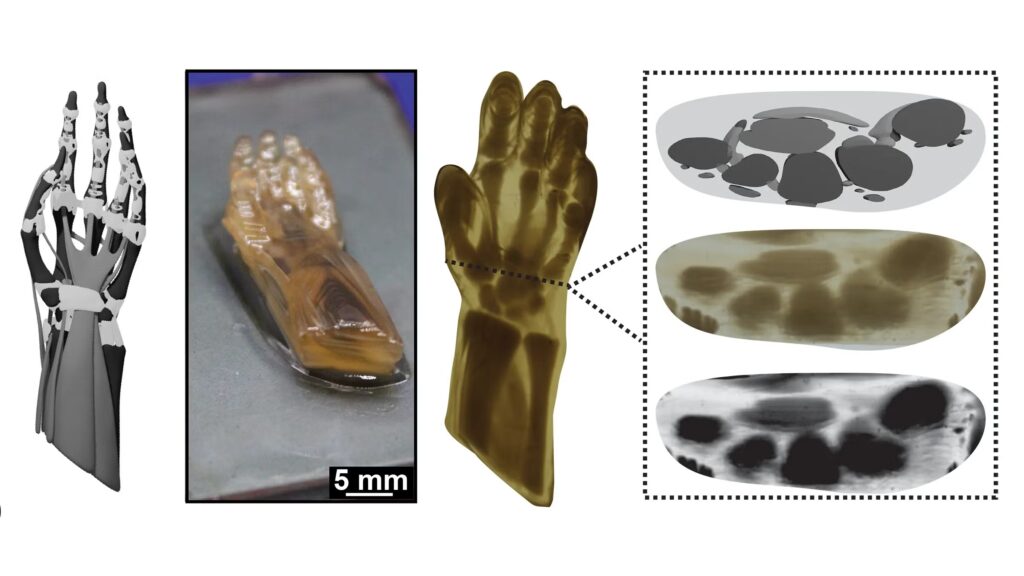 Researchers created a model human hand from a single feedstock with distinct domains that mimic the hardness or flexibility of skin, ligaments, tendons and bones. Image via University of Texas at Austin.
How CRAFT Works
The technique, named Crystallinity Regulation in Additive Fabrication of Thermoplastics (CRAFT), transforms a common liquid resin called cyclooctene into solid objects using a commercial 3D printer. The process projects a series of grayscale images onto a platform immersed in the resin. As the platform moves vertically, these images build up microscopically thin layers of polymer, creating complex structures with different levels of hardness and transparency.
CRAFT could provide medical schools with accurate 3D printed models of the human body, replicating the complex structure of bones, ligaments, and muscles. Unlike previous 3D printing approaches, which require costly inkjet printers and struggle with material adhesion, CRAFT produces integrated models that mimic natural tissue without interface failures.
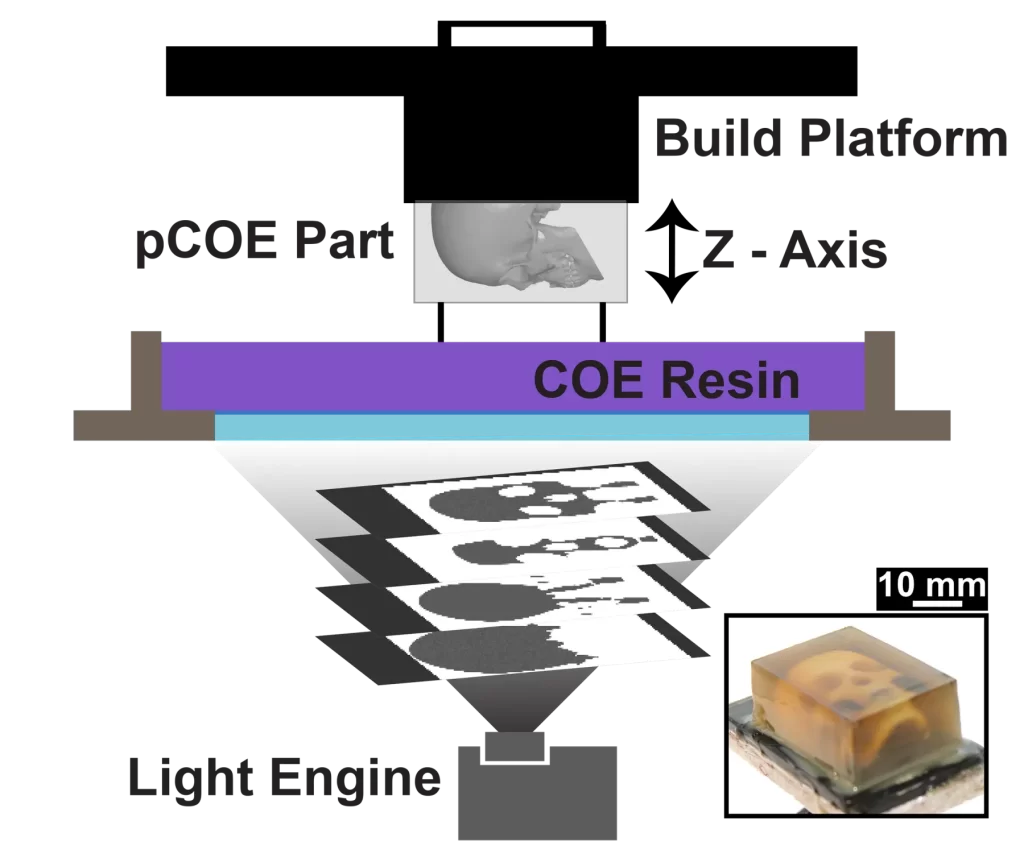 Schematic of the CRAFT method, illustrating the printing of a crystalline skull embedded within a more amorphous matrix. Image via University of Texas at Austin.
Beyond medical uses, the method may enable energy-absorbing materials for helmets, armor, and soundproofing. Page highlighted the potential for bioinspired designs, where alternating hard and soft regions—like tree bark or bone—allow structures to withstand vibrations and impacts.
“DLP or LCD 3D printing, which this method is compatible with, are some of the cheapest printers that you can buy,” Page said. “You can get one of these printers with the capability to do grayscale projection for $1,000 or less and be off to the races printing.”
While CRAFT-produced objects are not fully recyclable, they can potentially be melted or dissolved and recast, offering a way to reduce waste compared with conventional 3D printed items. Page has previously developed other 3D printing strategies for controlling stiffness and strength, though those methods required more complex resins and specialized equipment.
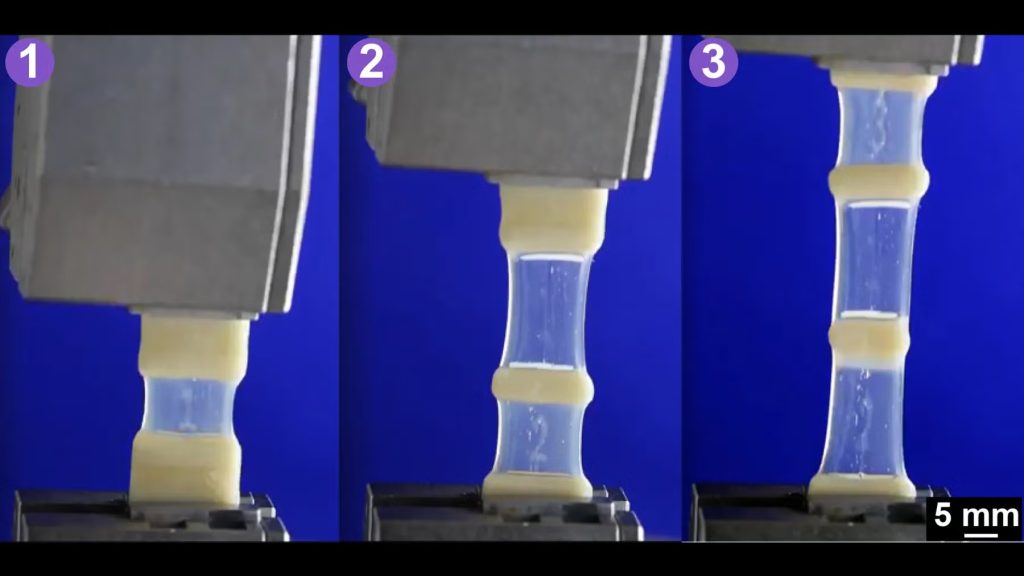 Researchers created a tensile bar with stiff regions and three softer regions. Image via University of Texas at Austin.
CRAFT Matters for 3D Printed Medical Models
Despite ongoing progress in multi-material medical model printing, current approaches still fall short of fully combining finely varied mechanical and optical properties at the voxel or pixel level, a capability central to CRAFT’s innovation. For instance,The Stratasys J750 / Stratasys J850 Digital Anatomy printers can mix multiple materials at the voxel level to create differentiated soft and hard regions for anatomical models, but they do so using pre‑defined material sets and software presets.
Existing 3D anatomical models, such as Anatomy Warehouse and Erler-Zimmer’s 3D prints, illustrate the educational value of detailed replicas, but they cannot yet achieve the fully continuous mechanical and optical variation that CRAFT enables.
Despite its promise, CRAFT faces several challenges. It currently relies on cyclooctene-based resins, limiting material versatility and biocompatibility. Ensuring uniformity across layers remains technically challenging, printed parts are not fully recyclable, and validation is needed to confirm that mechanical and optical properties replicate real tissues, which may affect regulatory or clinical adoption.
The 3D Printing Industry Awards are back. Make your nominations now.
Do you operate a 3D printing start-up? Reach readers, potential investors, and customers with the 3D Printing Industry Start-up of Year competition.
To stay up to date with the latest 3D printing news, don’t forget to subscribe to the 3D Printing Industry newsletter or follow us on Linkedin.
Featured image shows Researchers created a model human hand from a single feedstock with distinct domains that mimic the hardness or flexibility of skin, ligaments, tendons and bones. Image via University of Texas at Austin.