
Retail crime statistics: The numbers aren’t quite adding up.
Did New Zealand’s post-COVID retail crime wave actually happen, asks chief editor Nicholas Dynon, or was it just a statistical error?
Over the past few years, retail crime statistics in New Zealand have demonstrated a dramatic and sustained increase. Headlines, political debate, and frontline experience have reinforced a sense that retail environments have become materially more dangerous.
Almost as soon as New Zealanders emerged from their bubbles in the wake of COVID-19 lockdowns, ram raids and smash and grabs became news staples. Culprits – from a weak on crime justice system to student truancy – were identified, and political leaders rushed to implement fixes to balm an aghast electorate.
In addition to official statistics published by NZ Police and the Ministry of Justice, a range of stakeholders have released their own surveys and metrics supporting the notion that retail crime – and particularly harassment and violence against retail workers – was experiencing unprecedented increase.
View the article in the NZSM eMagazine…
According to Retail NZ, for example, 99% of respondents they surveyed had experienced some form of retail crime or nuisance behaviour in the year to 30 June 2024 – compared to 81% in 2017. Supermarket cooperative Foodstuffs North Island’s metrics claimed serious incidents in their stores had increased 246% from 2020 to November 2022. The 2022 ANZ Retail Crime Study found that violence and abuse experienced by retail staff was at record levels, with supermarkets and department stores bearing the brunt of the increased abuse.
The proliferating corpus of retail crime statistics has become an evidentiary bedrock from which stakeholders – retailers, security technology providers, lobby groups, law enforcement and political parties – have anchored their policy positions, public relations, funding allocations, enforcement priorities, and influencing activities. They have become a scorecard against which government hardness/softness on crime is measured, and the basis for a prevailing post-COVID moral panic.
Ultimately, retail crime statistics provide a key justification for the securitisation of the retail space and the making of security-focused decisions, such as the deployment of intrusive security technologies and the enactment of reactive legislation, that may profoundly change the future of how we experience our world as consumers.
But, what if these statistics have been wrong?
Statistics: General vs retail crime
A little over five years ago, New Zealand’s official crime statistics took an apparent turn for the worse. After several years of stability, the nation’s ‘resting’ crime rate was disrupted by a significant upswing. We had entered a new period of lawlessness.
According to NZ Police Victimisation Time & Place datasets, general crime rates started a rapid climb during late 2019 following several years of relative stability. After a brief artificial trough created by the initial 2020 lockdown, the national rate reached an historical peak in March 2023.
In terms of the crime types publicly reported in Victimisation Time & Place, this meant a jump from late 2019 to March 2023 from a typical profile of no more than 23,000 victimisations per month to a high of just under 35,000 – an increase of around 66%. After March 2023, the rate stabilised and then fell, hitting a low of 27,240 victimisations in June 2025 before edging up slightly since.
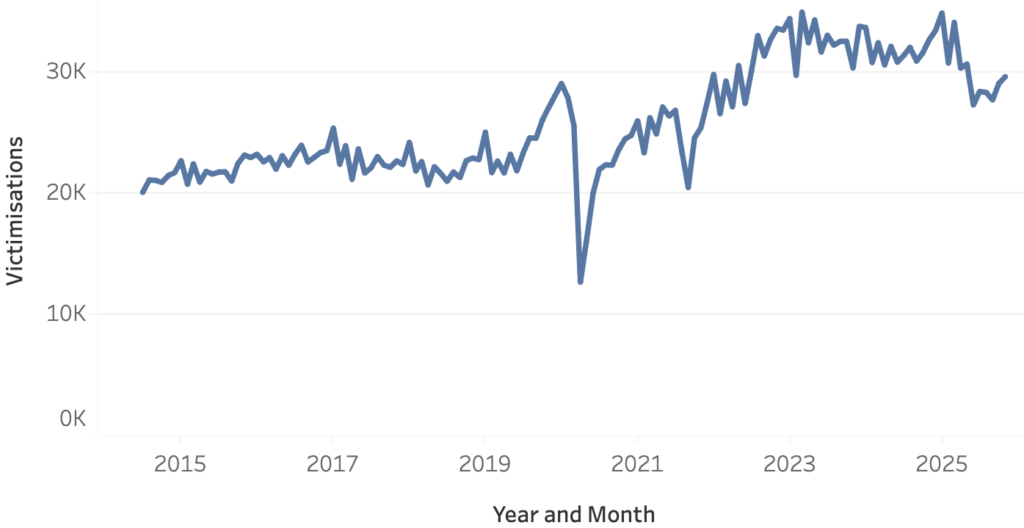
Above figure: NZ Police Victimisation Time & Place data 2014 -2025.
National retail crime rates also jumped over this period – and also after many years of stability. But the retail crime jump was by comparison much, much bigger.
The rate of victimisations occuring in retail locations started its climb in mid-2019, continuing to an historical high of 9,695 in January 2025 – a three-fold increase following many years of 3,000 victimisations per month. From the January 2025 high, retail crime has plummeted over the past year, recording 7,106 victimisations last November… still well over double the pre-COVID rate.
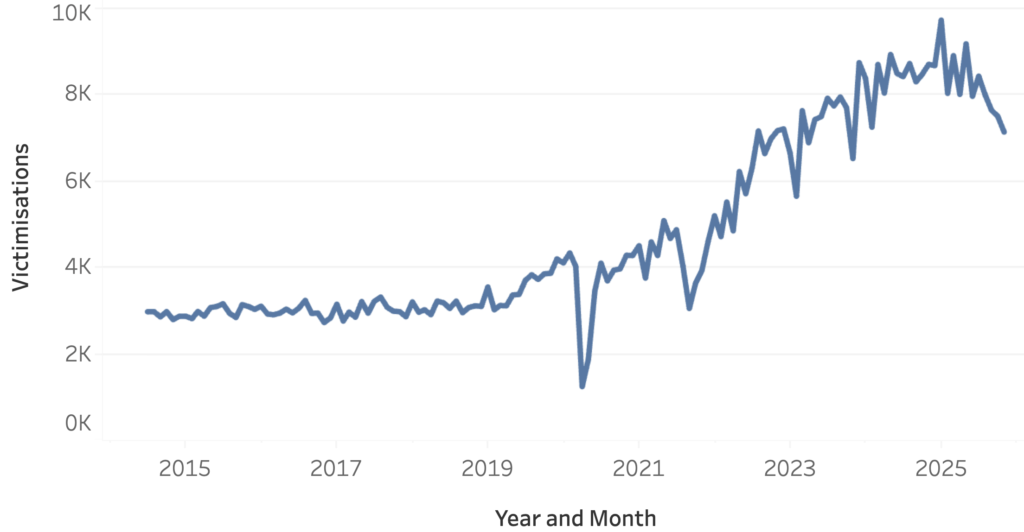
Above figure: NZ Police Victimisation Time & Place data 2014 -2025. Retail location categories only.
Interestingly, when we run the victimisation stats for the same period but with retail location categories removed, we find that from a stable rate of around 20,000 victimisations per month prior to late 2019, the rate climbed to a high of 27,643 in January 2023 – a comparatively modest increase of around 28%.
It’s fallen since, with the last few months of 2025 registering an average of around 20,000. In other words, the number of victimisations occuring in New Zealand in non-retail spaces have – for the past few months at least – returned to pre-COVID rates.
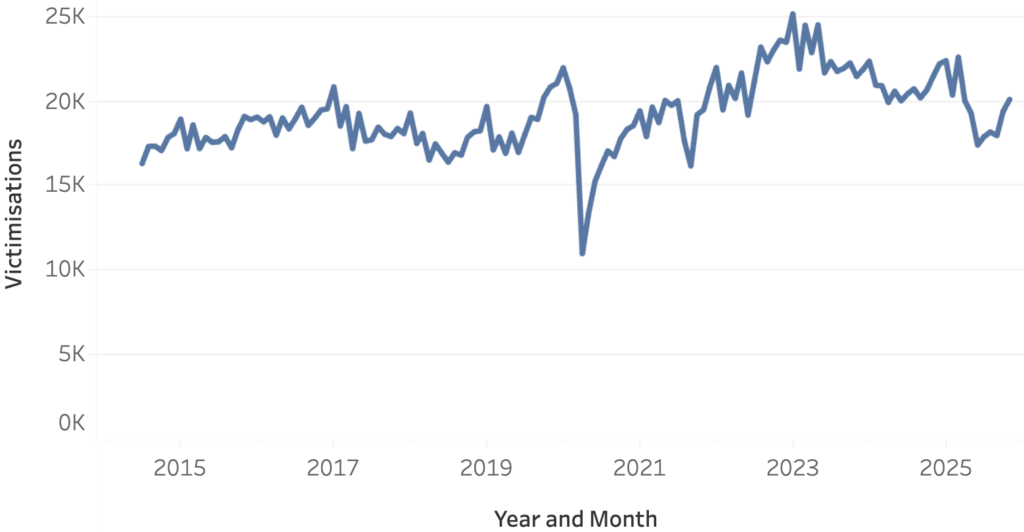
Above figure: NZ Police Victimisation Time & Place data 2014 -2025. Retail location categories removed.
What does all this mean? Why did retail crime rates increase so dramatically over the post-COVID period compared to non-retail crime? How come retail crime has fallen since January 2025? Are we seeing a potential return to New Zealand’s pre-COVID ‘resting’ crime rate? What’s driving the statistics, and what level of confidence can we have in them?
I’m particularly interested in the question of why retail crime rates appear to have increased so dramatically over the period compared to non-retail crime. It seems strange to me that a society would exercise significantly greater levels of criminality in retail spaces than in other settings, such as public spaces or the home, unless there were specific drivers for it. And why – if this is the case – has it happened only since 2019?
To explore this question, I considered three potential explanations:
Underlying economic conditions
Policy and response measures
Changing reporting practices
Underlying economic conditions
Researchers, including eminent American criminologist Richard Rosenfeld and American Enterprise Institute Senior Fellow Brent Orrell, have established that inflation is the most powerful economic predictor of crime. ie, historically, periods of low inflation produce relatively low crime rates while periods of high inflation produce relatively high crime rates.
The authors of a study published in 2007 by the journal Global Crime, which examined the relationship between crime and inflation and unemployment in the United States from 1960 to 2005, came to a similar conclusion.
“Crime rates rise as the inflation rate rises,” they wrote. “Because of the lag between price and wage adjustments, inflation lowers the real income of low-skilled labor, but rewards property criminals due to the rising demand and subsequent high profits in the illegal market.”
In other words as rising inflation erodes consumers’ purchasing power, this causes them to ‘trade down’, or buy cheaper. Those who are already buying the cheapest goods are inevitably faced with the prospect of having to turn – knowingly or unknowingly – to markets in stolen goods, and this increased demand in the shadow economy incentivises criminals to create supply.
In New Zealand’s case, after 30 years of inflation of between one and two percent, the CPI jumped to 3.30% in Q2 2021, hitting a historic high of 7.3% in Q2 2022. It had dropped to 2.2% by Q3 2024, rising slightly to 3.1% by December 2025.
Unlike the CPI, which measures inflation for the country as a whole, the Household Living-costs Price Index (HLPI) is a measure of inflation relevant to household spending. Because it includes interest payments (mortgage, credit cards) it’s a more accurate reflection of actual household outgoings.
The CPI hike of 2021-2022 had prompted the Reserve Bank of New Zealand (RBNZ) to hike the official interest rate (OCR) between 2022 and 2023 to combat inflation. With households paying higher mortgage rates, rents, and insurance premiums, the consequent negative real wage growth eroded household purchasing power.
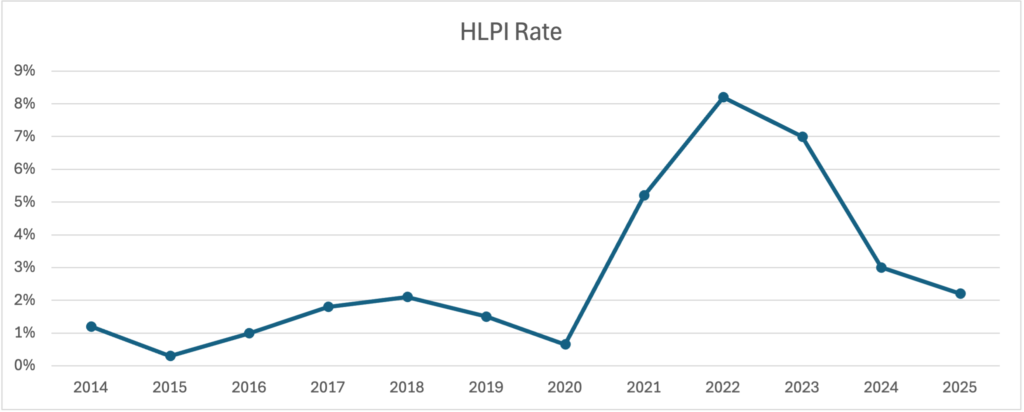
Above figure: New Zealand HLPI rate 2014-2025.
After years of sitting below two percent, New Zealand’s HLPI jumped to 5.1% in 2021, peaking at 8.2% in 2022 – and outstripping the CPI.
Echoing the international research mentioned above, the below table (covering the period March 2020 to December 2023) indicates a potentially strong correlation between a high HLPI in New Zealand and property crime rates.
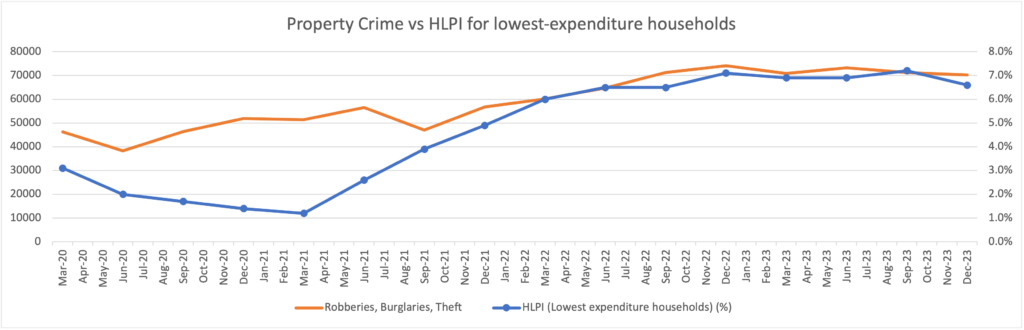
Above figure: Property crime versus HLPI (lowest expenditure household category) March 2020 – December 2023.
Utilising this ‘underlying economic conditions’ approach to explain New Zealand’s post-COVID retail crime trajectory places the blame for the crime surge squarely on the widely documented 2023-24 cost of living crisis. A decreasing HLPI also provides an explanation for the more recent fall in retail crime.
Of course, this approach – validated by peer-reviewed criminological research and reinforced by official victimisation and economic data may not necessarily provide the only explanation for what’s been going on, as Retail NZ Chief Executive Carolyn Young suggests in a mid-2025 media release:
“Although the cost of living crisis is often being blamed for the increase in retail crime, retailers confirm that the majority of offenders shoplift goods that are clearly unrelated to their daily basic needs,” stated Ms Young. “Sometimes they are shoplifting to order, sometimes to support their addictions or to gain notoriety on social media.”
Yet these alternate explanations don’t necessarily negate the validity of inflation as the driver. Ultimately, shoplifting to order, supporting addictions and gaining social media notoriety are all behaviours for which the economic conditions resulting in household unaffordability can be either a driver or contributor.
Policy and response measures
Another potential approach to explaining recent retail crime trends is to consider them through the lens of policy and response measures, specifically the various ways in which retailers, government, law enforcement, and the private security sector have sought to address retail crime.
A problem with this approach is the possibility that these varied parties may tend naturally to focus on the claimed efficacy of their own contribution to addressing crime. In the political sphere this also includes rubbishing an opponent’s track record on crime and justice.
Having come to power at the October 2023 election, the National Party-led coalition government have implemented a ‘law and order reset’ aimed at systemic changes to policing, sentencing, youth justice, and gang disruption, as well as a number of retail crime-focused measures, such as the Retail Crime Prevention Program and the controversy-plagued Ministerial Advisory Group for Victims of Retail Crime.
When the New Zealand Crime and Victims Survey was published late last year, the Justice and Police Ministers were quick to attribute falling serious crime figures to their deployment of more beat police and implementation of tougher laws.
“We announced nine targets in March last year, which included ensuring there are 20,000 fewer victims of serious violent crime by 2029, equating to 165,000 victims,” said Justice Minister Paul Goldsmith. “The latest New Zealand Crime and Victims Survey shows there were 156,000 victims of serious violent crime in the 12 months to May. That’s 29,000 fewer than when we came into government”.
“We know our plan to restore law and order is working and we make no apologies for getting tough on crime,” he continued. “We’ve given police and the courts more tools to go after gangs, we’ve put a stop to public funding of background reports, we’ve toughened up our sentencing laws, and reinstated the Three Strikes legislation.”
Retail crime intelligence company Auror also recently weighed in on the improved retail crime figures. The Auckland-headquartered company, which provides crime reporting software used by the retailers in New Zealand and internationally released its own statistics showing that violent events had trended down for January to October 2025 compared to the same period in 2024.
According to Auror, the use of weapons fell by 12%, nationally while violent events dropped by 6%, and threatening events by 5%.
“The figures demonstrate significant progress by retailers and police in getting on top of this issue, compared to the data from retailers overseas,” stated the announcement.
Auror co-founder and CEO Phil Thomson linked the crime drop to technology use, suggesting that the use of technology by retailers, government and police in New Zealand to tackle retail crime is a “lesson for the rest of the world”.
“There is no substitute for the incredible work police do in our communities, or the work retailers do to keep us all safe when we shop, but through technology and strong collaboration, we can help them be as effective and efficient as possible, and drive these rates down further,” he said.
Another technology that is being given credit for putting a dent in retail crime figures is live facial recognition technology (FRT). According to a June 2025 media release, Foodstuffs North Island (FSNI) claimed that its six-month, 25-store live FRT trial “prevented more than 100 serious harm incidents, including assaults, with a 16% reduction in harm being demonstrated.”
These results were reiterated in Retail NZ’s survey-based COMS Retail Crime Report 2024,which itself was produced in conjunction with COMS Systems, the provider of a facial recognition system specifically designed for the retail sector. FRT, states the report, “is a powerful tool to help keep retail staff safe at work and to reduce crime.”
While such crime and harm reduction claims are impressive, they are open to being assessed as subjective given that (i) they are being made by parties with a vested interest in having their specific contributions to reducing retail crime recognised, and (ii) they tend not to have been substantiated by independent, rigorous, peer-reviewed analysis.

Above image: Prime Minister Luxon speaking at Auror event. Image: Auror.
Changing reporting practices
An alternative approach to the previous two discussed is to consider the role that disparate and changeable reporting practices may have played in contributing to rises and falls in retail crime statistics.
It is widely accepted that much retail crime has tends to go unrecorded, with low-value theft, verbal abuse, intimidation, and repeat nuisance offending often absorbed as a cost of doing business.
Retail NZ’s COMS Retail Crime Report 2024 argues that the actual level of retail crime in New Zealand is “much higher than official statistics show”. Only 61% of retail crimes were reported to Police, stated the retailers’ group, with not often reporting thefts of low value items.
“Although Police data for the period shows a decrease in rates of reported crime,” states the report, “our survey found that this may be partly because Police do not hear about many crimes unless they are serious and/or involve physical violence.”
Alarmingly, Retail NZ’s report claims that only 60% of aggressive behaviour incidents, 54% of criminal damage incidents, and 65% of robberies were reported to police. 96% of incidents involving physical violence / assault were reported.
Retail NZ has actively encouraged retailers to report all incidents to police, regardless of the scale of the offending. Technology has made this easier.
Online tools such as those provided by Auror have lowered the threshold for recording and sharing incidents, and they’ve done this largely by lowering the friction involved in logging and sharing retail incidents.
Armed with these platforms, store staff can log an incident in minutes via web or mobile, they can save time with pre-built templates and standardised data fields, and they can upload still images or video files. Less friction means lower-order incidents like low-value theft, verbal abuse and suspicious behaviour are more likely to be reported than previously.
A sharp increase in recorded incidents is the inevitable result of sector-wide calls to action around increased reporting and the availability of new technologies to facilitate it. Incidents haven’t suddenly proliferated, but the recording of them has.
According to a December 2023 article in The Post, NZ Police stated that the platform was partially the reason for a rise in retail crime statistics.
This begs the question, did New Zealand’s infamous post-COVID retail crime surge actually happen? Did it happen to the extent that the statistics tell us it did? Or was the crime there all along, but just invisible to official reporting.
Technology-enabled changes to reporting practices make longitudinal analysis of New Zealand’s retail crime statistics, such as changes to crime rates over time, inherently risky. Using this incoherent data may well risk poor policy outcomes, misplaced security investments, deployment of inappropriate technologies, and unrealistic expectations.
Sir Arthur Conan Doyle is quoted as having remarked “It is a capital mistake to theorise before one has data.” I’d add that it would also be a mistake to do so with data as problematic as New Zealand’s retail crime statistics.
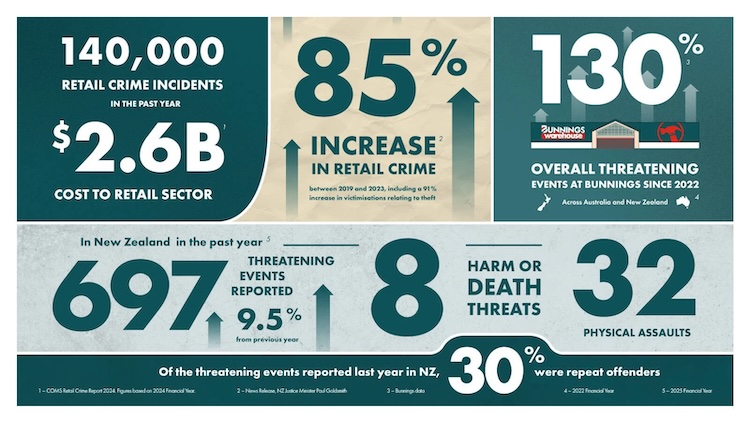
Above: Image featured on Bunnings New Zealand website.
Conclusion
So, to what do we attribute New Zealand’s post-COVID retail crime bubble? Underlying economic conditions, policies and response measures, or changing reporting practices?
There is strong evidence supporting the notion that the underlying post-COVID economic conditions of historically high inflation and low household affordability likely played a part in increasing property-related retail crime between 2021 and 2024 (inclusive).
It is possible that government-led initiatives and new technologies, along with other measures, may have contributed to a reigning in of retail crime, but this has not been objectively verified.
It is evident that retail crime reporting has dramatically increased in response to calls within the retail sector for increased reporting coupled with the widespread adoption of enabling reporting technologies. These changes to how retail crime is reported means that we need to treat recent years’ retail crime statistics with a high degree of scepticism. We should not for example, rely on official metrics to compare current retail crime rates with previous years.
In short, retail crime has not increased since 2019 to the extent to which the statistics tell us. Without appropriate explainers, the statistics are profoundly misleading, and using them to inform responses to retail crime will likely prove profoundly misguided.