
heic2605 — Science Release
The elusive object dubbed CDG-2 may be composed of 99% dark matter
18 February 2026
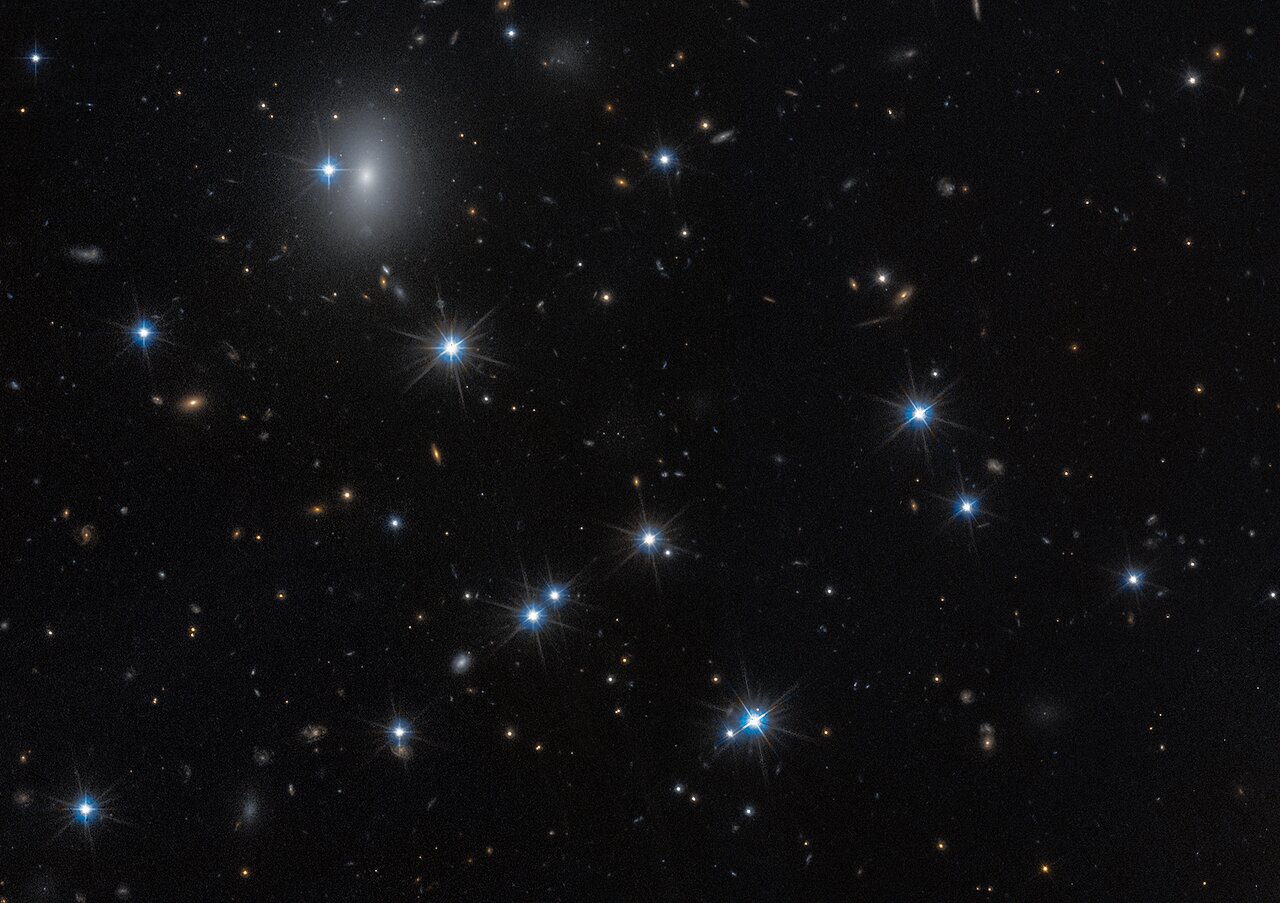
Most galaxies in the nearby Universe are quite luminous, but some are so faint they’re nearly invisible. Astronomers, using the NASA/ESA Hubble Space Telescope in combination with other observatories, identified a galaxy that appears to be almost entirely dominated by dark matter with only a smattering of stars. The galaxy, known as Candidate Dark Galaxy-2 (CDG-2), appears to contain just four globular star clusters (compared to the Milky Way’s 150-plus), and dimly shines with the light of only about 1 million Suns.
In the vast tapestry of the Universe, most galaxies shine brightly across cosmic time and space. Yet a rare class of galaxies remains nearly invisible — low-surface-brightness galaxies dominated by dark matter and containing only a sparse scattering of faint stars.
One such elusive object, dubbed CDG-2, may be among the most heavily dark matter-dominated galaxies ever discovered. Dark matter is an invisible form of matter that does not reflect, emit, or absorb light. The science paper detailing this finding was published in The Astrophysical Journal Letters.
Detecting such faint galaxies is extraordinarily difficult. Using advanced statistical techniques, David Li of the University of Toronto, Canada, and his team identified 10 previously confirmed low-surface-brightness galaxies and two additional dark galaxy candidates by searching for tight groupings of globular clusters — compact, spherical star groups typically found orbiting normal galaxies. These clusters can signal the presence of a faint, hidden stellar population.
To confirm one of the dark galaxy candidates, astronomers employed a trio of observatories: the Hubble Space Telescope, ESA’s Euclid space observatory, and the ground-based Subaru Telescope in Hawaii. Hubble’s high-resolution imaging revealed a close collection of four globular clusters in the Perseus galaxy cluster, 300 million light-years away. Follow-up studies using Hubble, Euclid, and Subaru data then revealed a faint, diffuse glow surrounding the star clusters — strong evidence of an underlying galaxy.
“This is the first galaxy detected solely through its globular cluster population,” said Li. “Under conservative assumptions, the four clusters represent the entire globular cluster population of CDG-2.”
Preliminary analysis suggests CDG-2 has the luminosity of roughly 1 million Sun-like stars, with the globular clusters accounting for 16% of its visible content. Remarkably, 99% of its mass, which includes both visible matter and dark matter, appears to be dark matter. Much of its normal matter to enable star formation (primarily hydrogen gas) was likely stripped away by gravitational interactions with other galaxies inside the Perseus cluster.
“The Euclid data clearly confirm the presence of the extremely faint, diffuse light of CDG-2, revealing the galaxy behind the globular clusters for the first time,” says Francine Marleau from the Institute for Astro- and Particle Physics at the University of Innsbruck in Austria. “The Euclid images of the Perseus cluster demonstrate the mission’s unique capability to detect new low-surface-brightness galaxies, including extremely faint ones, while also revealing their globular clusters, nuclear star clusters, internal structures, and surrounding environments.”
Globular clusters possess immense stellar density and are gravitationally tightly bound. This makes the clusters more resistant to gravitational tidal disruption, and therefore reliable tracers of such ghostly galaxies.
More information
The Hubble Space Telescope is a project of international cooperation between ESA and NASA.
Links
Contacts
Bethany Downer
ESA/Hubble Chief Science Communications Officer
Email: [email protected]