
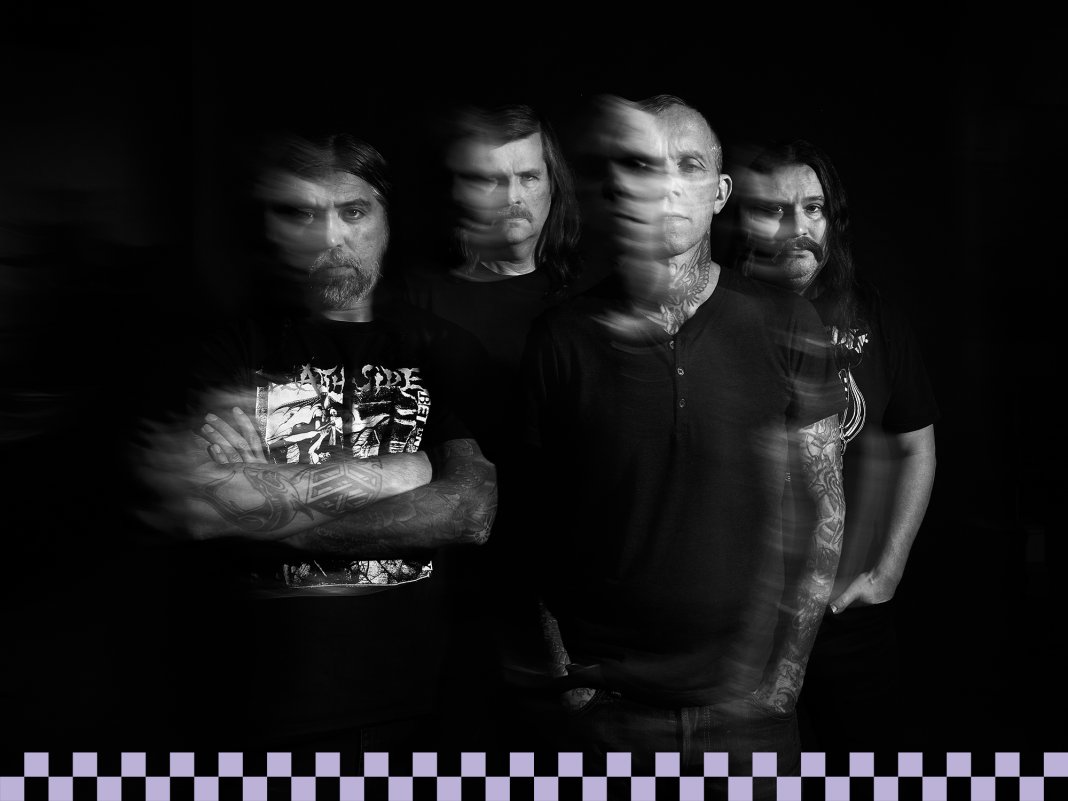
In Converge’s world, things don’t happen by accident – if they say something, they mean it. So, when vocalist Jacob Bannon ushered in the metalcore pioneers’ new record Love is Not Enough by observing that “realism is missing from a lot of modern music”, you knew they planned on doing something about it. “People, especially young people, crave authenticity,” guitarist Kurt Ballou expounds. “The process of recording metal music has been more akin to data entry than playing instruments for quite a long time now – there’s a whole generation who have been raised with this sort of ‘perfect’ music.”
Love is Not Enough is not that. It’s a hulking, febrile thing, alive in all its grit and human imperfections. It is Converge at their most Converge – a band reflecting upon the artistic choices and creative bonds that have underpinned a genre-shaping 35 year run. There are solos on the title track with the head-spinning ferocity of Axe to Fall’s all-timer of an opener Dark Horse, for example, while To Feel Something finds Ballou reinterpreting stabbing, lurching Jane Doe-era carnage from the perspective of someone who’s learned to control the violence at their fingertips. Following on from 2021’s Bloodmoon: I, a collaboration with modern goth icon Chelsea Wolfe, Ben Chisholm, and Cave In’s Stephen Brodsky, it is about uncovering fresh ore in old hills.
“There are songs on Bloodmoon that I barely played guitar on,” Ballou says. “Making Love is Not Enough, that goes back to regular Converge, where we are much more comfortable in our roles. The division of labour is well established in the band and it’s back to being focused on our own stuff. But, also, there’s less space to hide. The guitar ideas are mine, and I’m playing them all. There’s a deliberate lack of collaboration on it. Guitar solos are not my thing, but we’re not having guest musicians here. No one’s playing this solo for me, so I gotta fucking do it. So, you know, I did it.”
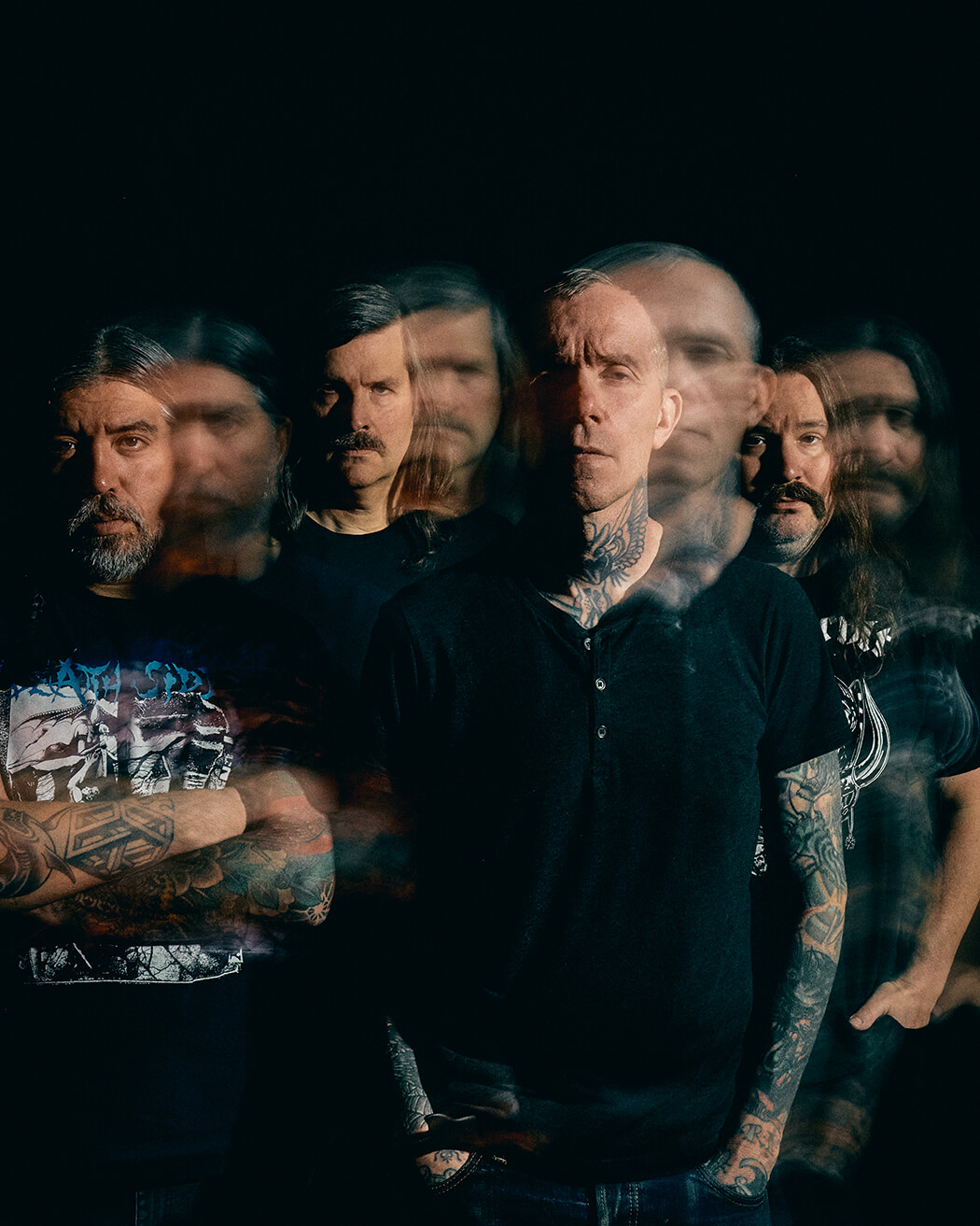 Image: PressCaving In
Recorded at Ballou’s God City facility in Salem, Massachusetts, the album is chiefly a document of a band capable of caving your head in from 10 paces. Bassist Nate Newton and drummer Ben Koller are a rhythm section with an unparalleled track record of unleashing sense-rearranging barrages, while Ballou and Bannon remain a pugilistic pairing pushing each other to scabrous new heights.
If you A-B the studio version of Love is Not Enough’s closer We Were Never The Same against its staging in Converge’s recent Audiotree session, you get a visceral idea of how close they have come to capturing the real thing. “When it comes to recording hardcore and metal my approach is always, ‘What does it feel like to watch this band live?’” Ballou says. “What does that excitement feel like, and can I try to capture that excitement? That’s my goal.”
Ballou is an interesting case study for this stuff, though, because he’s a working producer as well as a gnarly guitar player in a hardcore band. When he’s collaborating on Nails’ latest voyage into the death metal morass or helping Fleshwater assemble molasses-thick shoegaze-pop, his word isn’t law.
In fact, his views on recording music are malleable and driven by the desire to get at what people really want. “In my job, I interact with younger people who are fascinated with analog equipment – they’re taking pictures of their session with point and shoot film cameras,” he continues. “But I don’t want to be a luddite. I don’t want to be too cool for modern techniques.”
“All that technology exists for a reason,” he continues. “Incredible engineering has been done to create amp sims, drum replacements, audio file warping and tuning, and I do use that stuff sometimes when it’s helpful to present the music in the most flattering way. I’m not opposed to it. But I think that one of the things about technology that is important to keep in mind is exercising some restraint.
One of the things about an older style of recording is not so much that tape sounds better than digital, or tube amps sound better than modellers, it’s more that the process of using analog equipment necessitated a certain type of workflow. It didn’t require restraint when you were limited to 24 tracks. That was just what there was, and you had to make it work. Now, you would have to make a choice to limit yourself.”
Tools Of The Trade
That studio-rooted discipline also has interesting parallels with Ballou’s attitude towards his other-other career with God City Instruments (GCI), a boutique outfit producing guitars, basses, pedals and DIY pedal kits – something that grew out of Ballou’s legendary GCI business card, which took the form of an actual PCB (sans components) for his Brutalist Jr circuit.
“My wife does a lot of the order-fulfillment side of that and I QC guitars,” he says. “We’ll get a shipment every three or four months and I’ll spend a few days with them. The company is still pretty small, but it’s manageable. I’m not really trying to grow it – I don’t really want to lose control of it.”
“To double my sales would require more than double of my effort, you know? I think a lot of bands end up in a similar situation,” he adds. “Converge, for example, we have great people that we work with, our fans are awesome, and we can go and play shows just about anywhere in the world. But to play a venue twice the size is more than twice as expensive. We’d be required to have guitar techs and drum techs and lighting techs. The ticket price gets a lot higher and now we’re not doing things on our own terms.”
Perhaps unsurprisingly, GCI gear forms the backbone of Ballou’s work on Love is Not Enough. Fitted with their overwound Slug Jammer humbuckers, there are multiple Craftsman models in play, along with a 27.5” scale Deconstructivist baritone that was used to bring the muscle on Distract and Divide, To Feel Something and Amon Amok, a trio of Drop A monsters.
“I’ve also got a really good short-scale Tele with Lindy Fralin pickups,” he notes. “I used that for a bunch of the clean, atmospheric background sounds on Amon Amok. On Force Meets Presence I might have used my First Act Sheena. I can’t remember if I actually did this, or if I just was thinking about doing it, but a lot of that song is rooted on the A string, so to make that clean I might have taken the low E off of the guitar for that whole section.”
 Image: PressSpreading The Load
While working on Bloodmoon: I, Ballou had to find his place within a guitar sound that he viewed as vibe-based more than “dense or athletic”. Here, the opposite is largely true. But his amp selection process remained the same, with five or six rigs primed for work as he chased a tone. “I used to have a whole bunch of amps running at the same time, hoping to capture the best of all worlds,” he says. “But I’ve come to realise over time that it just flattens whatever cool character each one has.”
With the rhythm sounds oscillating between an early Sparrows Sons model, employed with a Boss OS-2 to accent its articulate, wide-ranging gain, and a GCI Onslaught-assisted Dean Costello HMW, most of the leads were tracked with a first generation Bad Cat Black Cat, paired again with an OS-2 or a GCI Crimson Cock.
“That’s like an NPN Rangemaster,” Ballou says. “It’s really the best for matching a guitar to an amp. If your guitar feels too bright or too dark, or not loud enough, or too loud, by turning a few knobs on that thing, you can make it work.”
What pass for cleans in Converge’s world, meanwhile, were captured on a Traynor YRM-1 that Ballou picked up for $99 in the mid-1990s. “I can, honestly, probably record anything with that amp,” he observes. “I also have a few JMP 2204s, but one of them is from a transitional year when it started getting a little more JCM900-ish. I want to say I have a ‘76 and a ‘79. They’ve obviously been maintained differently over the years, but the newer one is tighter and the older one is creamier. I like them both a lot – that was set up as a pedal platform as I needed different sounds. If a song needs a fuzz part or an HM-2 part, that amp can do it all.”
 Image: PressBright Spark
Zooming out, though, something remarkable about the way Love is Not Enough sounds is the warmth and clarity behind its guitars. As a riffer, Ballou is naturally a grimy, aggressive player, meaning that keeping a sense of nuance alive requires deliberate thought. “I’m always pushing the brightness to try to get more clarity,” he says. “But then sometimes you end up with a very chirpy sound, which is not very metal. The OS-2 quells the chirpiness and also starves the bottom end.”
From both a philosophical and practical perspective, Ballou sees his yard as the mid-range. Returning again to the idea of a division of labour, he is happy to leave the sludge to Newton and the splashy stuff to Koller’s cymbals. He’s not trying to grind you to a pulp, he’s trying to punch you in the solar-plexus. “Listen to the classic Slayer records – they don’t have crushing low end or sizzly high end,” he says. “There are great guitar sounds that have that, but we’ve always thought of Converge more as a hard band than a heavy band.”
Converge’s Love Is Not Enough is out February 13 through Deathwish/Epitaph.