
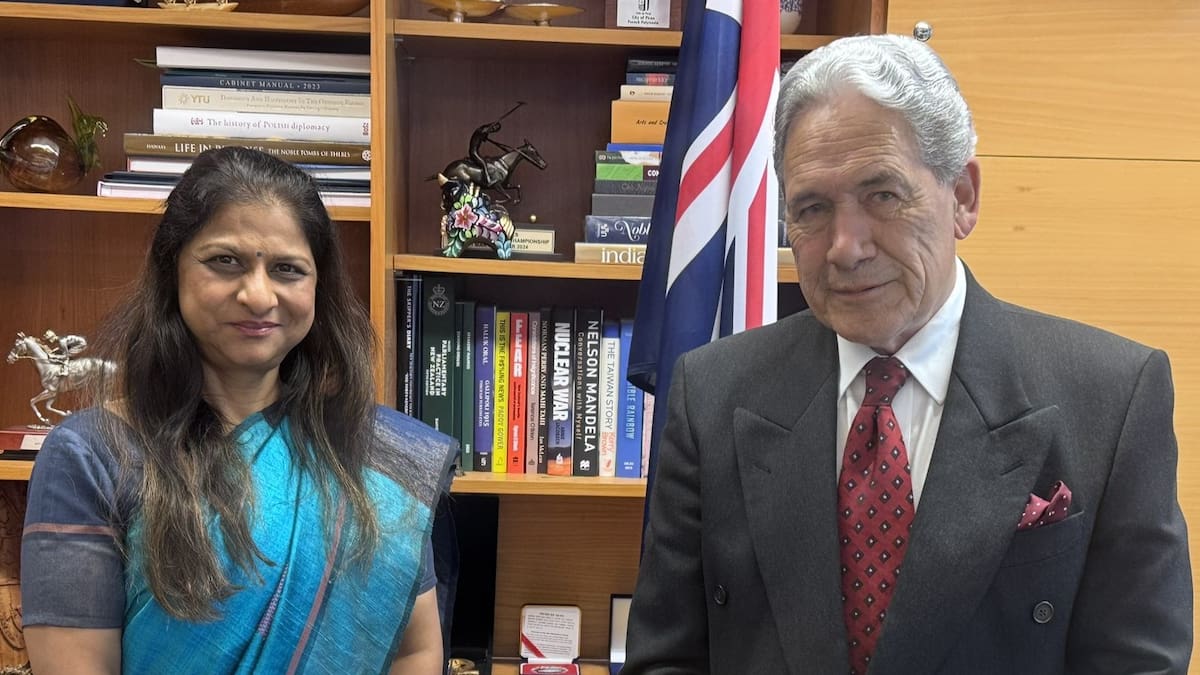
Neeta Bhusan, the Indian representative, was at the Beehive this week. Photo / Jamie Ensor
Bhushan’s comments are significant as there is a debate over whether the investment is a hard commitment with ramifications if targets are not achieved, or simply something to aim towards.
Prime Minister Christopher Luxon and Trade Minister Todd McClay have both described it as an ambition or aspirational target and talked down concerns about consequences for New Zealand if that private investment isn’t achieved.
McClay has said it is a commitment to “promote investment” rather than an explicit promise that the Government would ensure private businesses invest a certain amount of money.
“If we don’t promote investment, then actually India has the ability to come and talk to us about that and raise some concern,” he said. “But there is no commitment and dispute settlement against it over the amount that is being invested.”
In a document that summarises details of the FTA, the Ministry of Foreign Affairs and Trade said there is a “commitment for New Zealand to promote investment into India with the aim of increasing private sector investment by $20b over 15 years”.
However, material from the Indian Government states New Zealand has “committed to facilitating US$20b in investment into India over 15 years” and speaks of a “rebalancing clause” whereby India could “take remedial measures should delivery on investment be below commitment levels”.
Piyush Goyal, the Indian Minister of Commerce, has described this clause as a “clawback measure if investment targets are not met”.
Those comments have been seized upon by Peters in his criticism of the deal.
Labour leader Chris Hipkins is also asking questions about it. In a letter to the Prime Minister, he said the proposed investment is of an “unprecedented scale” and, if not met, could lead “India to unilaterally revoke market access” for some sectors.
Trade Minister Todd McClay has maintained the commitment is to “promote” investment. Photo / Mark Mitchell
The Herald spoke to Bhushan as she was exiting the Beehive this week. She had been making a “farewell call”, including with Peters, ahead of her tenure ending shortly.
She agreed to talk about the FTA, including the Indian Government’s perspective on what was promised regarding the private investment.
Asked whether the US$20b of investment was a hard commitment by New Zealand or an aspirational goal, Bhushan said it is “something to aspire towards”.
“It’s not easy to calculate, to be honest, on a monthly or even a yearly basis, what is the investment going into various parts of India,” the High Commissioner said.
“It is an aspiration definitely, that hopefully the idea is that more New Zealand companies will look at India as a country which is manufacturing in India, best world-class manufacturing, and Make in India is an excellent programme, and [NZ firms will] also use it as a very efficient part of the supply chain.”
The Herald asked about the potential for consequences, including tariffs, if New Zealand private business couldn’t invest the $20b.
As highlighted by Hipkins, there is some concern that India could restore tariffs to trade with New Zealand if the full investment wasn’t achieved, thereby voiding key benefits of the FTA.
Bhushan said: “Any agreement which comes into force has clauses for review. That is, of course, there, but I don’t see any such problem, frankly.
“I don’t see any such issue. It’s an aspiration. It’s a general aspiration.”
To reiterate the query, the Herald again asked if the investment was not a hard commitment for New Zealand to fulfil or face consequences.
“No, no, it is not. On the tariff reductions, yes, those are hard commitments. India does this, New Zealand does that. But those are general and indicative, to be honest.”
Bhushan said it was overall a “mutually beneficial agreement” for India and New Zealand.
In terms of investment, she said several New Zealand companies are “already establishing manufacturing units in India or collaborating to manufacture there”.
“I only see this increasing,” Bhushan said.
Winston Peters has pointed to comments by the Indian Commerce Minister as problematic. Photo / Mark Mitchell
Peters didn’t resile from his position, pointing to the Indians saying “we have to facilitate” the investment.
“That means we have to front up with it. Facilitation means in a legal contract completion of it, helping to complete it. It’s not a ‘good in principle’ … It’s a hard commitment,” he said.
He said if it was an aspiration, “why are they, if it’s not fulfilled over 15 years, able to change the whole contract?”
Peters dismissed Bhushan’s view and returned to what the likes of Goyal had said.
“They agree with what Winston Peters is saying. So why don’t you? If they’ve got all these conditions to pull out if it is not met, then facilitation means meeting it. It’s not in-principle, it’s not aspirational.”
‘Nothing to worry about’
Another hot topic regarding the FTA relates to mobility. Peters has claimed it allows “tens of thousands” of people to come to New Zealand – mostly the families of migrants given a new visa – but this has been disputed by National ministers.
Bhushan said she was aware of commentary about potential immigration but sought to dismiss concerns, telling New Zealanders there is “absolutely nothing to worry about on that”.
She said Indian migrant overstayers were low in number because Indians “are extremely law-abiding”.
“They are contributing to the economic growth of New Zealand and to the community. I think we should see it in that perspective,” said Bhushan.
“Indians are already in sectors like nursing, doctors, and wherever I go, people tell me that so and so has looked after my mother so well and thank you for that. They have a high reputation.”
The High Commissioner wasn’t aware of the specific detail of the proposed visa for migrants under the FTA – it is still being refined by the New Zealand Government – so wouldn’t comment on the ability of Indian immigrants to bring family members in, or absence of it.
“But I can assure you that it is just putting Indian workers on the same footing that New Zealand has agreed in other FTAs.”
‘Excellent rapport’ with Peters
Bhushan said she had enjoyed her engagements with Peters.
“It’s been outstanding, excellent rapport with him. I have had the chance to meet him several times during my tenure and he has always helped us and supported us and supported the relationship between India and New Zealand.”
As for whether Indian Prime Minister Narendra Modi could be visiting New Zealand sometime this year, Bhushan was tight-lipped.
“Well, you have to wait for that. I don’t know yet.”
The Herald revealed earlier this month that plans were being laid for Narendra Modi to visit in the middle of the year.
Jamie Ensor is the NZ Herald’s Chief Political Reporter, based in the Press Gallery at Parliament. He was previously a TV reporter and digital producer in the Newshub press gallery office. He was a finalist in 2025 for Political Journalist of the Year at the Voyager Media Awards.