
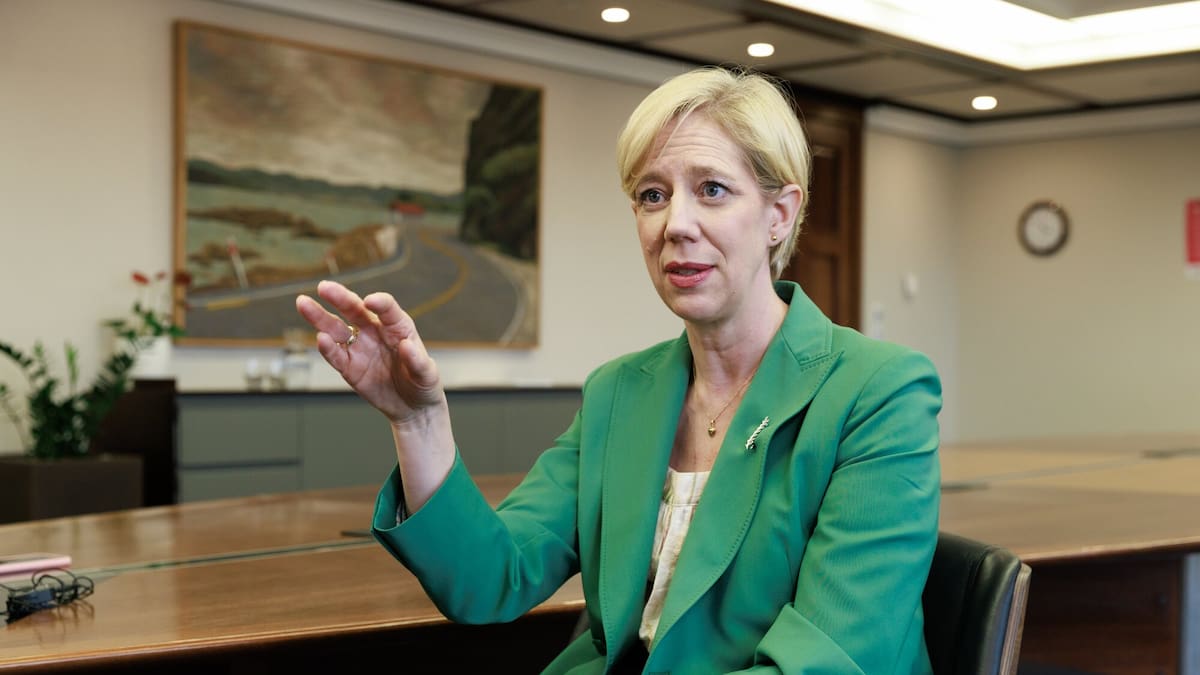
Newly-appointed Reserve Bank Governor Anna Breman, speaking at her first monetary policy news conference, said the bank was seeing the early stages of a recovery.
“But it’s true that many households will not feel this yet – they’re still feeling the high inflation that we had over the past few years,“ Breman said.
“So many businesses are still struggling, but what we are saying is that the data is showing us that we are at the early stages of a recovery, and we want to keep the OCR on hold to support the recovery while ensuring that inflation falls back to target,” she said.
“But we’re not planning on hiking the OCR until we see more inflationary pressures and a stronger economy.”
The Reserve Bank, in its statement, noted that house price growth remained weak, dampening household wealth and inclination to spend.
The central bank’s interest rate track edged up a touch from its last forecast track published in November, now implying a rate hike by the end of year.
ASB senior economist Mark Smith said the Reserve Bank (RBNZ) was biding its time.
“The Reserve Bank … seems to have sufficient comfort on the inflation outlook to be able to reduce monetary policy accommodation in measured and gradual steps,” Smith said.
He said the tone of the policy assessment was “tilted on the dovish side” but contained few red flags suggesting an imminent need for the bank to raise the OCR.
ASB continues to pencil in a 25-basis-point (bps) rate hike in December and a gradual pace of 25bps hikes until the OCR peaks at 3.25% towards the end of 2027.
“Nonetheless, we harbour concerns on the inflation outlook and see the risk of inflation outcomes hovering closer to 3% than 2% in 2026,” Smith said.
Kiwibank economists said the central bank’s messaging was clear: let the economy recover.
”Keep settings accommodative and if all goes well, look to rate hikes at the end of this year, or early next,” Kiwibank said.
“Ultimately though, we still think that the Kiwi economy will need a little more time to be fully mended and as such, retain our view of rate hikes kicking off in 2027.”
Capital Economics said although the bank did signal an openness to hiking rates by year-end, it was not convinced it would go that early.
“Accordingly, we’re sticking to our view that the next rate hike will only come in Q2 2027.”
BNZ economists said there were no major surprises in the release.
“Ultimately, the future trajectory of the OCR will depend on how the economy and outlook for inflation evolve,” senior economist Doug Steel said.
“There was nothing in today’s Monetary Policy Statement that changes our view of the world,” he said.
“We continue to expect the economy to expand, the output gap to close, and outlook for inflation to be sufficient to encourage the RBNZ to start lifting the OCR later in the year.”
BNZ continues to expect the first OCR hike to occur in September.
Jamie Gray is an Auckland-based journalist, covering the financial markets, the primary sector and energy. He joined the Herald in 2011.
Stay ahead with the latest market moves, corporate updates, and economic insights by subscribing to our Business newsletter – your essential weekly round-up of all the business news you need.