
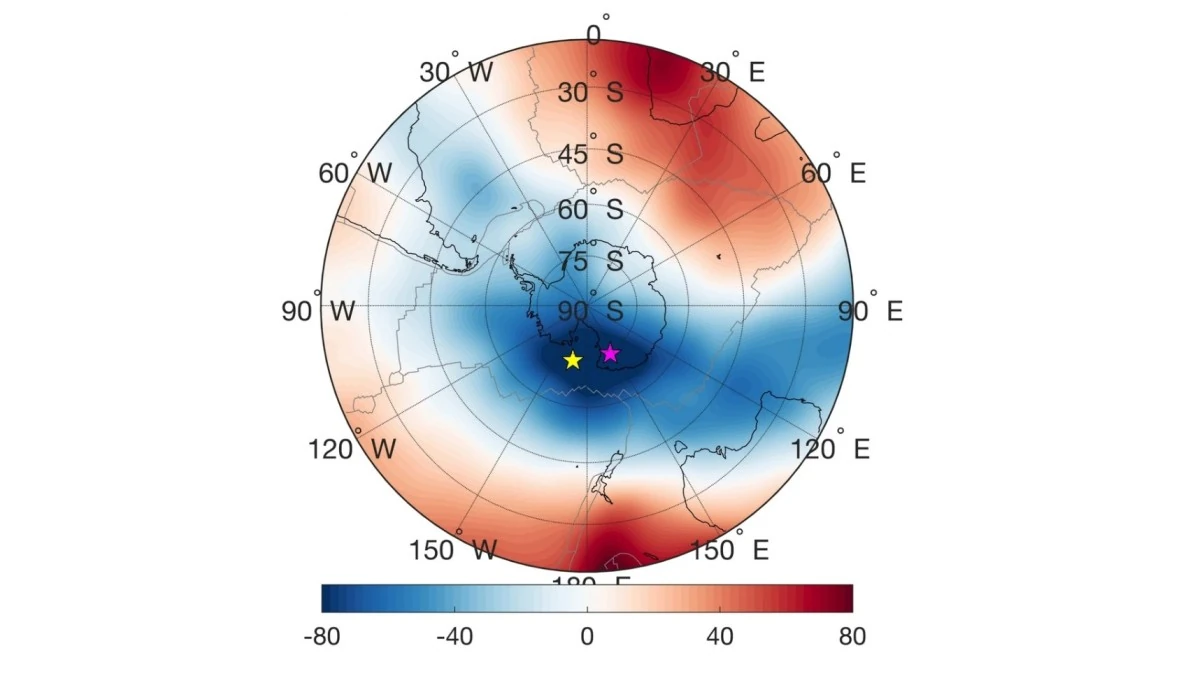
Although most of us think of gravity as a stable and constant value, in reality, its strength varies across our planet. The variations are influenced by Earth’s shape, rotation, and mass distribution, including geological structures.
One region where gravity is notably weaker is the Antarctic gravity hole. This is not a physical cavity in the continent but a region where Earth’s gravitational pull is slightly weaker than average. It corresponds to a deep geoid low, a dip in the planet’s theoretical sea-level surface, caused by variations in mass distribution within the underlying mantle.
Even small differences in gravitational force have measurable effects on the ocean surface. In areas of weaker gravity, the ocean surface sits slightly lower relative to Earth’s centre, as water mass shifts toward regions of stronger gravity. As a result, sea-surface height around Antarctica is lower.
The study, led by Petar Glisovic, Ph.D., of the Paris Institute of Earth Physics and co-authored by Alessandro Forte, Ph.D., professor of geophysics at the University of Florida, showed that the gravity hole formed over tens of millions of years through the extremely slow movement of rocks deep within Earth’s interior.
The researchers also found that historical changes in the anomaly appear to coincide with major climate transitions in Antarctica. According to the scientists, future research may clarify how gravity variations influence the growth of the continent’s ice sheets.
“If we can better understand how Earth’s interior shapes gravity and sea levels, we gain insight into factors that may matter for the growth and stability of large ice sheets,” said Alessandro Forte.
The researchers reconstructed both present and past subtle variations in Earth’s gravitational shape. Present-day maps derived from GRACE satellite data show distinctive global geoid patterns, including a deep gravity low near Antarctica. These maps distinguish between anomalies referenced to Earth’s geometric shape and those caused by deeper mass variations within the planet.
To understand how this feature evolved, the scientists generated time-dependent geoid predictions for key moments in Earth’s history (about 65 million years ago, 40 million, and today).
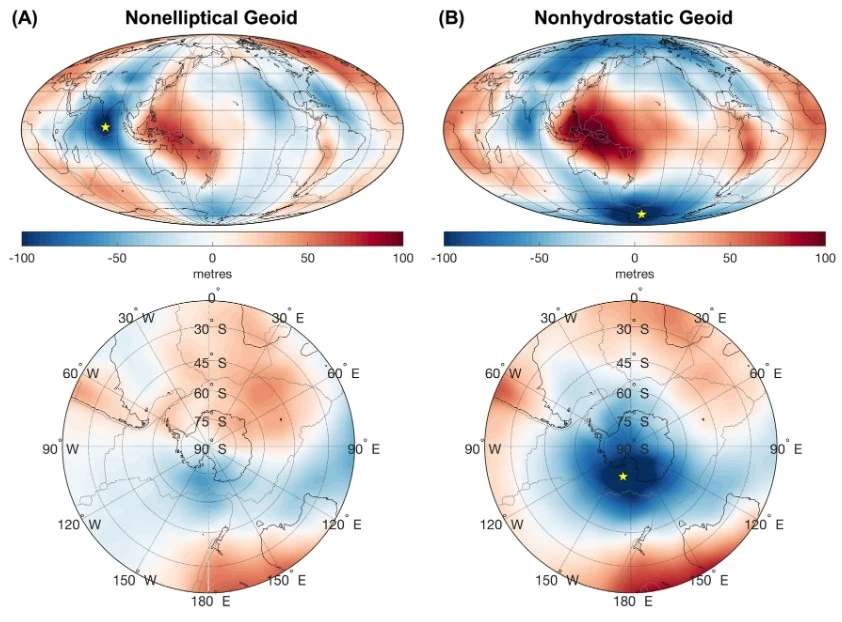 Figure 1. Present-day geoid anomalies from GRACE. (a) Nonelliptical undulations relative to WGS84. (b) Nonhydrostatic undulations relative to Earth’s hydrostatic figure. Top: global patterns; bottom: Antarctica. Star: deepest geoid depression. Lines: plate boundaries and coastlines. Credit: Glišović et al., Scientific Reports (2025)
The study combined global earthquake records with physical models to reconstruct Earth’s three-dimensional interior.
“Imagine performing a CT scan of the entire planet. We do not have X-rays as in a medical setting — instead, we use earthquakes. Earthquake waves provide the ‘light’ that illuminates the planet’s interior,” Forte explained.
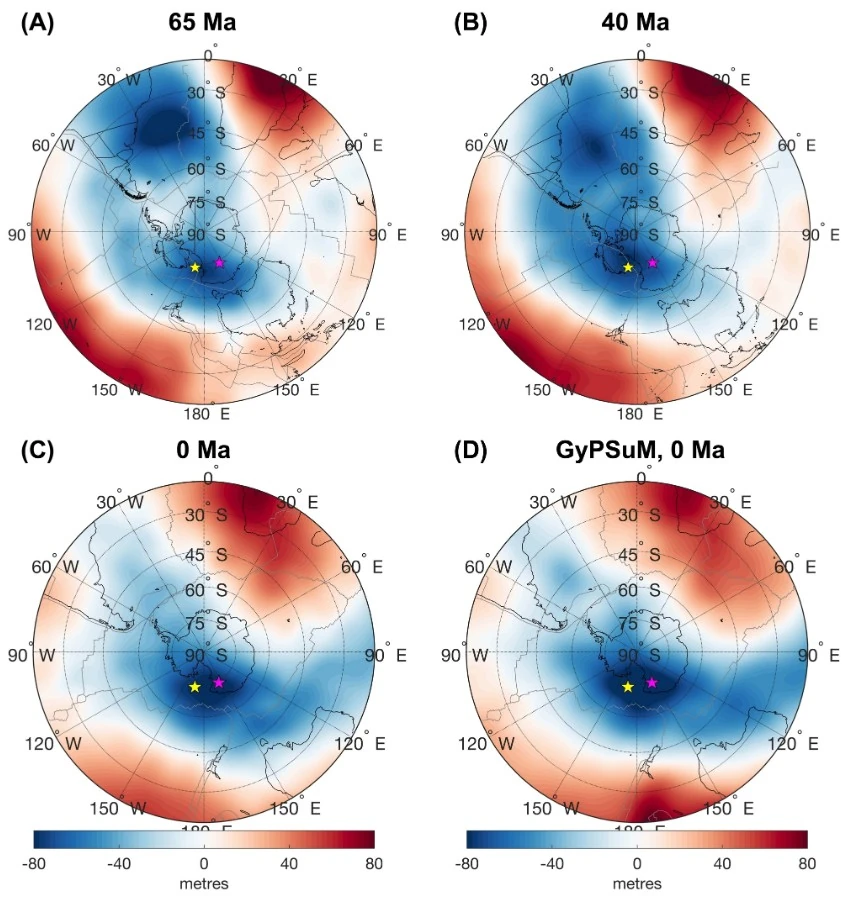 Figure 2. Time-dependent geoid predictions. (A) 65 Ma, (B) 40 Ma, (C) 0 Ma from reconstructed mantle structure; (D) present-day GyPSuM model. Yellow star: present-day lowest nonhydrostatic geoid. Magenta star: maximum crust-corrected depression. Lines: reconstructed plate boundaries and coastlines. Credit: Glišović et al., Scientific Reports (2025)
The scientists successfully reconstructed a global gravitational map consistent with satellite gravity data, lending support to their model. Their computer simulations also reproduced patterns of deep interior rock flow and traced their evolution back as far as 70 million years.
The results suggest that the gravity hole was initially weaker and began strengthening between 30 and 50 million years ago — a period that coincides with significant climate changes in Antarctica.
As a part of further research, the scientists aim to uncover the link between the Earth’s climate and the interior workings of our planet. They will use new models to examine the connection between the gravity, sea level, and changes in continental elevation.
References:
1 Cenozoic evolution of Earth’s strongest geoid low illuminates mantle dynamics beneath Antarctica – Petar Glišović et al. – Scientific Reports – December 19, 2025 – DOI: 10.1038/s41598-025-28606-1