
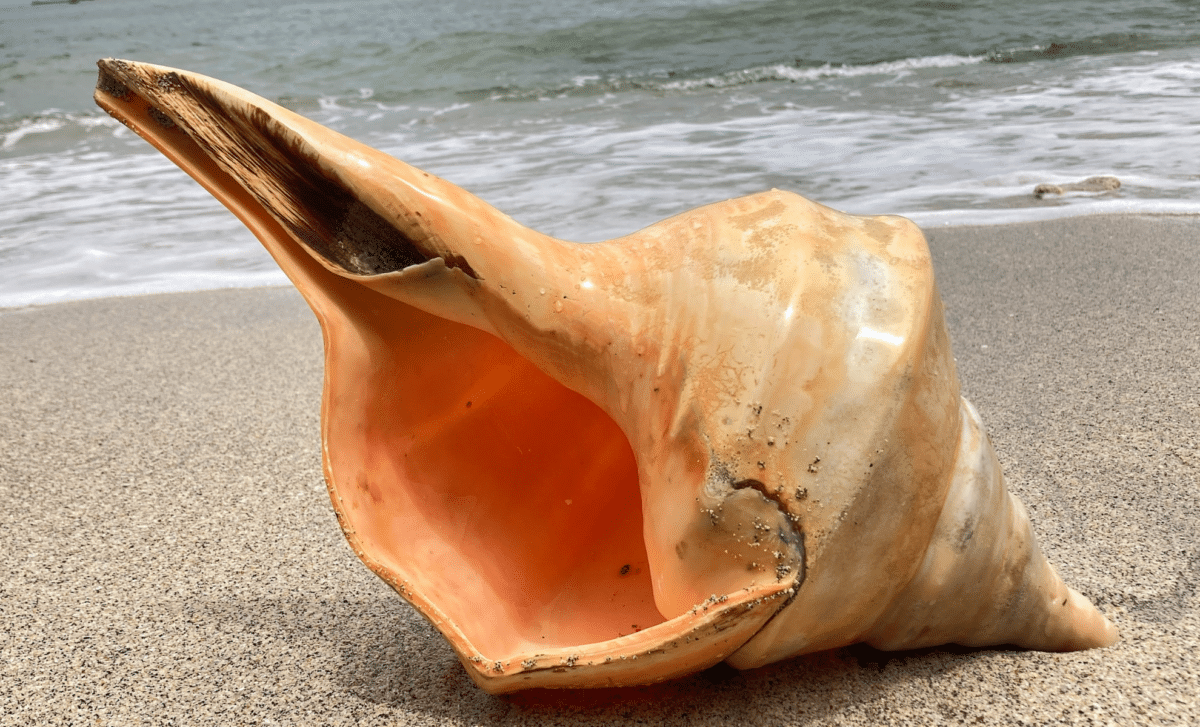
The Australian trumpet snail (Syrinx aruanus), a giant gastropod found in the waters of Western and Northern Australia, holds the title of the world’s largest living shelled snail. With a shell length that can reach nearly a meter, this massive mollusk is a formidable marine predator.
The Impressive Size and Anatomy of the Australian Trumpet Snail
The Australian trumpet snail is not just large in size but also in its distinctive physical features. With shells that can extend up to 91 centimeters (approximately 3 feet) in length, the snail’s size is unparalleled in the world of gastropods. These massive snails are not passive creatures, but active hunters, using their enormous, vibrant yellow foot to crawl across the seafloor in search of prey. The shell itself can weigh as much as 18 kilograms (40 pounds), a burden that would feel like lifting a heavy tire, yet it doesn’t slow down the snail in its quest for food.
The snail’s large, spiraled shell is both a protective structure and a tool for hunting. Although many snails use their shells for defense, the Australian trumpet also employs it as a tool in its hunting technique. The shell, though heavy, provides stability and a large surface area for muscle attachment, allowing the snail to exert considerable force while hunting. This makes it a fearsome predator capable of capturing large prey, such as polychaete worms, that are often hidden deep in the sand.
Feeding Habits: The Art of Hunting Large Worms
One of the most fascinating aspects of the Australian trumpet is its feeding habits. Unlike other snails that may graze on algae or detritus, the Australian trumpet is a voracious predator that hunts down large polychaete worms. These worms, which can grow up to several feet long, make for an ideal meal for the giant snail. However, hunting these elusive creatures is no easy task. According to the study published in ResearchGate by Taylor et al., the snails are equipped with a long, extensible proboscis that they use to reach deep into the sediment to extract their prey.
“By easing the animals gently away from the sediment, it was seen that some individuals had proboscides inserted into large polychaete tubes, other individuals were located above large empty polychaete tubes and in other cases the Syrinx were resting in depressions in the sediment,” wrote the study authors.
This observation provides a glimpse into the snail’s highly specialized hunting techniques, which are integral to its survival. The proboscis is not only long but also highly flexible, allowing the snail to access worms that retreat deep within their protective tubes.
The proboscis can extend for impressive lengths, sometimes reaching depths of up to 250 millimeters (10 inches), as noted by Taylor and colleagues.
“The possession of a long extensible proboscis is essential to exploit these large worms which can retreat a long way back into the tubes,” the study further explains.
This ability to extend its feeding apparatus into the depths of worm tubes is a significant adaptation that allows the Australian trumpet to capture prey that would be inaccessible to other predators.
The Role of Proboscis in Feeding
The proboscis of the Australian trumpet snail is perhaps its most vital anatomical feature when it comes to feeding. This specialized appendage enables the snail to hunt efficiently by reaching into tight spaces where its prey hides. Unlike many other marine snails, which rely on a simpler feeding method, the Australian trumpet has developed a highly evolved mechanism that allows it to thrive in competitive environments where food is scarce.
The long, flexible proboscis works in conjunction with the snail’s muscular foot to ease the animal’s body into the mud, where it can extend the proboscis into polychaete tubes. These tubes, often buried deep in the sediment, are where the worms retreat to avoid predators. The proboscis’ ability to penetrate these tubes and extract the worms is a testament to the evolutionary ingenuity of the Australian trumpet snail.
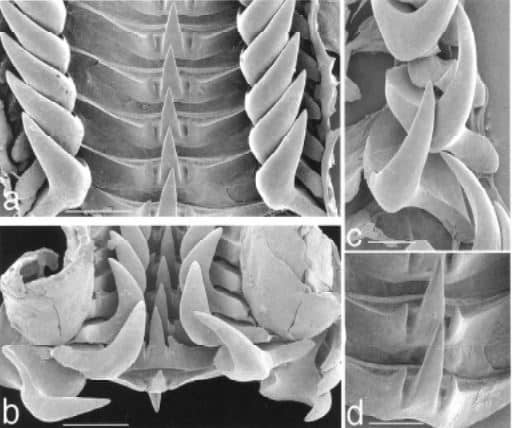 a–d. Radular teeth of Syrinx aruanus, Withnell Bay, Dampier, shell height 127 mm. a, central and lateral
teeth; b, central and lateral teeth at bending plane; c, detail of lateral teeth; d, detail of cusps on central
teeth. Scale bars: Figures a & b = 200mm, Figures c & d = 100mm
Ecological Importance and Role in Marine Ecosystems
As one of the largest gastropods in the world, the Australian trumpet plays an important role in its ecosystem. Its predation on large polychaete worms helps regulate the population of these worms, maintaining a balanced food web. The presence of such a large predator also influences the behavior of smaller species in the area, ensuring that the ecosystem remains diverse and dynamic.
While the Australian trumpet is a predator, it is also prey for larger animals. Its massive size and shell provide a level of protection, but it is not invulnerable. Predators such as large fish and sea birds are known to target the snail, though its impressive size and thick shell make it a difficult target. As a result, the Australian trumpet snail has evolved to be both a skilled predator and a hard-to-catch prey.
The Mystery Behind the Name: Why “Trumpet”?
The name “Australian trumpet” comes from the snail’s iconic shell, which resembles the shape of a trumpet. Historically, the empty shells of these snails were used by humans as musical instruments. While we do not recommend blowing into a living Australian trumpet, its shell has a unique resonance that has captured the imagination of collectors and musicians alike.
The use of the snail’s shell as a trumpet is just one example of how humans have creatively interacted with nature. From being a source of food for some cultures to becoming an item of fascination for others, the Australian trumpet snail’s shell has served many purposes throughout history. Its large size and striking appearance have made it a symbol of both the beauty and the danger of the ocean.