
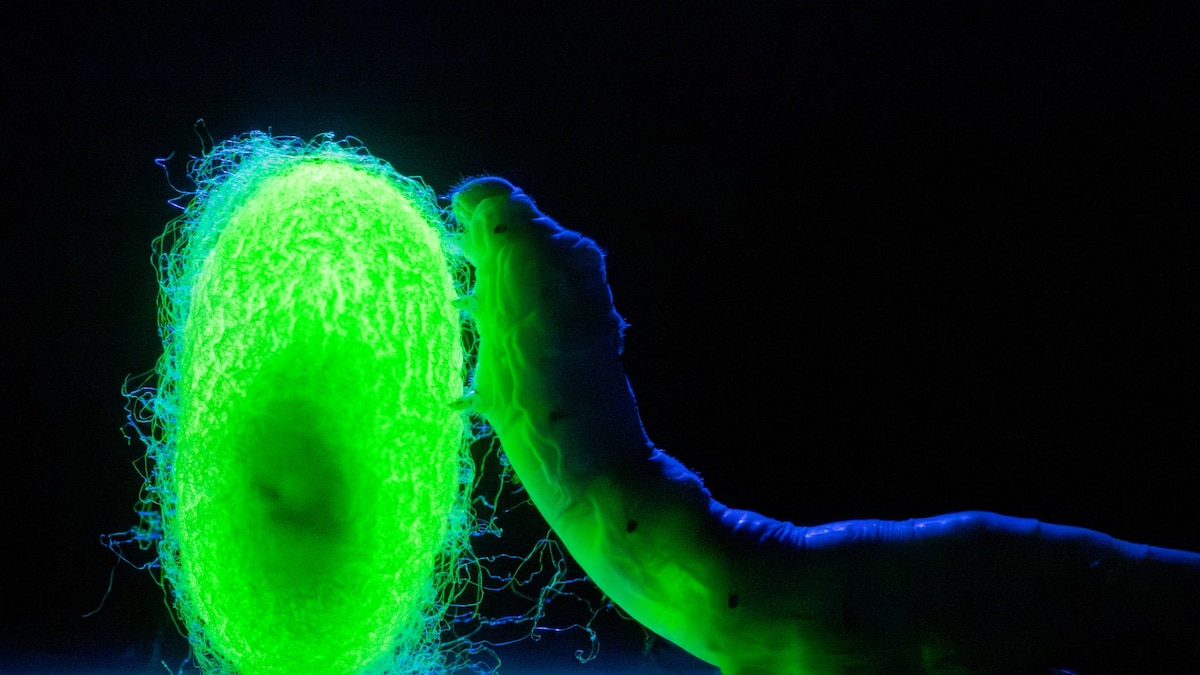
Somewhere in Michigan, 10,000 silkworms are spinning the future of supermaterials. They labor in the thick air of a warm, humid warehouse, pulling a sticky white strand from a gland in their face and weaving it into a cocoon the size of a grape. Since they were first domesticated in China thousands of years ago, their silk has been used to make the world’s finest fabric. But these silkworms aren’t like the millions that came before. They are spinning spider silk, or something close to it.
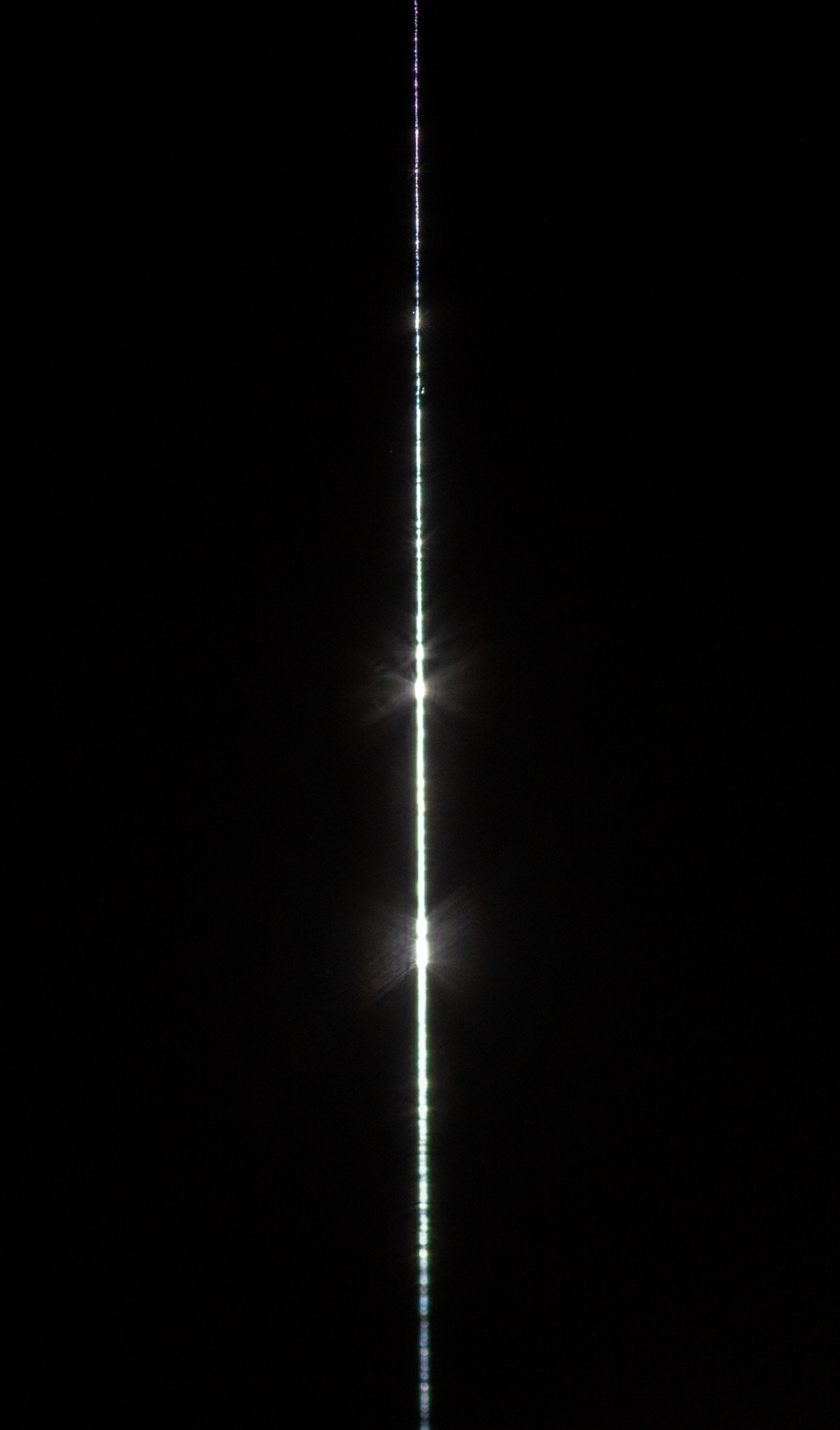
At Soochow University, in eastern China, a single fiber of supersilk produced by a transgenic silkworm is stress tested to see how it compares with true spider silk.
Pound for pound, spider silk, which has tantalized scientists for decades, combines strength and elasticity unlike anything else, natural or artificial. Five times stronger than steel by weight but completely organic, it’s “the stuff of superheroes,” says Fiorenzo Omenetto, director of the Silklab at Tufts University in Massachusetts. It exists in the same rarefied space as graphene and Kevlar, human-made creations with similarly extraordinary physical properties. But those can require synthetic chemicals to manufacture. Spider silk could do what they do, possibly better, and organically. That, in turn, has led to a steady stream of hype: Spider silk, if mass-produced, could unlock everything from improved bulletproof vests to ultra-light jet planes to next-generation vaccine delivery—if only we could crack the code. Spiders, though, are cannibalistic when forced to live together, making them neither domesticable nor easily scalable.
But in the past few years, everything’s changed. Those spider silk–spinning silkworms, all genetically modified, live at the Lansing, Michigan, research center of biotech firm Kraig Biocraft Laboratories. Kraig is just one of several companies around the world that have made breakthroughs in manufacturing spider silk. Or a very close analog. Those silkworms can’t quite match spider silk’s superhero-level physical properties just yet, but there is enough spider gene in the mix to give their silk fibers special qualities. Other companies have charted a different path—one less reliant on worms munching mulberry leaf cake—but with the same goal. “The goal is to mimic, and eventually surpass, the performance of natural spider silk, and then push it toward real-world applications,” says Wenbo Hu, a spider silk expert at Southwest University in central China. “We’re getting incredibly close.”
For the first time, the long-hyped supermaterial dubbed “supersilk” seems to be real. But the start-ups and genetic engineers who’ve spent years (and millions of dollars) pursuing this holy grail are now having to reckon with a question they’d been able to ignore in the quest for supersilk at scale: Once you make a supermaterial, what do you do with it? The answers, it turns out, aren’t as obvious as they’d imagined.