
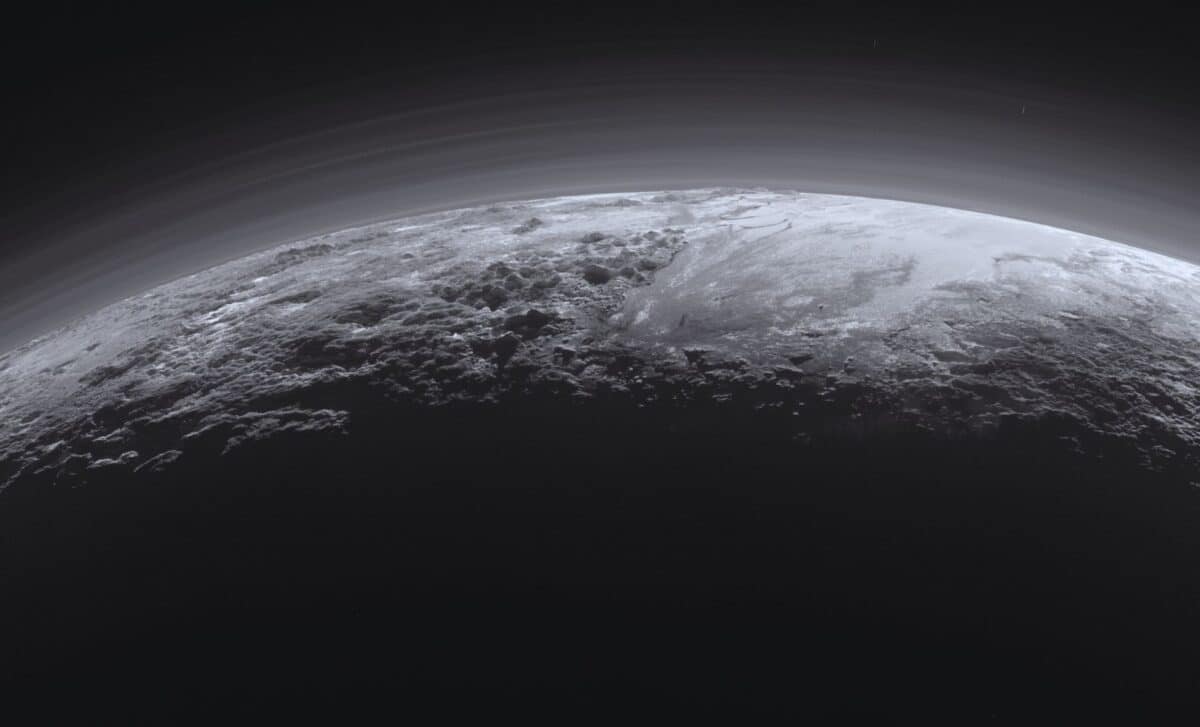
NASA’s New Horizons spacecraft has delivered extraordinary video footage showing towering ice mountains on Pluto’s moon Nix. These ice peaks, some rising as high as 11,000 feet, are made of pure water ice and behave like rock due to the intense cold.
The footage from New Horizons provides unprecedented details of Nix, a moon that has long fascinated researchers. Located in the frigid outer reaches of our solar system, Nix’s ice mountains are not only visually striking but also scientifically significant. While Pluto and its moons are largely composed of ice, Nix stands out for its unique geological features. The new data is helping to reveal the active processes shaping the surface of the moon.
A Frozen World: Nix’s Ice Mountains
According to NASA, the ice mountains on Nix are made of pure water ice, which in the extreme cold of the moon behaves more like rock. These towering formations, some of which reach impressive heights of 11,000 feet, offer a rare example of ice in its most rigid form.
“This observation is so tantalizing, I’m finding it hard to be patient for more Nix data to be downlinked,” stated Carly Howett, mission scientist at Southwest Research Institute in Boulder, in a NASA statement.
The extreme temperatures on Nix, which hover around -280°F (-173°C), prevent the ice from melting, and instead, it remains solid and stiff, giving it a rock-like appearance. Researchers believe this ice could be among the youngest geological features on the moon, only about 100 million years old, which is relatively young in the context of the solar system’s 4.56 billion-year history.
 A captivating view of Pluto’s moon: Nix. Credit: NASA
New Horizons Reveals Nix: A Closer Look at Pluto’s Moon
The images and video footage captured by NASA’s New Horizons spacecraft are crucial to expanding our understanding of Pluto’s moons. Launched in 2006, New Horizons made its historic flyby of Pluto in 2015, and the mission continues to provide invaluable data about the dwarf planet and its satellites.
It took 9 years and 3 billion miles to get this shot.
Pluto’s icy Mountains.pic.twitter.com/jpj3kSYQoz
— Curiosity (@MAstronomers) December 27, 2025
The spacecraft’s LEISA spectral imager, which collects detailed data about surface compositions, has been key to unveiling the true nature of Nix’s surface. This technology allows scientists to analyze the characteristics of Nix’s icy terrain in fine detail, helping them understand how these features form and evolve in the harsh environment of deep space.
Nix and Hydra: A Duel of Moons
While Nix shares similar characteristics with another of Pluto’s moons, Hydra, there are distinct differences in their surface compositions.
“Nix and Hydra – the second and third moons to be discovered – are approximately the same size, but their similarity ends there.” explained NASA in the same statement.
According to data from the New Horizons mission, Nix is covered predominantly by water ice, while Hydra exhibits higher reflectivity in visible wavelengths, which suggests that it might have a slightly different surface composition. These differences are important for scientists who are trying to piece together the geological history of Pluto’s moons.
“New Horizons’ findings on the surface characteristics and other properties of Nix and Hydra will help scientists understand the origins and subsequent history of Pluto and its moons,” as explained by the U.S space agency.
 New Horizons captures a rare image of Pluto’s moons Nix (left) and Hydra (right). Credit: NASA