
Header image credit: North Carolina State University
To keep up with today’s computing needs, researchers mine the quantum realm to find better ways to handle massive data demands. A new field known as “orbitronics” is the newest of these efforts. Orbitronics uses the path of an electron around a nucleus, a property known as orbital angular momentum, to store and process more information, much more efficiently. Typically, controlling an electrons’ orbit requires using magnetic materials, like iron, that are heavy, expensive and burdensome for practical orbitronics devices.
In a new study, researchers developed the most streamlined system yet for generating orbital angular momentum in electrons. Their secret—a discovery in one of the hottest research topics in modern physics, a phenomenon known as chiral phonons.
For the first time ever, the authors showed that chiral phonons can transfer orbital angular momentum to electrons directly to electrons in a non-magnetic material.
“We don’t need a magnet. We don’t need a battery. We don’t need to use voltage. We just need a material with chiral phonons,” said Valy Vardeny, distinguished professor in the Department of Physics & Astronomy at the University of Utah and co-author of the study. “Before, it was unimaginable. Now, we’ve invented a new field, so to speak.”
The paper was published on Jan. 21, 2026, in the journal Nature Physics.
The race to crack chiral phonons
The study’s innovation was using the natural symmetry and vibrations of atoms to control the orbital momentum of electrons. Atoms in a solid are tightly packed together in lattice-like structures, whose shape depends on the material. In some materials, like metals, the atoms are arranged in a cube pattern, stacking together symmetrically so that its mirror image superimposes perfectly.
In chiral materials, such as quartz, the atoms are arranged in a helical pattern, like the threads of a screw. The atoms stack together with a built-in twist with either a “left-” or “right-” handedness that can’t superimpose onto each other, a symmetry called chirality. Human hands are a classic example of chiral symmetry—hold them out with the palms facing up, then put one of top of the other. That’s chiral!
Now, onto chiral phonons. Individual atoms vibrate in place while staying in a fixed position. In symmetrical materials like metals, the atoms wiggle side-to-side. In chiral materials, the twisted lattice structure forces the atoms to naturally wobble in a screw-like pattern with right- or left-handedness.
Phonons are the collective vibrations that travel through a solid, like a ripple moving through its atoms. Chiral materials have chiral phonons. Imagine you’re in the pit at a rock concert when the ballad hits. Someone starts swaying, hands in the air, forcing their neighbor to sway, and so on until the wave pattern ripples through the crowd.
The fact that the atoms vibrate in a circular, chiral path means that the atoms themselves naturally have an angular momentum. The study is the first to show that the chiral phonons’ angular momentum transferred directly to electrons’ orbital angular momentum.
Aligning the atoms
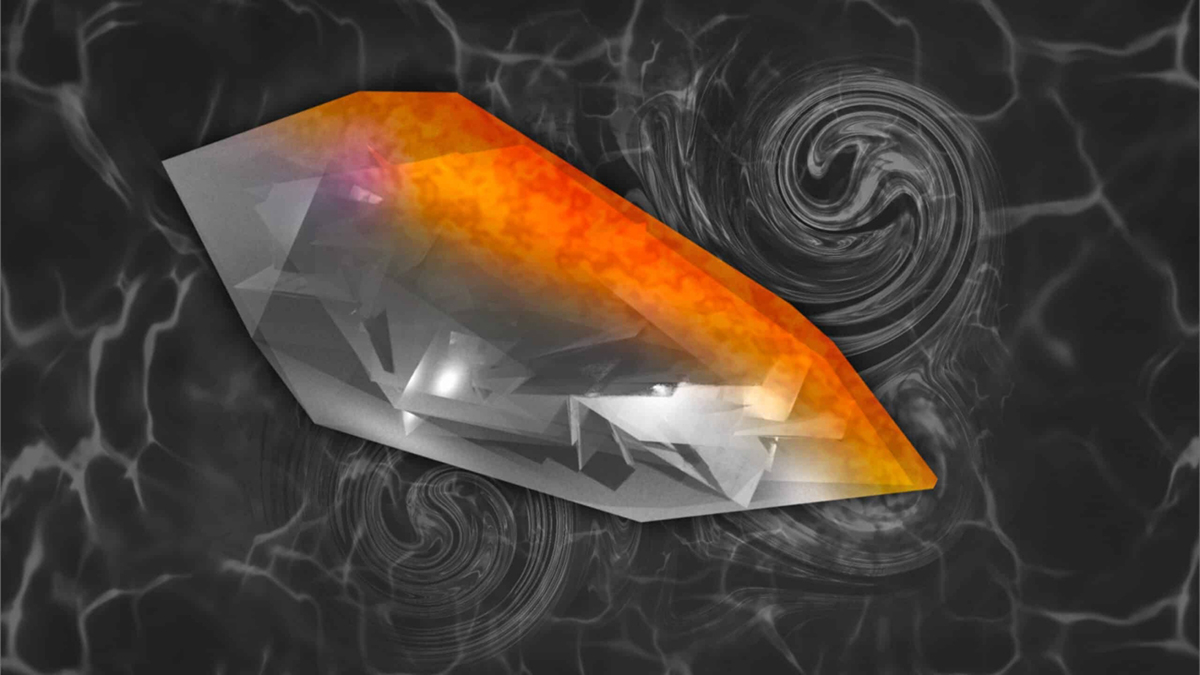 A quartz crystal subjected to a temperature gradient, leading to the generation of orbital angular momentum in the surrounding electron environment. Credit: North Carolina State University
Because electrons have a negative charge, magnetic fields are an essential ingredient to influence an electron’s orbital angular momentum.
“The generation of orbital currents traditionally necessitates the injection of charge current into specific transition metals, and many of these elements are now classified as critical materials,” said Dali Sun, physicist at North Carolina State University and co-author of the study. “There are other ways to generate orbital angular momentum, but this method allows for the use of cheaper, more abundant materials.”
Quartz, for example, is lightweight, inexpensive and its chiral phonons carry their own internal magnetic field. For the first time, University of Utah physicists directly measured the magnetism in quartz, using equipment at the National High Magnetic Field Lab in Florida. The scientists shot lasers through the system and analyzed the properties of the light that was reflected. The changes in light, color, wavelength, etc., revealed that quartz chiral phonons carry a substantial magnetic field.
Under everyday conditions, chiral phonons have a random mix of right- and left-handed atoms that all have various energy levels. The researchers used α-quartz, a crystal with a chiral atomic structure, to test their theory. By applying a magnetic field to the quartz, the researchers forced the material to align the right- and left-handed phonons.
The authors showed that getting a critical mass of aligned chiral phonons was enough to transfer the effect to the electrons—without needing an external magnet. This created a flow of electron angular momentum that the authors coined the “orbital Seebeck effect,” named after a well-known process, that influences electron spin called the “spin Seebeck effect.” To directly measure the orbital Seebeck effect, the scientists put layers of metals (tungsten and titanium) on top of the α-quartz, which conferred the hidden “orbital flow” into a measurable electrical signal.
The method will work on other chiral materials, such as tellurium, selenium and hybrid organic/inorganic perovskites. It’s more efficient because it uses less material while holding the orbital angular momentum far longer than other systems have been shown to do.
“Even though the material itself isn’t magnetic, the existence of chiral phonons gives us these magnetic levers to pull on,” said Rikard Bodin, doctoral candidate at the U and co-author of the paper. “When we talk about discovering things, like the orbital Seebeck effect—I can’t tell you that your TV is going to run on it, but it’s creating more levers that we can pull on to do new things. Now that it’s here, someone else can push it forward and before you know it, it’s ubiquitous. That’s how technology is.”
****
The research was supported by the United States Department of Energy (DE-SC0020992, DE-FG02-07ER46451); the U.S. Air Force Office of Scientific Research (FA9550-23-1-0311, LRIR 23RXCOR003, 23RT0542), and the U.S. National Science Foundation (DMR-2143642, DMR-2509513, OAC-2311202, CNS-2320292, CBET-1943813); the Israel Science Foundation (ISF: 2974/23); and the Penn State Materials Research Science and Engineering Center for Nanoscale Science from NSF (DMR-2011839)
Other authors include Binod Pandey from the University of Utah; Yoji Nabei, Cong Yang, Hana Jones, Ziqi Wang, Andrew H. Comstock, Benjamin Ewing, John Bingen, Rui Sun, Jun Liu and Dali Sun from North Carolina State University; Hong Sun and Jun Zhou from Nanjing Normal University; Thuc Mai and Rahul Rao from the Air Force Research Laboratory; Tian Wang and Xiaosong Li from the University of Washington; Yuzan Xiong and Wei Zhang of the University of North Carolina at Chapel Hill; Dmitry Smirnov of the National High Magnetic Field Laboratory; Axel Hoffmann from the University of Illinois at Urbana-Champaign; Ming Hu from the University of South Carolina; and Binghai Yan from Pennsylvania State University.
Find the study, titled “Orbital Seebeck effect induced by chiral phonons,” in Nature Physics. Jan. 21, 2026. DOI: 10.1038/s41567-025-03134-x
MEDIA & PR CONTACTS
Lisa Potter
Research communications specialist, University of Utah Communications
949-533-7899
lisa.potter@utah.edu