
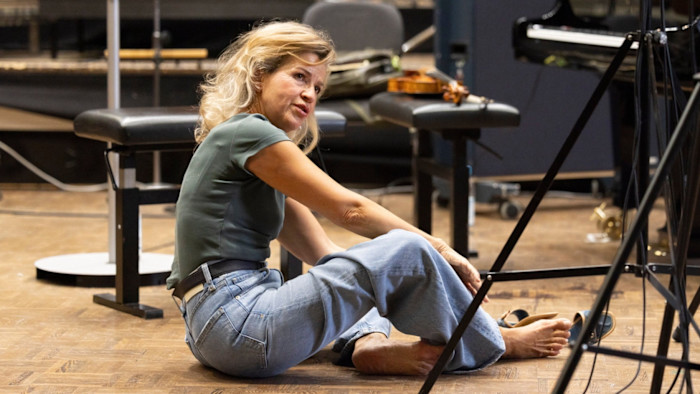
Beat this for a career that went off like a rocket: the violinist Anne-Sophie Mutter was 13 when she made her public recital debut in 1976 and a year later appeared in Salzburg as a much-anticipated soloist with no less than Herbert von Karajan and the Berlin Philharmonic, then at the peak of their reputation.
This year marks Mutter’s 50th anniversary as a performer. Some mid-ranking violinists would probably be happy with a career half that length, as the range of popular concertos open to them is limited and promoters soon move on to the next young star. But Mutter is no ordinary violinist. Her pre-eminent position has never wavered, a feat only possible for one who started young and has discovered a path to self-renewal: by bringing new music into the world, she has spent the decades constantly revitalising her career.
Her anniversary year is opening with a tour of Tchaikovsky’s Violin Concerto in the company of conductor Karina Canellakis and the London Philharmonic Orchestra. From the first concert at the Royal Festival Hall in London that took place on Wednesday night, it now moves on to performances across Germany, Luxembourg and Austria.
Then comes the launch of a series of recordings by Alpha Classics devoted to the new works Mutter has commissioned. “I was inspired by the generation of string players before me,” the 62-year-old says, speaking to me over video call from Munich. “[Jascha] Heifetz, who commissioned Walton and Korngold, and [David] Oistrakh, [who commissioned] the great Russian composers. Then I started to play string trios with [Mstislav] Rostropovich and was amazed how much he had enlarged the repertoire. That is one of the wonders of the world.”
 Anne-Sophie Mutter performing as a teenager at the International Music Festival in Lucerne in 1976 © Alamy
It is fair to say that no living musician is closer to equalling Rostropovich’s tally than Mutter. The roll-call of composers who have written works for her includes Thomas Adès, Unsuk Chin, Henri Dutilleux, Sofia Gubaidulina, Krzysztof Penderecki, André Previn, Wolfgang Rihm, Jörg Widmann and John Williams. Their styles extend from hardline modernism to Star Wars. Nobody can say Mutter lacks a diverse musical palate.
“There is a growing number of young people who are more interested in contemporary music than the standard repertoire, which makes me very happy,” she says. “And I can understand why. For us players it is a liberating moment to have this carte blanche. [In the standard repertoire], even if you try to shrug it off, you are burdened by expectation and tradition. With contemporary music, in discussion with a composer, you can bring more of your own insights to the score and this is liberating. I can understand that the audience feels that sense of travelling to a far place and discovering something new.”
Sometimes receiving a new piece feels vertiginous. Mutter remembers being sent the score to Polish composer Witold Lutosławski’s Chain 2, commissioned for her by Paul Sacher, before the world premiere in 1986. “I looked at it and I was like, ‘Oh my God! This is a total disaster’,” she says. “I could just see myself jump off the cliff and never come back.” Happily, she did not jump off the cliff: I heard her play it at the Salzburg Festival in 1988, conducted by the composer, and her recording confirmed it as a major addition to the violin repertoire.
She has curated her Alpha Classics series with an eye on how varied she can make it. The first volume, East meets West, features composers from Iran, South Korea, Germany and the UK, in works for solo violin, violin duo, string quartet, and the last a concerto-like piece for violin and orchestra.
“I hope that people who listen to East Meets West will be intrigued by this journey around the globe,” says Mutter. In Widmann’s case she was taken by the composer’s fusing of emotion and skill. With Chin it was the Korean’s virtuosity, while Adès she describes as “a poet”. His Air — Homage to Sibelius, written during Covid, is a kind of “mourning aria”, and very beautiful it is, too.
“As soon as I got [Iranian-Dutch composer] Aftab Darvishi’s piece I thought it fascinating, but then I put it within the wider scope of the women’s lib movement in September 2022 [after the death of Mahsa Amini],” says Mutter. “Who would have thought that we would have to relive that loss of freedom in the current situation, which is way worse now in Iran?
 ‘With contemporary music, you can bring more of your own insights to the score — this is liberating’: Mutter with Thomas Adès © Matthew Johnson
“We have to protect music as a safe space in which we can share our differences of heritage and religious belief, and that is ever more important in a narrowing world where dialogue is not really fostered. Music is more than entertainment. It is about the human struggle for connection. Old Ludwig [van Beethoven] knew it and that is what we must still believe in.”
Not least among the album’s pleasures is Mutter’s playing. Many composers have said they respond to the exceptional quality she achieves on the very highest notes — not a thin squeak, but sweet, otherworldly, as if emanating from Pythagoras’s celestial music of the spheres.
Apparently, though, this can be a mixed blessing, as Mutter raises an eyebrow when it is mentioned. Adès has said that he knew Air — Homage to Sibelius would have a top note and the piece would be all about “reaching the ceiling”. Then Chin’s Gran Cadenza heads even further into the stratosphere. “It was one of the rare moments when I called up and said, ‘Ms Chin, I’m very sorry, but I don’t think this is going to work’,” says Mutter. “It would be fantastic for flute, but the violin is not a flute. There was a pause and she said, ‘I don’t write for a specific instrument’. At the end, of course, because you have struggled so much, you love it.”
This first album is due for release on March 27. Volume two, American Tunes #1, featuring works by Previn and Sebastian Currier, follows in August, and further volumes are planned for 2027 and 2028.
Meanwhile, Mutter is out on the road with the Tchaikovsky concerto. At the tour’s opening concert in London this was no simple run-through, but a complex vision of the music which found new colours and windows of reflection round every corner, now fast, now slow (the attentive Canellakis and LPO players did well to stay at her side) and the big cadenza was a showpiece of virtuosity. An ovation followed, rewarded with an encore, Previn’s rapt Song in an arrangement with orchestral accompaniment. Do not fret that you may have missed Mutter in her prime. She is still in her prime now.
Find out about our latest stories first — follow FT Weekend on Instagram, Bluesky and X, and sign up to receive the FT Weekend newsletter every Saturday morning