
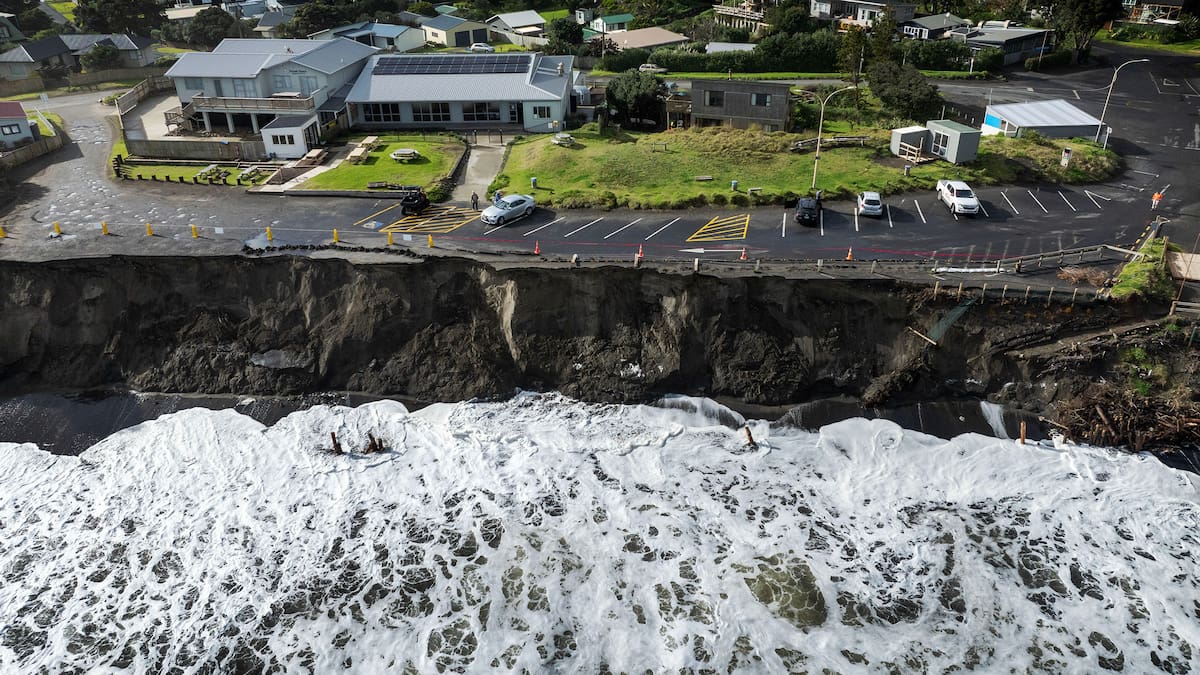
In 2022, the Waikato District Council asked residents to “manage retreat” after two homes were left uninhabitable when storms claimed 3m of the beach, wiping away the only access.
The long-term strategy included moving community facilities.
It meant any protection for the carpark (since destroyed by erosion) and other facilities would be short-term, cost-effective and environmentally responsible to slow erosion while a long-term relocation/retreat plan was developed.
In 2024, the council’s then-deputy mayor, Caroyln Eyre, said “managed retreat” was not a “do-nothing policy”, and the council had worked on initiatives such as sand renourishment trials.
“So no, it’s not do-nothing, but we recognise it’s a dynamic coastline, and unfortunately, erosion is not going to be halted,” she said.
Sunset Beach Lifesaving Charitable Trust chairman Malcolm Beattie told the Waikato Herald that residents were not prepared to move.
Sunset Beach Surf Lifesaving Club president Malcolm Beattie. Photo / Mike Scott
“This is our home, and we’re not leaving town.”
The trust is a non-profit organisation that supports the Sunset Beach Lifeguard Service, which manages the community hub and funds local lifesaving.
Beattie, also the lifeguard club’s president, said residents had fought for three years to get council consent for the sea wall.
The trust raised funds and received grants to pay for the wall. It was done without council funding, but with its support.
Beattie said the sea wall was a “long time coming”.
Construction of the sea wall at Port Waikato’s Sunset Beach.
“For something to happen, it was either don’t find the money and don’t do it, or find the money and make sure we’ve got it so we can do it.
“We chose the latter,” he said.
The dune restoration project includes the sea wall made of 950 225mm wooden poles, each 4m high and buried 3m into the sand. They are backfilled with sand and rock along 800m of coastline.
It is paired with what Beattie calls “New Zealand’s West Coast-first sand push-ups,” which transfer low-tide sand to dune toes (where the dune meets the beach) to slow erosion.
Resident Josephine Poland, who has lived at Sunset Beach since 1994, believes that, without the sand push-ups, “my home probably wouldn’t be here anymore”.
The house with the slide is Josephine Poland’s, where she’s lived for over 30 years. Photo / Mike Scott
“The wall is like a permanent push-up and buys us time, so we can wait for the sand slugs (large accumulation of sand) to make their way up here.
“It’s saved my home and given me hope for the future.”
Rereokeroa Shaw, chairman of Ngāti Karewa and Ngāti Tahinga, a Waikato-Tainui hapū, said, “As tangata whenua, we wholeheartedly support this country-first project”.
She said iwi already had the local knowledge, energy, and commitment to protect the coastline because of their relationship with the land.
Construction of the sea wall at Port Waikato’s Sunset Beach has been completed.
“The project is a significant step forward in collaborative, locally led responses to climate change and coastal erosion, grounded in mātauranga Māori, community commitment, and environmental responsibility.”
Beattie said the sea wall was “meeting all expectations that I thought it would deliver”, but it was not a cure for erosion.
“We never promised anybody this would be the end of erosion, but we’ve said this is definitely our target to slow the erosion down.
“When Mother Nature brings more sand in, we’ll be well equipped to get with it.”
The next priority will be to restore public road access to Sunset Beach.
Timelapse of erosion at Port Waikato since 2013.
Malisha Kumar is a multimedia journalist based in Hamilton. She joined the Waikato Herald in 2023 after working for Radio 1XX in Whakatāne.