
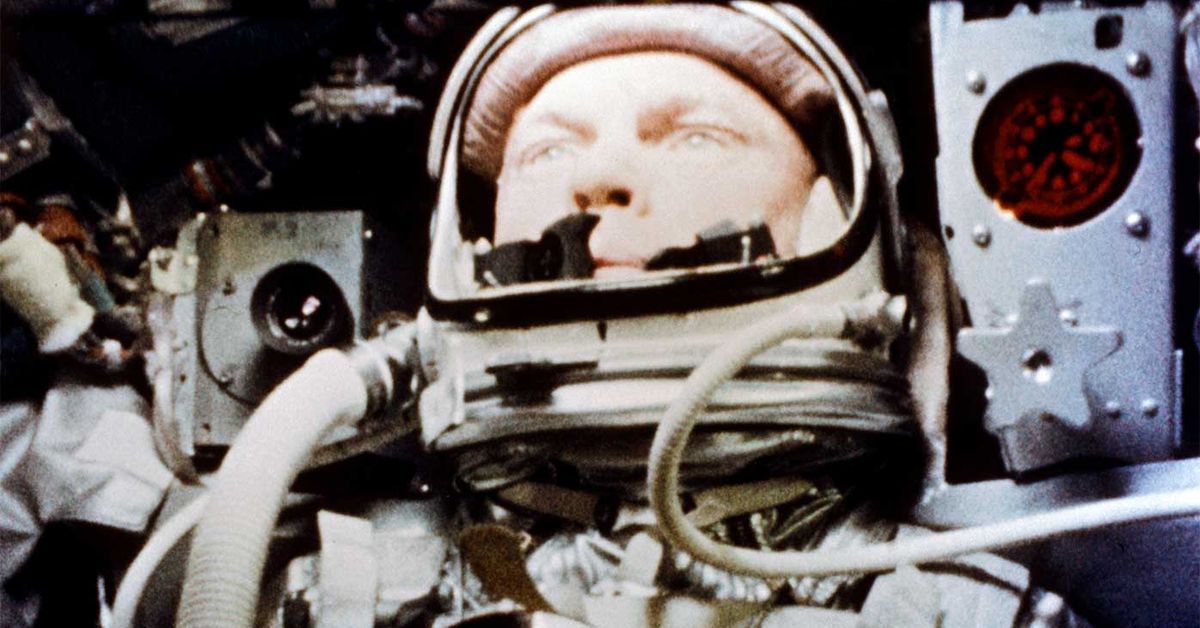
During his short flight, Glenn was astounded by an unexpected phenomenon.
 John Glenn becomes the first American to orbit the Earth aboard the Friendship 7 on February 20, 1962. (AP)
He described his capsule going through a mass of “fireflies”.
“I am in a big mass of some very small particles, they’re brilliantly lit up like they’re luminescent,” he told ground control.
“A whole shower of them coming by. They swirl around the capsule and go in front of the window and they’re all brilliantly lighted”.
Despite his description of them as “fireflies”, the dazzling sight was actually more banal.
NASA concluded the “fireflies” were merely ice crystals venting from elsewhere on the spacecraft, flying past his window.
 John Glenn orbited the Earth in a tiny capsule. (Nine Archives)
Because of issues with the capsule’s heat shield, Glenn had a much warmer re-entry than planned.
But despite fears he would burn up in the Earth’s atmosphere, he survived in one piece.
In anticipation of a delayed rescue after his ocean splashdown, the Friendship 7 was equipped with a life raft, a desalination kit, survival rations, matches and shark repellent.
But Glenn did not have to wait long for rescue, landing just 10km away from a US Navy destroyer.
They would be alongside the Friendship 7 just 17 minutes later.
Not only had cosmonaut Gherman Titov already orbited the Earth seven months earlier, he had done so 17 times over 25 hours. John Glenn becomes the first American to orbit the Earth aboard the Friendship 7 on February 20, 1962. (AP)
Titov had a much hairier re-entry than Glenn.
Because a module failed to detach, Titov had to eject himself from the capsule as it was hurtling to Earth.
Titov parachuted to the ground with a bloody nose after banging his helmet trying to eject.
Glenn would be regarded as a national hero, and would be elected to the US Senate in 1974.
He returned to space on a nine-day mission in 1998.