
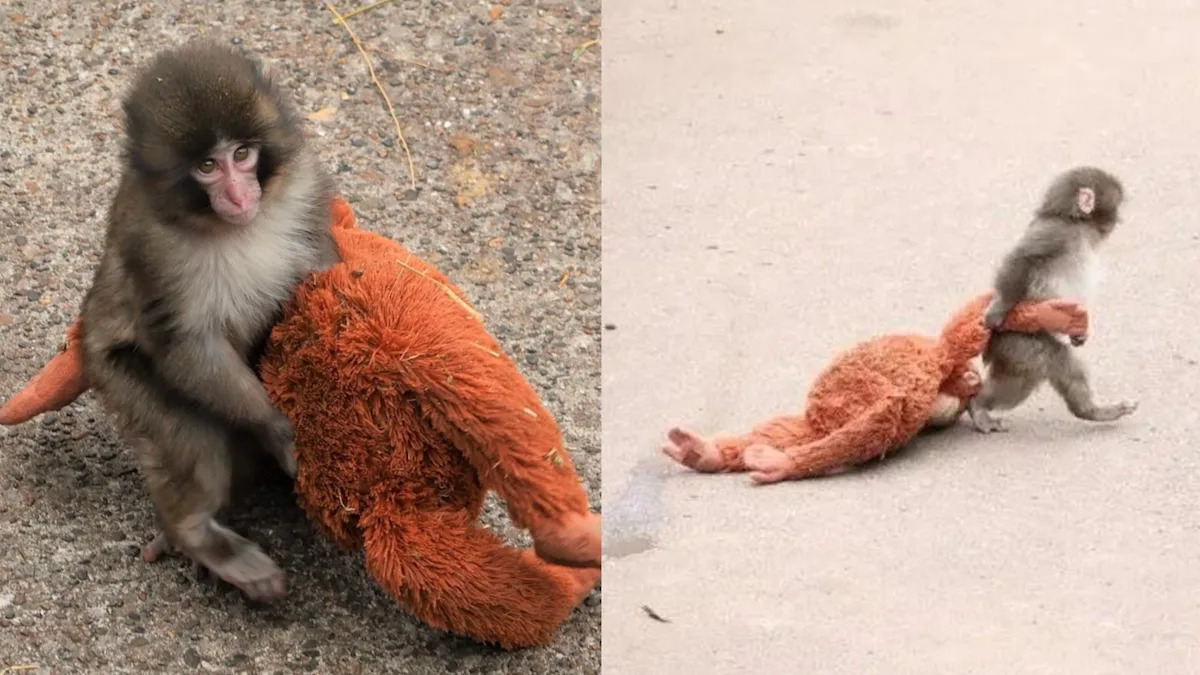
A six-month-old monkey, currently residing at the Ichikawa City Zoo in Japan, is testing the emotional regulation skills of people worldwide. Punch (pronounced Punch-kun in Japanese) is a baby macaque whose mother rejected him at birth. During his first few months of life, he struggled to bond with the other monkeys in his zoo’s enclosure and had only the company of his human keepers and a stuffed orangutan toy to rely on. The global public is aware of this because the zoo posted Punch’s life story, along with some heartbreaking photographic evidence, on its X account, asking visitors to “Please watch over Punch’s growth with warm support.”
Since the Ichikawa City Zoo team posted this plea, footage of Punch has gone viral, including clips of him cuddling his plush toy and parading it around his enclosure. There’s even one clip of a monkey pushing Punch away (truly one of the most gut-wrenching scenes captured on film since Hamnet).
Unsurprisingly, the sad little monkey has garnered widespread pity. Images of him staring listlessly at the sky or treating his stuffed toy with gentle care have been turned into reaction memes over the past few days, mostly because they’re unbelievably tragic. When I sent one particular image of Punch to a colleague, she found it so heartbreaking that she, like some others online, questioned whether it was generated by AI.
But all hope is not lost for Punch. Following days of widespread adoption requests and demands for the zoo to bring him some sort of friendly monkey companion, things are looking up. Brands have begun to do what they do best when a new viral zoo animal enters the zeitgeist (see 2024’s Moo Deng craze): hitch their wagons to the virality. IKEA Japan, which produced Punch’s favorite stuffed toy, sent the zoo several more plushies for him to enjoy—taking advantage of both the perfect promotional opportunity and a chance to provide Punch with some added comfort.
It also appears that Punch is starting to make living, breathing monkey friends. As his story continued to cause worldwide despair, the zoo shared videos of him hugging a fellow monkey and receiving his first grooming from a peer, easing worries that he would be forever lonely in the enclosure. (Though the conveniently timed kindness does invite tongue-in-cheek “clout chaser” allegations—funny how everyone now wants to be friends with the only monkey in the enclosure who’s a viral sensation.) The Ichikawa Zoo also shared that an unexpected influx of visitors have stopped by to see Punch, along with photos of lines of fans waiting to visit their favorite once-lonely monkey.
My main takeaway from this ordeal is that while Punch’s origin story is the stuff of nightmares (and proof that the loneliness epidemic has affected animal species, too) there are always brighter days ahead. Gloom is transient. Let Punch’s story serve as inspirational evidence of that fact.
You Might Also Like