
It’s a frigid January day in Berlin but, inside Sprüth Magers’ head office in the central Mitte district, the mood is one of excitement. When I meet the veteran gallerists Monika Sprüth and Philomene Magers, they are visibly thrilled by the news that a short film co-directed by one of their stable, the multidisciplinary artist Alexandre Singh, has just been nominated for an Academy Award.
“This is pretty new for us,” says Magers, beaming warmly.
“Actually we get an Oscar every year,” Sprüth jokes drily, before adding more seriously, “the only other artist to win one was Steve McQueen.”
 ‘Hatchet’ (2025) by David Salle © John Berens, courtesy Sprüth Magers
The announcement arrives alongside another milestone in Los Angeles. Just down the road from the Academy headquarters on Wilshire Boulevard, Sprüth Magers’ LA outpost is marking its 10th anniversary with a programme tracing the gallery’s long-standing Californian connections. During LA art week it will open an exhibition dedicated to David Salle, the New York-based painter whose work is rarely seen in LA but who studied at the California Institute of the Arts under the late conceptualist John Baldessari. Fittingly, he inaugurated the Wilshire space a decade ago and will also be the focus of the gallery’s booth at Frieze LA.
The art market is a confusion. There’s much more money involved, and it has aspects of speculation. That often has nothing to do with cultural or artistic quality
Monika Sprüth
Baldessari was one of several LA-based artists in Sprüth Magers’ roster — alongside Barbara Kruger, Ed Ruscha and Sterling Ruby — who drew the gallery to the west coast in 2016. “We’d been working with artists there for 30 or 40 years, and we were always travelling [to the city],” recalls Magers. At the time, the local collector base was still modest compared with New York (where Sprüth Magers would open in 2022) and only a few international galleries had established a foothold. For Magers, however, it simply “made sense” to be closer to their artists. Sprüth agrees. “We were quite happy to avoid New York at that moment,” she says, “because we felt more at home within the discourse of artists who were more familiar to us.”
 ‘Camel (Albino) Contemplating Needle (Large)’ (2013) by John Baldessari © John Baldessari Family Foundation Courtesy Estate of John Baldessari; Sprüth Magers. Photo: Roberto Marossi
That artist-centric approach has underpinned their success across four decades. Today, Sprüth and Magers are among the most influential gallerists in the art world, regularly featured on ArtReview’s Power 100 list and representing more than 70 artists and estates. The pair have long been known for their fierce championing of conceptual and feminist practices. Sprüth, who describes herself as a “failed artist”, cut her teeth as a gallerist in Cologne’s “very lively, quite male-dominated” art scene in the early 1980s. From the outset, her focus was on contemporary female voices.
“Cindy Sherman, Jenny Holzer, Louise Lawler and Rosemarie Trockel were part of that very early programme,” she says. “Art historically, we felt that was necessary — to give visibility to great female artists and to develop role models for a younger generation.”
 ‘Untitled Film Still #18-A’ (1978) by Cindy Sherman © Cindy Sherman. Courtesy the artist and Sprüth Magers. Photo: Timo Ohler.
In 1991, Magers launched her own gallery in Bonn with a programme favouring conceptual, critically rigorous work. Early shows included Sylvie Fleury’s designer shopping bags, Ad Reinhardt’s Black Paintings, and Baldessari’s photographs and text paintings from the 1960s. The two women, who knew each other through Magers’ gallerist mother, merged their galleries in 1998, eventually establishing their vast flagship in a former social club in Berlin in 2008.
Today, Sprüth Magers operates four spaces in Europe and the US, alongside offices in Seoul, Beijing, Hong Kong and Cologne. Like other mega-galleries, it has had to embrace a multi-city model in order to keep pace with an international circuit of art fairs and exhibitions. Even so, the pair insist they have been restrained in their expansion. “We always say we try to be as small as possible, but to work well for our artists we have to be a bit global,” says Sprüth.
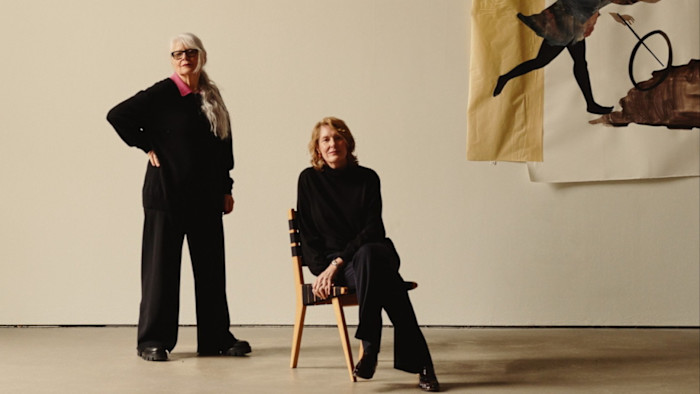
 Philomene Magers (seated, left) and Monika Sprüth (standing, right) at the gallery in Berlin © Photographed for the FT by Robert Rieger
Yet that balance has become harder to maintain as the art market has transformed. Sprüth notes that it now bears little resemblance to the one she entered in the 1980s. “The art market is a confusion,” she says. “There’s much more money involved, and it has aspects of speculation — you see that in the auction houses. That drive often has nothing to do with cultural or artistic quality.”
We focus on artists we believe have real cultural relevance — who genuinely contribute something to the conversation
Philomene Magers
For Magers, this speculation has also fuelled a broader commodification of political and social discourse. While she views these conversations as important, she’s wary of how galleries have sought to capitalise on them by taking on large numbers of artists simply because their work addresses these themes.
 ‘Untitled (Your Body Is A Battleground)’ (1989) by Barbara Kruger © Courtesy the artist, The Broad Art Foundation and Sprüth Magers
Sprüth Magers, she adds, resists that tendency. “We try to focus on artists we believe have real cultural relevance — artists who genuinely contribute something to the conversation at a specific moment in time, rather than fulfilling expectations or chasing financial gain.”
A more welcome shift for the pair has been the expansion of the art canon, which has seen many of their long-standing women artists — Sherman, Holzer, Kruger — move from the fringes into the spotlight of major institutions. Magers, however, is clear-eyed about the current rightwing backlash against historically marginalised voices.
“It’s a really sad situation,” she says. “If you look at history, you always have phases when things are advancing into a humanistic vision of the world. And then a certain part of the population feels neglected, which I think we see in this rather misogynist development that is taking place right now.”
 ‘The Mountaintop’ (2025) by Kara Walker © Kara Walker. Courtesy Sprüth Magers. Photo by Jason Wyche
For a time, she adds, progress seemed secure. “In the last couple of years we reached a certain threshold where everything felt, in this part of the world at least, quite advanced and safe. And now we see this is all up for discussion again.”
That discussion is confronted head on in their Berlin space, where a new body of cut-out collages, pastels and watercolours by Kara Walker (to April 4) feels especially urgent amid the Trump administration’s renewed attack on diversity and attempts to minimise Black history. Flailing figures and violent allusions stalk these troubling panoramas, which unsettlingly employ a storybook aesthetic to evoke the US’s racist past. In Los Angeles, Walker is also part of a concurrent group exhibition, Monuments, which unfolds across Moca and The Brick, where she has taken a plasma cutter to a decommissioned Confederate statue and reconfigured it as a disorientating abstract sculpture.
 Installation view of the ‘Monuments’ exhibition at The Brick, featuring Kara Walker’s work made from a mutilated Confederate statue © Photo by Fredrik Nilsen. Courtesy of MOCA and The Brick
While Sprüth and Magers emphasise that their role as gallerists isn’t to make statements, Walker’s excoriating Berlin show is nonetheless testament to their enduring commitment to some of the most politically engaged, vital artists working today. Magers stresses the importance of sticking to core principles in such times. “It’s very important that we just keep doing what we do.”
The approach has paid off: the gallery has never lost an artist. Asked why, Sprüth has a simple answer. “More or less, it’s because we are old-fashioned and serve the artist. Of course we also sell art — but we don’t sell art in order to have a private plane.”
Find out about our latest stories first — follow FT Weekend on Instagram, Bluesky and X, and sign up to receive the FT Weekend newsletter every Saturday morning