
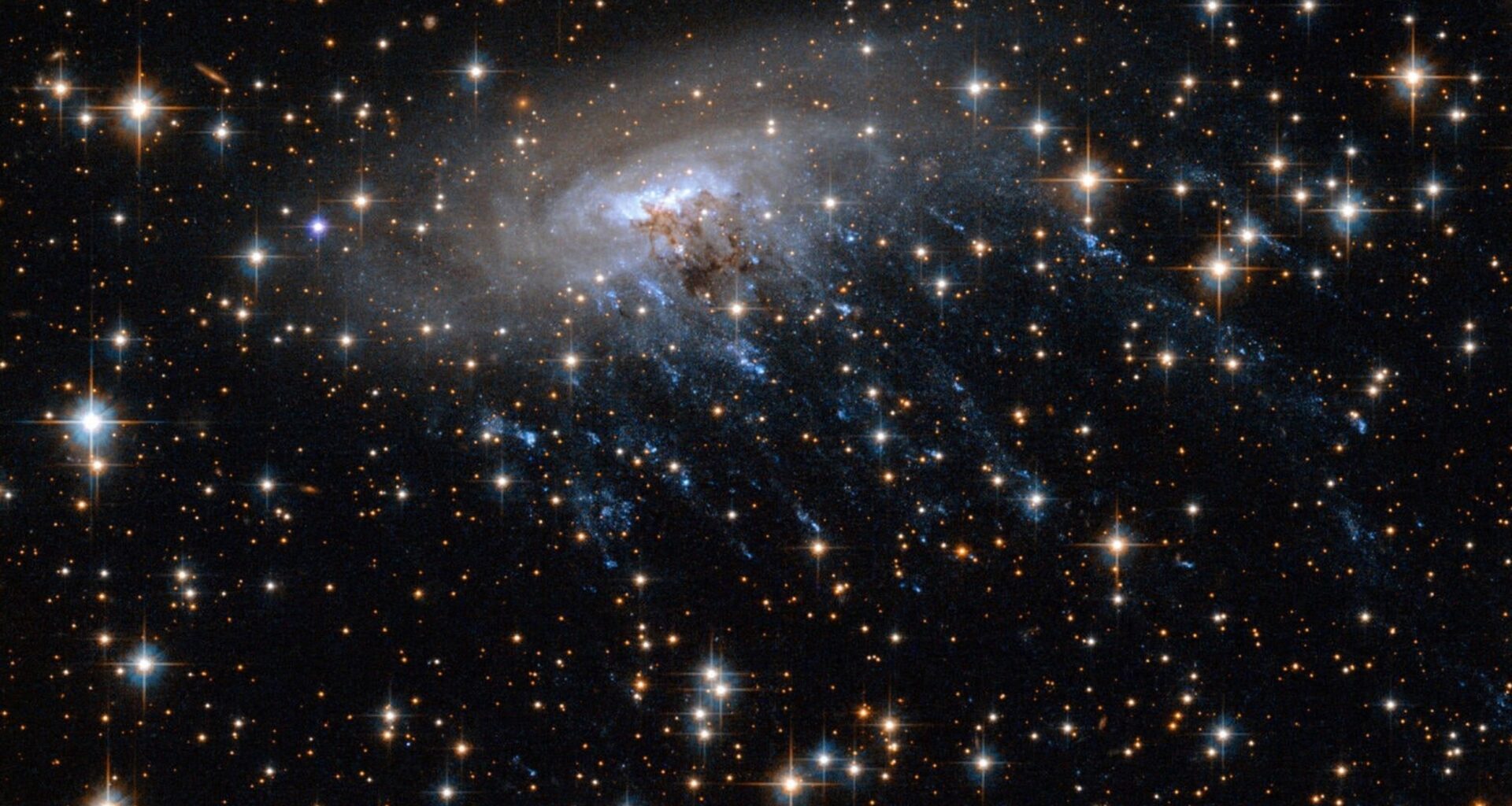
A strange galaxy with trailing blue streams has turned up in one of the most studied patches of the sky.
What looks otherworldly is actually a window into the universe 8.5 billion years ago, when galaxies were still being reshaped by their surroundings.

Long strands stretch out behind the galaxy, glowing with newborn stars. Astronomers call these objects jellyfish galaxies. They earn that name because of the way gas trails behind them like tentacles.
As they speed through crowded galaxy clusters, hot gas in the cluster pushes against them. That pressure strips away their own gas and leaves it streaming out the back.
The process has a technical name, ram-pressure stripping. It is messy, violent, and powerful enough to change a galaxy’s future.
A glimpse into the early universe
The newly spotted jellyfish galaxy sits at a redshift of z = 1.156. In plain terms, that means we are seeing it as it was 8.5 billion years ago, when the universe was much younger than it is today.
Back then, galaxies were still growing and colliding. Clusters of galaxies were taking shape.
Scientists found this object in deep space images taken by the James Webb Space Telescope, or JWST. They were combing through data from the COSMOS field, short for the Cosmic Evolution Survey Deep field.
This region of the sky is a favorite among astronomers. It lies far from the crowded plane of the Milky Way, so there is little interference from nearby stars and dust.
It is also visible from both the northern and southern hemispheres, which makes it a shared window for telescopes around the world.
“We were looking through a large amount of data from this well-studied region in the sky with the hopes of spotting jellyfish galaxies that haven’t been studied before,” said Dr. Ian Roberts, postdoctoral fellow at the Waterloo Centre for Astrophysics in the Faculty of Science.
“Early on in our search of the JWST data, we spotted a distant, undocumented jellyfish galaxy that sparked immediate interest.”
Roberts and his colleagues at the University of Waterloo quickly realized they were looking at something special. This is the most distant jellyfish galaxy of its kind ever captured.
Stars born in the wake
At first glance, the galaxy’s main disk looks fairly normal. It has the familiar flattened shape seen in many spiral galaxies. The real action happens behind it.
Bright blue knots light up the trailing streams. Those blue patches are very young stars. Their age tells astronomers something important: these stars formed outside the main body of the galaxy, in the gas that had already been stripped away.
That fits with what scientists expect from ram-pressure stripping. As the galaxy plows through hot, dense gas in its cluster, the pressure shoves its own gas backward.
The displaced gas can collapse and form new stars in the trails. In a way, it leaves behind a wake of stellar newborns as it moves. Finding this process so far back in time surprised researchers.
Rethinking cosmic history
For years, many scientists believed that 8.5 billion years ago, galaxy clusters were still assembling.
Experts thought the environments inside those clusters were not yet harsh enough to strip galaxies so dramatically. Ram-pressure stripping was expected to be rare at that stage. This new observation challenges that idea.
“The first is that cluster environments were already harsh enough to strip galaxies, and the second is that galaxy clusters may strongly alter galaxy properties earlier than expected,” Roberts said.
“Another is that all the challenges listed might have played a part in building the large population of dead galaxies we see in galaxy clusters today. This data provides us with rare insight into how galaxies were transformed in the early universe.”
Those “dead galaxies” are systems that no longer form new stars. They are common in modern clusters. If stripping and other harsh conditions were already active 8.5 billion years ago, then clusters may have been shutting down star formation much earlier than scientists thought.
The team also reported three additional discoveries tied to this work, all pointing toward a tougher, more active cluster environment in the early universe than expected.
That shifts the timeline for when galaxies began to lose their gas and stop forming stars.
Changing the story of galaxy clusters
The James Webb Space Telescope has changed how we see the distant universe. Its sharp vision and sensitivity to infrared light allow it to detect faint, faraway galaxies that older telescopes missed.
Objects at z = 1.156 are not just dots. They show structure, color, and motion.
This jellyfish galaxy adds a key piece to the puzzle of how galaxies grow up. Galaxies do not evolve in isolation. Their neighborhoods matter.
When they enter dense clusters, galaxies face intense heat, high speeds, and powerful forces that can strip away the raw material needed to make stars.
The new discovery suggests that these rough neighborhoods were already shaping galaxies billions of years earlier than many models predicted.
Astronomy often moves forward by catching something that does not quite fit expectations. A single galaxy with long blue trails might seem small against the scale of the cosmos.
Yet it tells a bigger story. It says the young universe may have been more extreme, more crowded, and more transformative than we once believed.
Image Credit: ESA, NASA
—–
Like what you read? Subscribe to our newsletter for engaging articles, exclusive content, and the latest updates.
Check us out on EarthSnap, a free app brought to you by Eric Ralls and Earth.com.
—–