
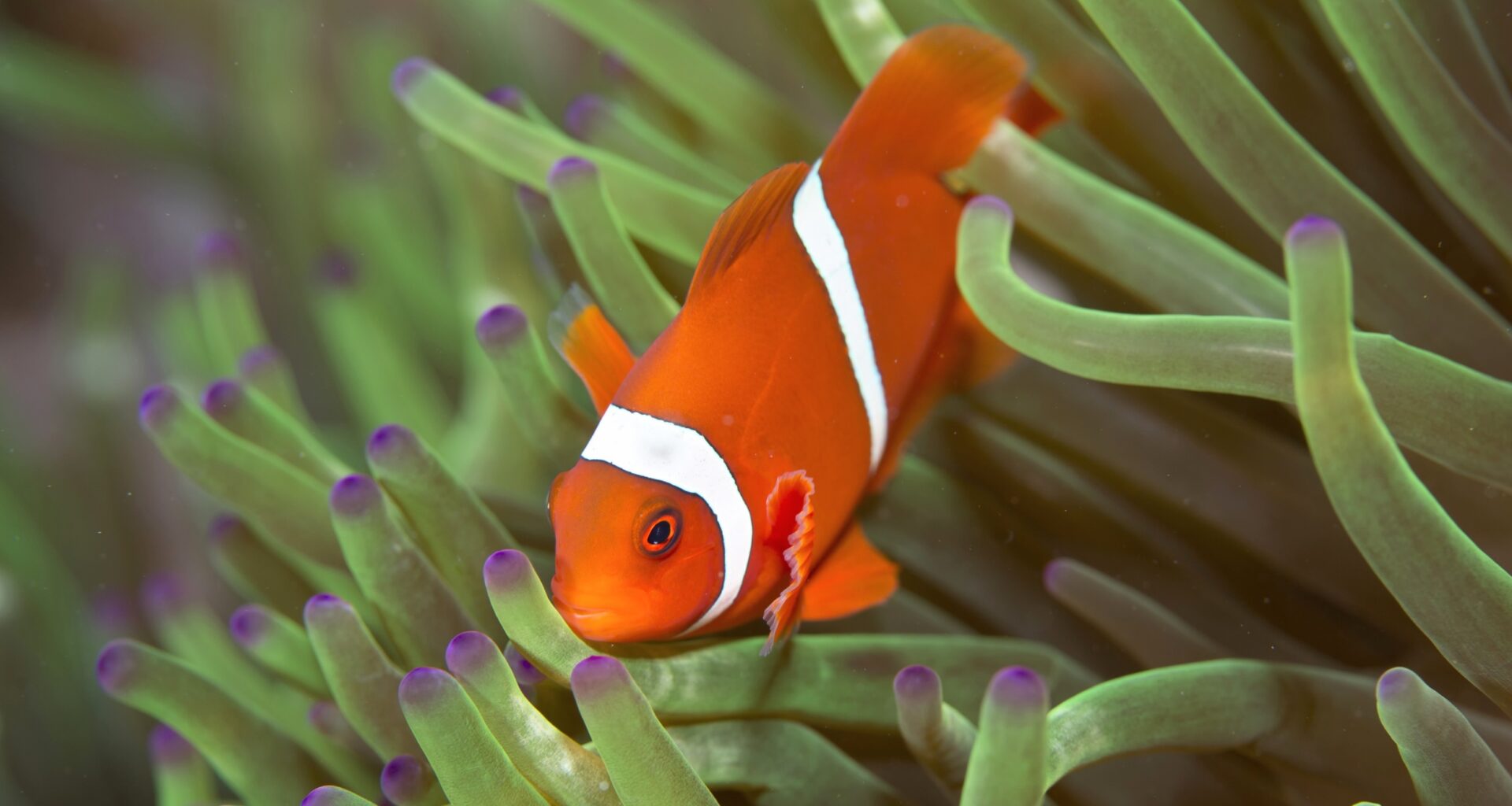
Why would a fish alter its stripes based on its neighbors? It may seem unexpected, but the social world inside a sea anemone can influence how a young clownfish develops and looks.
A detailed study shows that young tomato anemonefish adjust their white bars depending on their social world. Scientists at the Okinawa Institute of Science and Technology explored how this happens and why it matters.

The study focused on tomato anemonefish, a species that lives in close partnership with sea anemones. Young fish often begin life with two white vertical bars. As growth continues, one bar disappears.
This change does not happen at the same speed for every fish. Social surroundings play a major role.
Adult clownfish speed up stripe loss
In the wild, anemonefish live in strict social groups. One breeding pair leads the group, and smaller fish take lower ranks. Size and color help show who is dominant and who is not.
The researchers observed that young fish living with adult fish lost the extra white bar about 24 days earlier than fish raised without adults. This means the social environment can speed up physical development.
Living conditions and clownfish stripes
The team also tested different living conditions. Some juveniles stayed with live sea anemones and adults. Others stayed with anemones but no adults.
Some lived with fake anemones, and others lived in empty tanks. Fish with live anemones and adults showed the fastest bar loss. Fish without a real host or adults kept their white bar much longer.
Scientists believe that young fish may adjust their look to avoid conflict. During behavioral tests, adults attacked one bar juveniles more often than two bar juveniles.
The extra white bar seems to make a young fish appear less threatening. Once accepted into the group, losing the extra bar may help the juvenile fit into the social order.
What happens inside the skin
White bars form because of special cells called iridophores. These cells contain tiny crystal plates that reflect light and create bright white color.
Under a powerful microscope, researchers saw that these cells shrink and break apart during bar loss.
The process is not random. It follows a clear pattern. The white bar fades from back to front. Scientists found that iridophores do not move to another area. Instead, the cells die and disappear. Orange pigment cells then fill the space.
This cell death is called apoptosis, or programmed cell death. It is a natural process that shapes many parts of the body.
Hormones trigger stripe change
To understand what controls this change, the team studied gene activity in the skin. When bar loss began, genes linked to cell death became more active.
One important gene, caspase 3, increased strongly in juveniles living with adults. Caspase 3 helps carry out apoptosis.
When scientists blocked caspase activity using a chemical inhibitor, bar loss slowed down. This result proves that programmed cell death drives the fading of the white stripe.
The study also found changes in thyroid hormone related genes. Thyroid hormones often control growth and development in animals.
Juveniles living with adults showed signs of increased thyroid hormone signaling. This suggests that social signals may affect hormones, which then trigger changes in skin cells.
Stripe loss evolved socially
The researchers looked at the family tree of anemonefish species. Bar loss during growth did not come from one single ancestor. Instead, different species developed this ability at different times.
Species that show bar loss often live in smaller social groups. In small groups, a young fish faces a higher risk of direct aggression from adults.
A flexible color pattern may help reduce dangerous fights during the early stage of joining a group.
Clownfish stripes show social life
This research shows how social life can shape physical traits. A simple white stripe is not just decoration. It carries meaning. It helps fish communicate rank, avoid attacks, and survive in a competitive reef environment.
The study reveals how environment, behavior, genes, and hormones work together. Over time, such flexible changes may even lead to permanent differences between species.
Even in the colorful world of coral reefs, appearance tells a story. For tomato anemonefish, losing a stripe is not just growing up. It is a smart response to social life.
The study is published in the journal PLOS Biology.
—–
Like what you read? Subscribe to our newsletter for engaging articles, exclusive content, and the latest updates.
Check us out on EarthSnap, a free app brought to you by Eric Ralls and Earth.com.
—–