
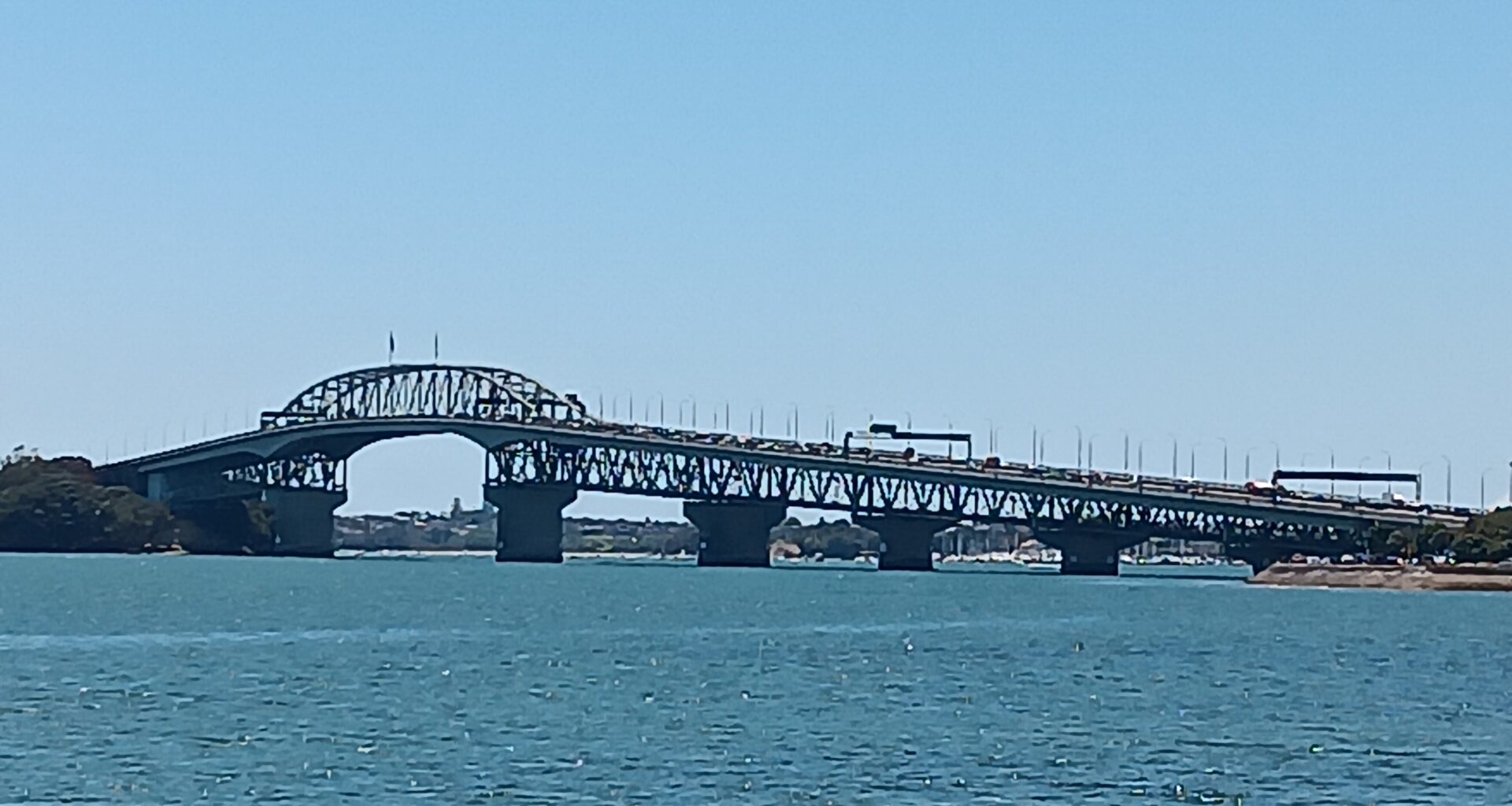
How do you pay for a multi-billion-dollar harbour crossing without chewing into funding for hospitals, schools and other social infrastructure? The Infrastructure Commission’s answer begins with a number: $9.
The Infrastructure Commission has put that price on the table for the current and future Auckland harbour crossings, saying its proposal reflects the maximum sustainable toll to help fund the multi-billion-dollar project.
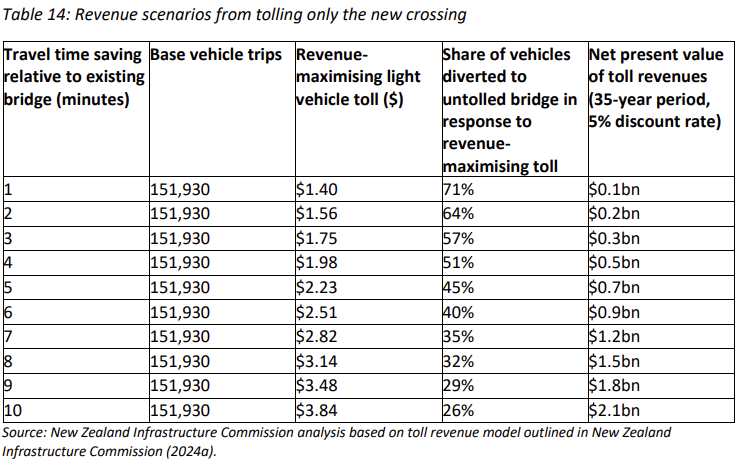
Infrastructure Commission chief executive Geoff Cooper said the figure represents the revenue-maximising charge to raise up to $7 billion to $9 billion, and is intended to spark a broader debate about how New Zealand pays for its most expensive infrastructure.
“How have we got the $9? The question we’re asking here and that we have been asking for several years now is, can tolls pay for new roading infrastructure? And for a great many of the roads that we are contemplating, the answer to that question is unequivocally no,” Cooper said.
“Tolls do not cover a significant proportion of the capital and ongoing, renewal and replacement requirements of the roads.”
Cooper said $9 was the estimate of the most amount of revenue that you could collect to then fund the capital cost of a new crossing.
“If you charged a little bit less than $9, the revenue would fall, and if you charge more than $9, people would substitute away from the bridge, maybe they wouldn’t make a trip and your revenue would fall.”
Inflation adjusted
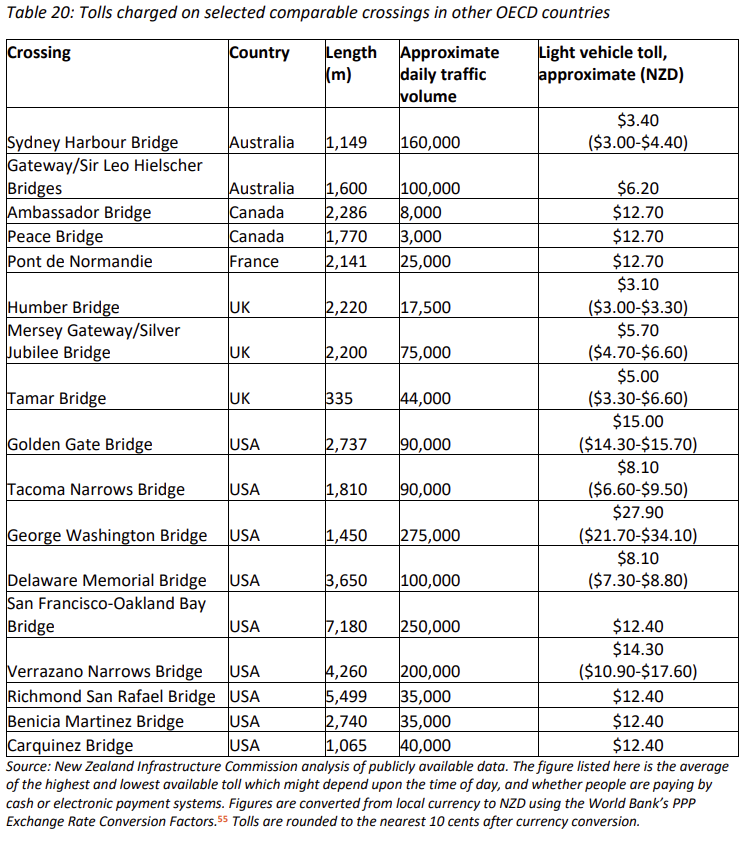
Cooper said coincidentally the $9 figure was the inflation adjusted number from the harbour toll in the 1960s.
“It tells you that we have paid this kind of toll to build this kind of project in the past. We don’t make any assumptions about the acceptability of that toll, but you can observe that it’s something we have paid before.”
Cooper said they put the number out “because it helps folks understand what a reasonable capital envelope for the project could be, and that capital envelope is somewhere between $7b to $9b”.
There was a choice for ministers on what the toll should ultimately be, he said, or if there should in fact be a toll, or if it could be done alongside other broad based funding instruments, such as a Funding and Financing Act (IFF) levy, “as in what Wellington has done with its sludge minimisation plant”.
“You could say, $9 too much, and you can conclude that actually the project needs to get smaller than $7b to $9b… Our view would be, that’s exactly the right discussion to be having,” Cooper.
“We’re trying to use the revenue maximising tool to help people understand a project envelope that would give confidence to a decision maker, to write it down in a budget such that they didn’t crowd out a tonne of other investments or have to go down a funding path that required non-users to contribute to the toll.”
Cooper said the motivation for offering tolling revenue advice was to spark conversation about safeguarding funds for social infrastructure such as hospitals and schools.
“With the Auckland Harbour Bridge, this is our most expensive infrastructure project on the horizon and what is unique about this project is that it has… a very narrow, if not no, path to funding through conventional funding tools.”
‘We don’t even know what we’re building yet’
During a Q+A in Auckland on Thursday, Transport Minister Chris Bishop was asked about the toll proposal.
“I want to stress we’re a wee way away from a decision, we don’t even know what we’re building yet.
“I get people want certainty. But also when you’re spending like 15 billion bucks of government money on a new bridge or tunnel – not saying one or the other. People would want us to take a proper process around it, I don’t think that’s unreasonable.”
“We’re not shagging spiders here. We’re like creating a massive multi generational infrastructure project for New Zealand for the next 50 years of New Zealand. So let’s get it right.”
Finance Minister Nicola Willis on RNZ called the toll proposal a “completely hypothetical scenario in the Infrastructure Commission’s plan”.
“It’s not something that the government has given consideration to.”