
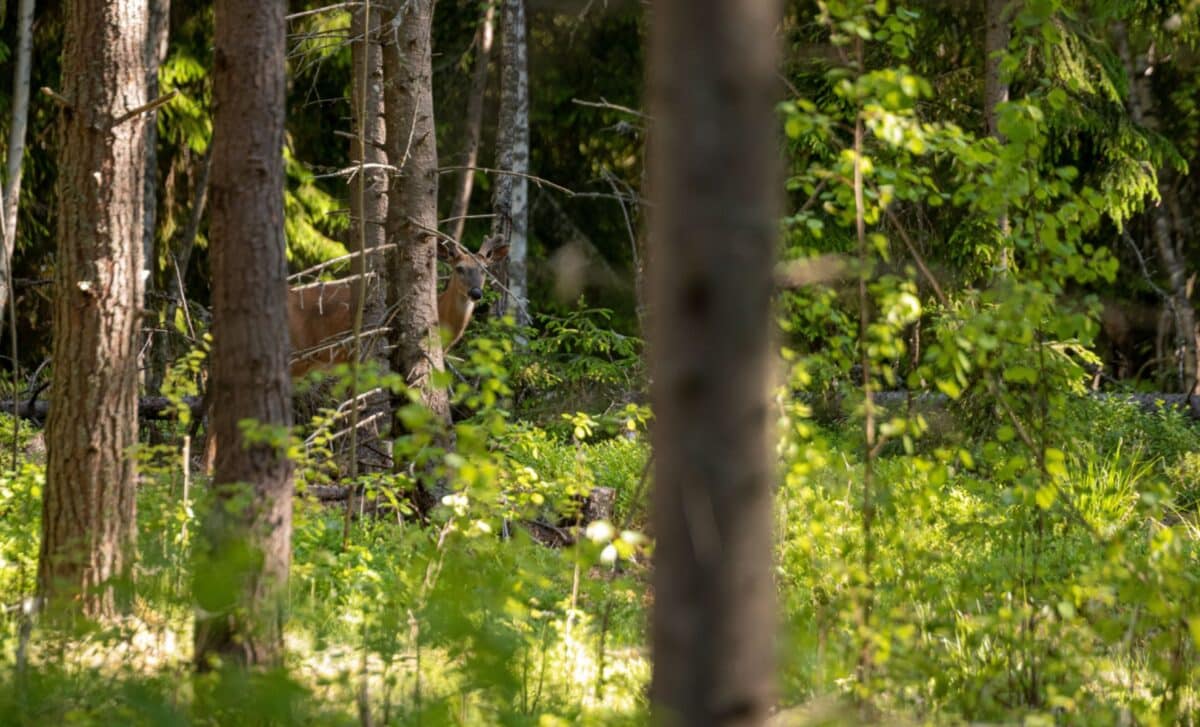
White-tailed deer are leaving behind more than scent marks during mating season. A new study reveals that their rubs and scrapes emit ultraviolet-induced photoluminescence, visible to deer but invisible to us. The findings suggest that deer may be using glowing visual cues as part of their communication system, adding a new layer to behaviors long thought to rely mostly on smell.
For decades, researchers have known that male white-tailed deer (Odocoileus virginianus) mark trees and soil during the fall breeding season. They rub their antlers against bark, paw the ground, and deposit urine and glandular secretions. These “signposts” have been widely understood as olfactory signals, warnings to rivals and invitations to potential mates.
Now, scientists at the University of Georgia report that these same signposts glow under ultraviolet light in ways that align precisely with deer vision. According to the study published in Ecology and Evolution, this is the first quantitative evidence that a mammal may be functionally using environmental photoluminescence.
Ultraviolet Light Reveals What Human Eyes Cannot See
Researchers analyzed 146 deer signposts in Whitehall Forest, a 337-hectare research site in Georgia. The team examined 109 antler rubs and 37 scrapes during two survey periods in fall 2024, returning at night with ultraviolet flashlights peaking at 365 and 395 nanometers, wavelengths present in the atmosphere during dawn and dusk, when deer are most active.
Using a PR-650 spectrophotometer, the scientists measured irradiance values reflected or emitted by each signpost and compared them to surrounding bark and forest floor. According to the authors, “Rubs and urine found on scrapes exposed to 395 and 365 nm had greater average irradiance values (i.e., brighter) than the surrounding environment, and exhibited photoluminescence.”
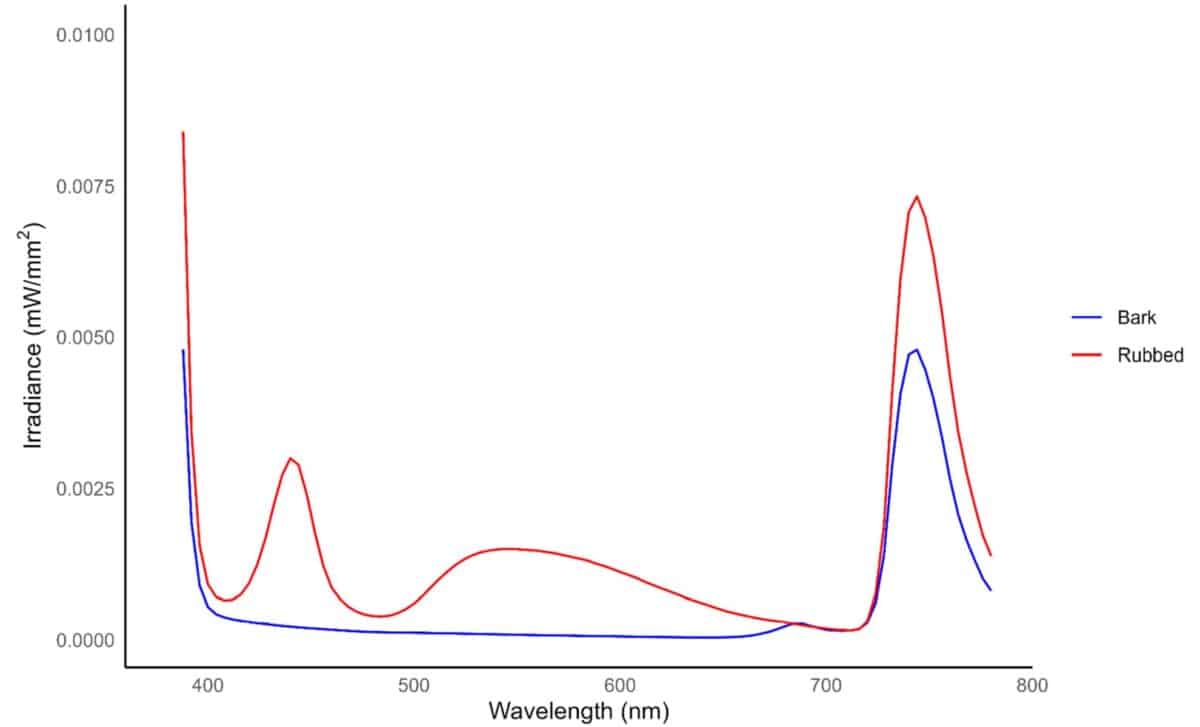 White-tailed deer rubs show higher irradiance and photoluminescence at ~450 and 550 nm under 365 nm UV light, aligning with deer visual sensitivity (Athens-Clarke County, 2024; N=109; p<0.001) ©Ecology and Evolution
Under 365 nm light, rubbed trees showed photoluminescence peaks around 450 and 550 nm. Under 395 nm, emissions ranged from roughly 500 to 590 nm. These peaks closely align with the short-wave sensitive (450–460 nm) and middle-wave sensitive (537 nm) cones in deer eyes, first described in earlier vision studies.
“The resulting photoluminescence would be visible to deer based on previously described deer visual capabilities,” the researchers write. Urine deposits on scrapes also showed significant contrast with the surrounding forest floor. When exposed to 365 nm light, urine exhibited a distinct emission peak between 420 and 460 nm. Under 395 nm, emissions extended from approximately 480 to 600 nm.
A Seasonal Signal Linked to Breeding Behavior
The timing of the glow may matter. The study found that rubs created later in the season, closer to peak breeding, had higher irradiance values than those made earlier.
Rubs formed between October 14 and November 12 showed significantly greater brightness under 365 nm exposure than those recorded between September 8 and October 2 (p < 0.001). The authors note that rubbing behavior intensifies as testosterone levels rise and the breeding season approaches.
Although the team did not directly test behavioral responses, they observed that irradiance increased in parallel with known hormonal shifts. As stated in the paper, “Though we did not directly test for a behavioral change in deer as a result of the presence of photoluminescence, the irradiance of rubs increased at the same time as deer hormone levels increased, and behavioral changes are known to change with the progression of the breeding season.” Urine was only present at scrape sites during the later survey window, reinforcing the seasonal pattern.
What Makes the Marks Glow
The source of the photoluminescence likely varies. According to the study, lignin in exposed wood layers can glow under ultraviolet light. Deer forehead glands produce phenols and terpenes, compounds known to exhibit photoluminescence. Urine contains porphyrins and amino acids, which also emit light when excited by UV wavelengths.
“Whether the photoluminescence is the result of deer forehead glandular secretions or wood properties, the fact remains that rubs visually contrast the surrounding environment in a way that is uniquely suited for deer vision,” the team explains.
The researchers evaluated their findings against criteria proposed in earlier work on photoluminescence in mammals. The excitation wavelengths occur naturally, the emitted light contrasts with typical backgrounds, the marks are positioned visibly in the environment, and deer possess the spectral sensitivity to detect them. Four of five functional criteria were met.
For a species long thought to rely mainly on scent and sound, the forest may be lit with signals we simply cannot perceive. According to the paper, this study offers “new perspective about how white-tailed deer perceive their environment and communicate,” suggesting that twilight in the woods may be brighter, at least to deer, than anyone realized.