
After a major oil spill, rescue teams face a painful choice. Oil spreads quickly across water and poisons marine life. One fast way to stop that spread is to burn the oil on the surface.
This method, called an in-situ fire, keeps oil from reaching coastlines. But it creates thick black smoke, releases toxic soot into the air, and leaves behind sticky sludge on the water.

Now, scientists have tested a bold new idea. Instead of letting oil burn in a flat pool, researchers created giant spinning flames called fire whirls. These tornado-like flames burn oil faster and more cleanly.
A large-scale experiment shows that fire whirls could change how the world handles oil-spill disasters.
A new way to fight oil spills
This research was supported by the Bureau of Safety and Environmental Enforcement. The project is led by Dr. Elaine Oran and Dr. Qingsheng Wang from Texas A&M University, along with Dr. Michael Gollner from the University of California, Berkeley.
“This [is] the first time anyone has conceived using fire whirls for oil spill remediation, and it’s really just the beginning,” said Oran, professor of aerospace engineering in the College of Engineering.
“Our goal is to harness the chaotic nature of fire whirls as a powerful, precise restoration tool to protect coastlines, marine ecosystems and the environment as a whole.”
What is a fire whirl?
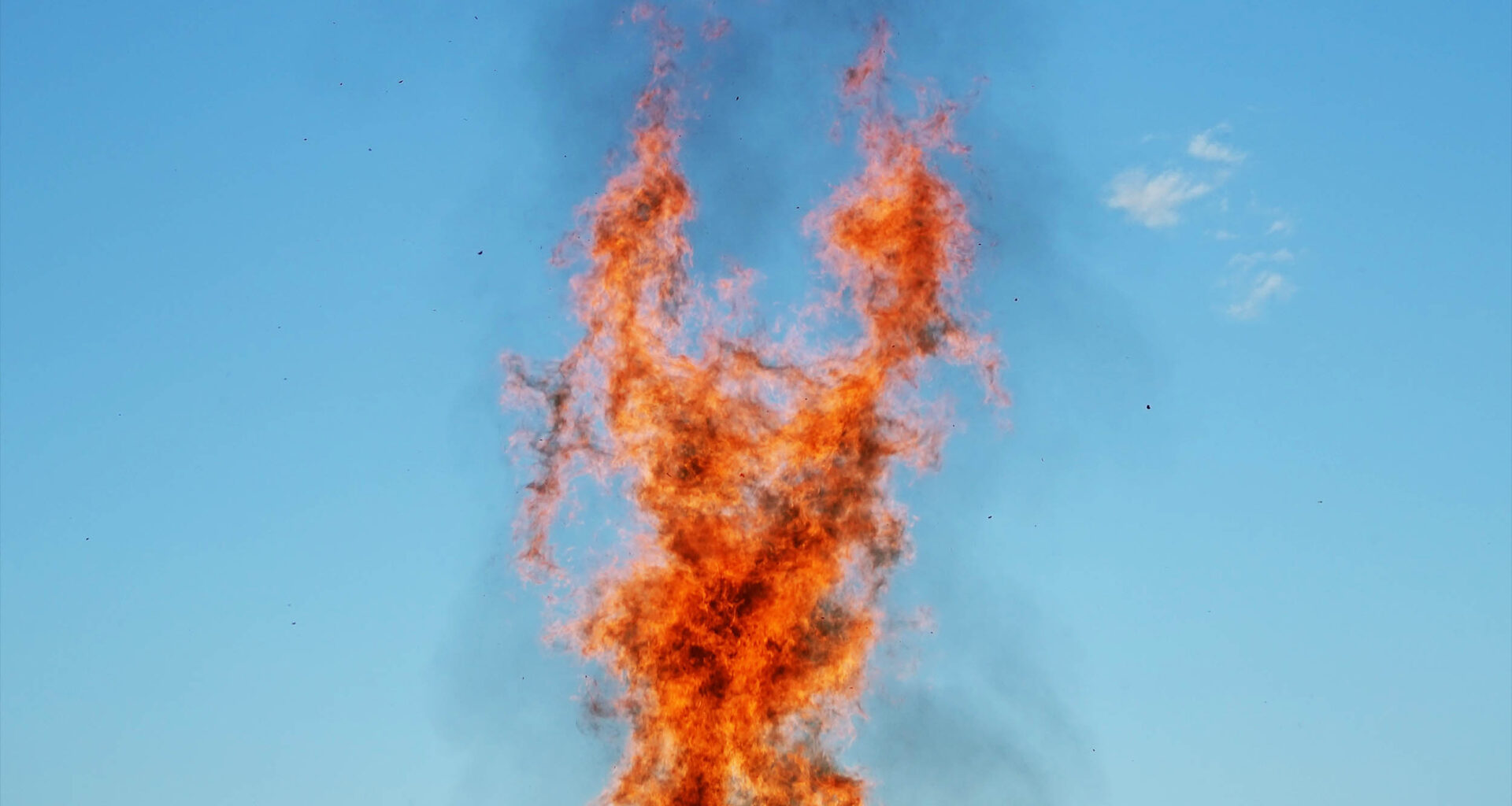
A fire whirl looks like a spinning column of flame that rises upward instead of spreading outward.
The spinning motion pulls in more oxygen, almost like a turbo-charger in a car engine. Extra oxygen makes the flame burn hotter and more completely.
In tests, fire whirls burned oil nearly twice as fast as regular in-situ fire pools. Even more impressive, fire whirls reduced soot by about 40 percent and burned up to 95 percent of the fuel.
That means far less smoke and far less toxic residue left behind.
Lessons from Deepwater Horizon
The 2010 Deepwater Horizon disaster remains a powerful reminder of what oil spills can do.
The explosion killed 11 workers and caused the largest offshore oil spill in United States history. Thousands of marine animals died, and ocean habitats suffered massive damage.
Traditional burning methods helped control some of the spread, but thick smoke filled the sky. Burning oil always comes with environmental costs.
“We are looking at environmental disasters like oil spills, and identifying ways to remediate them in faster, greener and more sustainable ways,” Oran said.
Time is critical
Speed matters during an oil spill. Oil can travel long distances in a short time. Sensitive marine habitats and protected coastlines remain at risk.
Fire whirls may give response teams a faster tool to destroy oil before it spreads.
“Fire whirls burn through crude oil spills nearly twice as fast as in-situ fire pools, potentially giving cleanup crews faster operational and response times to eliminating the oils from spreading,” Oran said.
Reducing smoke emissions
Burning oil on open water can send pollution high into the air and across nearby communities.
“One of the biggest challenges of burning oil spills is the sheer volume of smoke emitted,” Oran said.
“Our results show that fire whirls, compared to in-situ fires, dramatically reduce overall emissions.”
A fire whirl acts like a giant incinerator. The intense spinning flame destroys many of the particles that normally form black smoke.
Instead of leaving behind a heavy tar-mat on the ocean surface, the whirl vaporizes most of the oil.
Beyond oil spills
The research results showed that fire whirls burned oil about 40 percent faster, cut soot emissions by 40 percent, and reached up to 95 percent fuel-consumption efficiency compared to in-situ fire tests.
The science behind this discovery could also help engineers design high-efficiency combustion systems.
Firefighters might even use this knowledge to better predict and control wildfire behavior on land.
“Our study has universal applications,” Oran said. “By understanding the physical laws that govern fire whirls, we can harness their power beyond oil spill remediation.”
Engineering a fire tornado
Scientists usually study fire whirls in small laboratory experiments. However, cleaning an ocean oil spill requires large-scale testing.
“The scale of our experiment is one of the reasons why our investigation is so unique, and what sets it apart as a first-of-its-kind,” Oran said.
The team built three 16-foot-tall walls arranged in a triangle. This structure carefully controlled airflow. At the center, a wide pool of crude oil floated on top of water.
When researchers ignited the oil at the Texas A&M Engineering Extension Service Brayton Fire Training Field, a nearly 17-foot-tall fire whirl formed.
The results were clear. The spinning inferno burned hotter, faster, and cleaner than a normal fire pool.
Finding the Goldilocks zone
“Fire whirls are incredibly powerful, and can be incredibly beneficial,” Oran said. “But they’re also sensitive and only reach high efficiency when the conditions are just right.”
Too much wind can cause the column to collapse. Poor airflow control can turn the whirl back into a regular fire pool.
Even oil thickness matters. If the oil layer becomes too deep, the whirl can go out too soon.
Researchers call this balance the Goldilocks zone. Conditions must be just right for maximum efficiency.
Future response systems
With more research, scientists hope to design mobile systems that crews could place over burning oil slicks.
Such systems could transform destructive flames into controlled fire whirls.
This work shows that fire does not always have to mean destruction. In the right conditions, controlled flames could help protect oceans, coastlines, and marine life.
Sometimes, the boldest ideas lead to the biggest breakthroughs. In this case, a spinning wall of fire may become a powerful tool for saving the sea.
The study is published in the journal Fuel.
—–
Like what you read? Subscribe to our newsletter for engaging articles, exclusive content, and the latest updates.
Check us out on EarthSnap, a free app brought to you by Eric Ralls and Earth.com.
—–