

Highlights
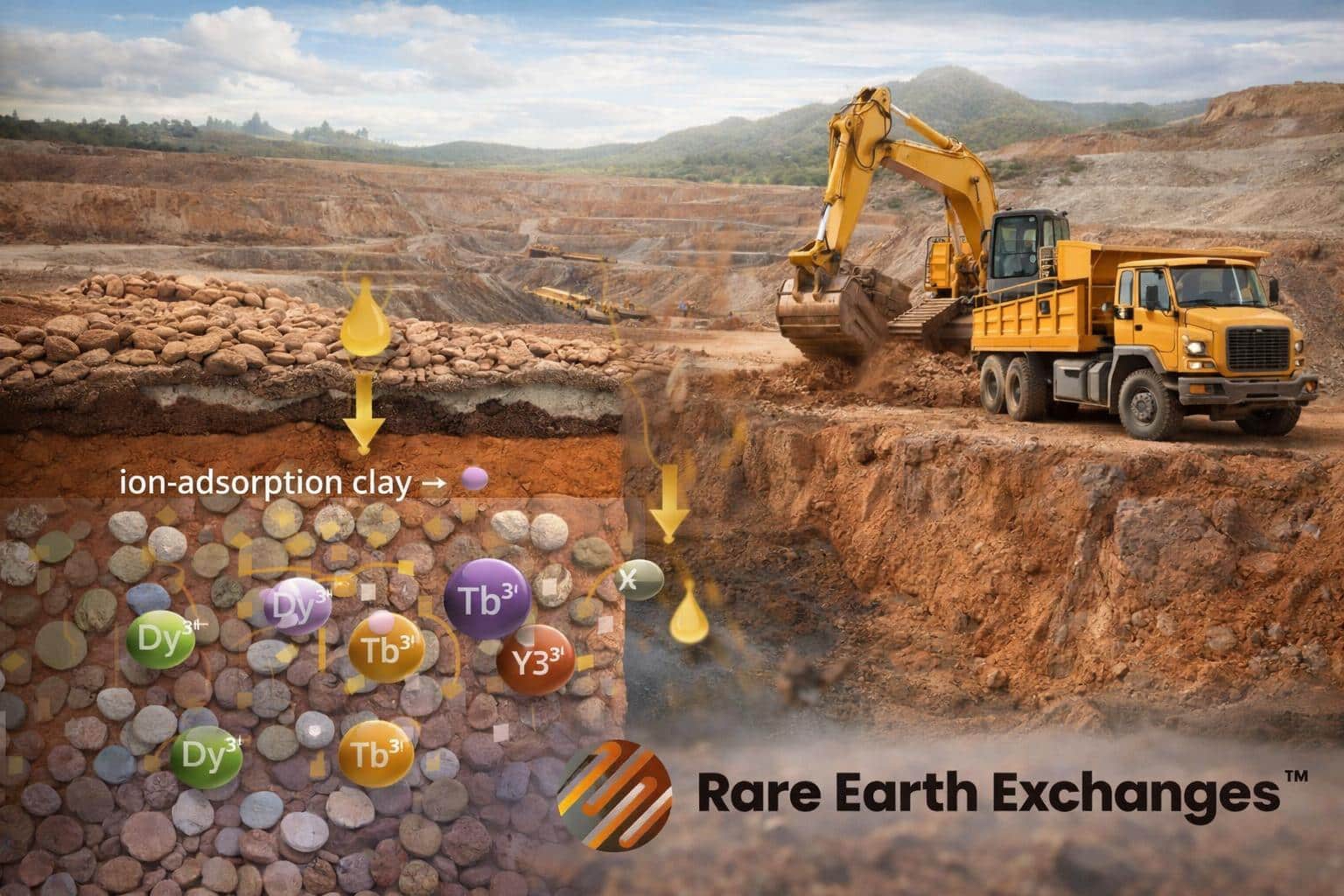
Ion-adsorption rare earth (IARE) ores are the world’s primary source of heavy rare earths like dysprosium and terbium, but current in-situ leaching methods require high ammonium inputs, cause slow extraction, and risk slope instability and pollution.
A critical review of 342 publications shows the field is pivoting from end-of-pipe cleanup toward source-level control—preventing impurity mobilization, improving ore permeability, inhibiting clay swelling, and reducing chemical dependence at the leaching stage.
Future HREE supply security depends on mastering cleaner, faster, and safer extraction chemistry and geotechnical stability, moving promising lab-scale innovations to validated field deployment with standardized metrics and scalable systems.
Ion-adsorption rare earth (IARE) ores are the world’s most important source of heavy rare earth elements (HREEs)—the dysprosium- and terbium-class materials that keep high-performance magnets stable at high temperatures. In a new critical review in the Journal of Rare Earths, Bingxuan He and colleagues at Central South University, School of Minerals Processing & Bioengineering (opens in a new tab); Key Laboratory of Biohydrometallurgy, Ministry of Education, examine why extracting HREEs from these ores remains both strategically vital and technically stubborn. Their core message is clear for the Rare Earth Exchanges™ community: IARE ores can yield HREEs efficiently because many rare earths are held by clays, but current in-situ leaching practices still carry heavy costs—high ammonium input, slow leaching, weak impurity control, and even slope instability—so the next generation of extraction must be greener, faster, and safer without sacrificing recovery.
REEx Reflection
The team from Central South University in Changsha, Hunan Province explain how the world extracts heavy rare earth elements—like dysprosium and terbium—from ion-adsorption clay deposits, which hold most of the global supply. These ores are easier to process than hard rock deposits because the rare earths sit loosely on clay surfaces, but current methods use large amounts of ammonium chemicals, take a long time, and can cause soilinstability and pollution. The study reviews over a decade of researchand highlights new ideas to reduce chemical use, control impurities earlier in the process, improve how liquids move through the ore, and prevent clay swelling. The authors conclude that future progress depends on cleaner chemistry and safer in-situ leaching methods so heavy rare earth production can become more efficient, stable, and environmentally responsible.
Study Methods: From Mineralogy to Mechanism
This is a critical review that synthesizes the field’s research trajectory and technical bottlenecks, drawing on 342 publications since 2010 identified through Web of Science keyword searches (“ion-adsorption rare earth ores” + “leaching”). The authors start “from the root,” reviewing mineral characteristics, REE occurrence states (noting that a large share is ion-exchangeable, while colloidal and mineral-boundspecies are less studied), and the evolution of mining/extractionapproaches. They then organize technical progress around five innovation directions for in-situ leaching agents:
reducing ammonium salt inputs, 2) suppressing impurity leaching, 3) improving recovery of non-ionic REE states, 4) improving permeability/seepage, and 5) inhibiting clay expansion. They also survey “non-mainstream” options such as bioleaching and field-enhanced leaching (e.g., electromagnetic/ultrasonic assistance).
Key Findings: A Field Shifting Upstream
The review documents a visible pivot away from pure “terminal treatment” (cleaning impurities after leaching) toward source-level control—preventing aluminum/iron and other impuritiesfrom mobilizing in the first place and improving solution flow throughore bodies. Over the last five years, the authors note research emphasis moving from kinetics and leaching efficiency toward permeability, clay swelling inhibition, and ore microstructure, reflecting recognition that in-situ leaching is as much a hydro-geotechnical problem as a chemical one. The authors argue that sustainable progress will depend on pairing smarter lixiviant chemistry (opens in a new tab) with stability management to reduce irreversible changes to soil structure and shear strength during injection.
Limitations and Controversial Edges
Because it is a review, the paper does not present new field trials; many promising approaches remain lab-scale or early pilot concepts, and real-world deployment will hinge on economics, site variability, and regulatory constraints. A practical tension remains: IARE ores represent a huge share of HREE reserves, yet the leading extraction route—injecting chemicals into ore bodies—can introduce lasting geotechnical and environmental disturbance, which makes “green, sustainable, efficient” a demanding three-way target rather than a slogan.
Implications: The Next Magnet War May Be Won in Leach Chemistry
For Rare Earth Exchanges readers, the paper reinforces a supply-chain reality: HREE security is not just about owning deposits—it’s about mastering extraction and control at the ore body. If industry can cut ammonium dependence, curb impurity mobilization, and stabilize ore permeability and slopes, it could improve both cost and social license. What should follow: more field-validated demonstrations, standardized metrics for impurity control and stability, and clearer pathways to scale “novel” methods beyond the laboratory. The frontier is not only new mines—it is better leaching systems.
Citation: He, B., Wang, J., Liu, Y., Zhang, R., Liu, H., Yang, B., Zhu, Z., Hu, S., & Qiu, G. (2026). Mechanisms of rare earth elements extraction from ion-adsorption rare earth ores: A critical review. Journal of Rare Earths (in press). https://doi.org/10.1016/j.jre.2026.01.032 (opens in a new tab)
Fantastic! Thanks for subscribing, you won’t regret it.