

Keeping pace with Hollywood’s awards horserace. Sign up for the newsletter here.
For too long, one group of actors has been cruelly locked out of Academy Awards consideration: young hot men.
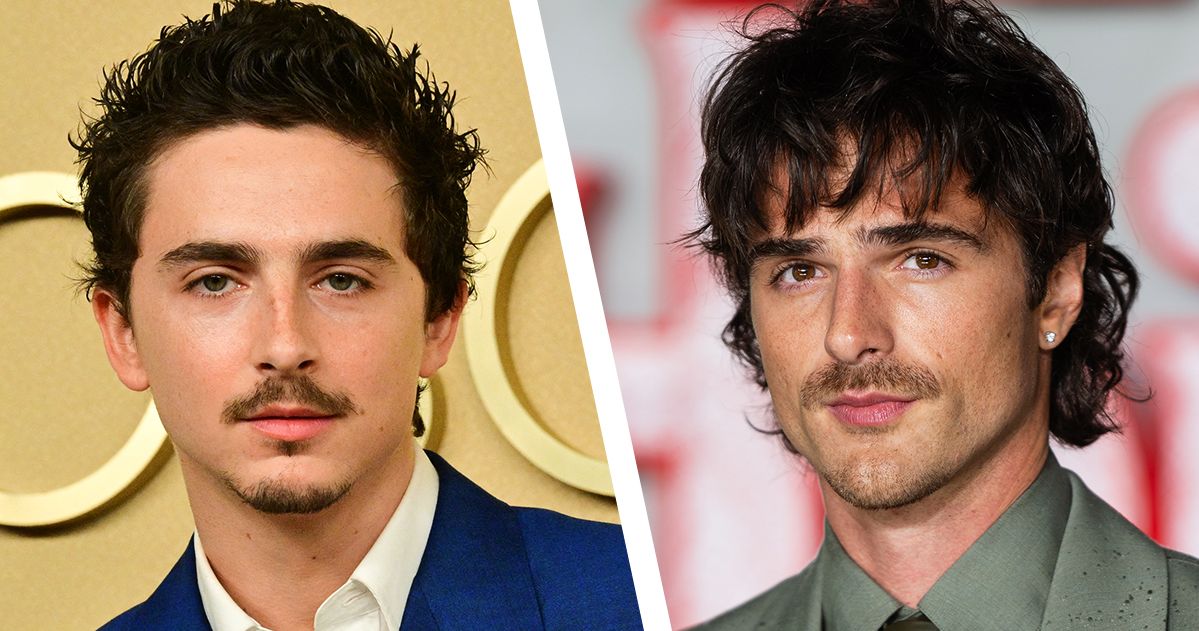
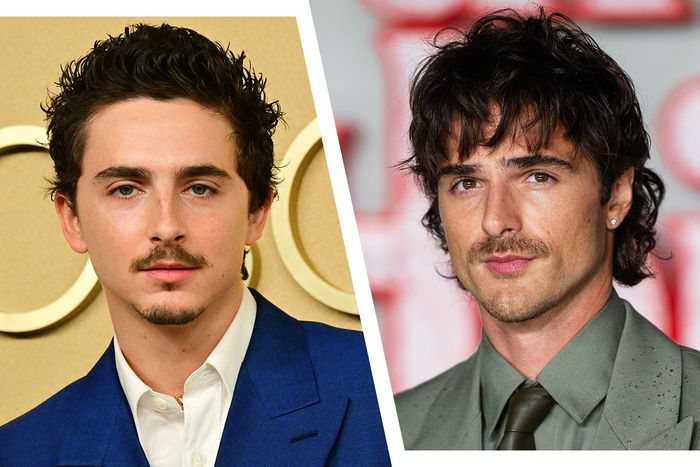
Photo-Illustration: Vulture; Photos: Frederic J. Brown/AFP via Getty Images, Samir Hussein/WireImage
It seems as if every year at the Oscars, another of the Academy’s old biases falls by the wayside. Genre films like Everything Everywhere All at Once, Barbie, and Sinners now rack up major nominations. International contenders regularly compete all across the ballot. More work remains to be done — infamously, there has still never been a Black Best Director winner — but it’s heartening to see the definition of what, and who, is considered Oscar-worthy expand beyond the narrow confines of yore.
This season may bring another crack in Oscar’s glass ceiling. For too long, one group of actors has been cruelly locked out of Oscars consideration, their podium moments relegated to low-rent precursors like the Golden Globes and MTV Movie Awards. That could turn around this year, when these long-overlooked performers finally get their moment in the sun. I’m talking, of course, about young hunks.
For as long as I’ve been following the Oscars, it has been conventional wisdom that young men do not win acting trophies. This is particularly true for Best Actor, where there has been only one winner younger than 30 in the entire history of the Oscars: The Pianist’s Adrien Brody, who was 29 when he won in 2003. The reasoning for this usually goes that these guys already have everything — millions of dollars, beautiful women, the full flush of youth — so the mostly male, mostly middle-aged members of the Academy prefer to make them sweat a bit before allowing them to get an Oscar, too.
The go-to example is Leonardo DiCaprio, who wasn’t even nominated when Titanic pulled in 14 Oscar nods on its way to winning Best Picture and who had to wait into his 40s before he was allowed to win for The Revenant. DiCaprio’s fellow ’90s idol Brad Pitt didn’t win an acting Oscar until he was in his mid-50s, for Once Upon a Time in … Hollywood (though by then he already had a trophy for producing 12 Years a Slave). This decade, we’ve seen Elvis’s Austin Butler lose to The Whale’s Brendan Fraser and, in a poetic irony, Brody win his second for The Brutalist before Timothée Chalamet could win his first for A Complete Unknown. And those are the guys who did get nominated. Whiplash’s Miles Teller, Creed’s Michael B. Jordan, 1917’s George MacKay — none of them even got in the door.
That may be about to change. Chalamet is nominated for Best Actor again this year for Marty Supreme, and this time he’s the betting favorite to take the prize. Both the Critics Choice Awards and the Golden Globes tipped his way, and while industry groups like SAG and BAFTA could yet upend the race, given the fact that Chalamet won at SAG last year, he’ll be a safe bet to repeat this year. As for BAFTA, Marty Supreme was the third-highest-grossing Best Picture contender at the U.K. box office, behind only F1 and Hamnet, so he should have a decent shot at the win there as well.
Ever since an awards strategist I spoke to a few weeks ago mentioned this theory, I haven’t been able to stop thinking about it.
How did Chalamet go from also-ran to front-runner in the span of 12 short months? Many have pointed out that the actor turned 30 back in December, thus crossing the invisible line that separates “young whippersnapper” from “seasoned veteran.” There may be some truth to that. Two men have won Best Actor at age 30, Richard Dreyfuss for The Goodbye Girl and Marlon Brando for On the Waterfront, though looking at the data, it’s more the 32-to-34 range where age stops being a factor. That’s the Daniel Day-Lewis–Nicolas Cage–Eddie Redmayne zone: No one would call you “old,” but you’re not young, either.
However, I’d venture there’s another factor behind Chalamet’s seemingly effortless leap to front-runner status: Timmy isn’t handsome in Marty Supreme. Ever since an awards strategist I spoke to a few weeks ago mentioned this theory, I haven’t been able to stop thinking about it. The Chalamet we see onscreen in Marty Supreme is not the elegant young Dauphin we saw in Call Me by Your Name or Dune, nor the brooding heartthrob and New York playboy we see in perfume commercials. Besides his terrible skin and glaring unibrow, there’s something a little reptilian about Marty Mauser. He feels cold-blooded somehow. There’s no warmth behind those beady little eyes.
If you’re not the kind of person who sticks around for talk-backs, you may be under the impression that this is what Chalamet actually looks like. (Even his co-star Gwyneth Paltrow thought so.) In that case, our hypothetical Oscar voter may find themselves feeling a touch more sympathy for young Chalamet: When he’s not all dolled up for the cameras, he’s actually kind of a dweeb … just like me! If you are plugged-in, though, you know that Chalamet’s Marty Supreme look actually required hours of labor. As makeup designer Mike Fontaine told Variety, the transformation incorporated five separate prosthetics: “large pieces that covered his cheeks to give the acne-pockmarked skin texture … another piece on his cheekbone to create a deep scar on one side, two smaller pieces for scars under his lip, and a long scar under his chin.” To sell Marty’s nearsightedness, director Josh Safdie forbade the use of lensless frames. Instead, Chalamet wore contact lenses that ruined his vision, then put on real glasses to correct it.
As much as Chalamet has been running an unconventional version of a classic Best Actor campaign, emphasizing the strenuous effort behind his performance — he was secretly practicing Ping-Pong for six years — it strikes me that one secret to his success is that he’s also running a classic actress campaign. Because it’s Best Actress that gave birth to the cliché about pretty people uglying themselves up for an Oscar. The most famous example is Charlize Theron in Monster, in part because she was the third in a row: The two women who preceded her, Halle Berry in Monster’s Ball and Nicole Kidman in The Hours, also de-glammed themselves. Recent winners like Brie Larson of Room and Michelle Yeoh of EEAAO have gone for similar, if subtler transformations, while Yeoh’s co-star Jamie Lee Curtis took the same path to victory in Supporting Actress.
I don’t think this is a conscious strategy on Chalamet’s part, but, regardless, it makes a certain kind of sense. Like DiCaprio in the ’90s, he’s got the kind of fine-boned softness that scans as feminine. (Contrast with Austin Butler, the Brad to his Leo.) His prettiness takes just as much effort to tamp down as Theron’s did 20 years ago — why shouldn’t he reap similar rewards?
I think there’s a third factor at play as well. As luck would have it, Chalamet isn’t even the biggest dreamboat in the Oscars race this year. The honor goes to Frankenstein’s Jacob Elordi, who became the first Kissing Booth alum to be nominated for an Oscar when he made the Supporting Actor lineup. Elordi isn’t working quite the same angle as Chalamet. For one, he’s competing in a category that’s far less averse to awarding young men. The 28-year-old Australian is only a year younger than Cuba Gooding Jr. was when he won for Jerry Maguire and Heath Ledger would have been on the night of his posthumous win for The Dark Knight. (The record was set by 20-year-old Timothy Hutton for Ordinary People, more twink than hunk.) Elordi is also less favored to win as most pundits peg Sentimental Value’s Stellan Skarsgård as the one to beat in Supporting Actor. But Skarsgård wasn’t nominated by SAG, so there’s every chance that, as he did at the Critics Choice Awards, Elordi could take advantage of a split vote between One Battle After Another’s Benicio del Toro and Sean Penn and win there. After that, who knows?
Whether he becomes a threat to take the trophy or not, Elordi has already surpassed everyone’s expectations. The stakes are higher for Chalamet.
The six-foot-five Elordi is far more of a traditional hunk than Chalamet, and his stature has only grown with the success of Emerald Fennell’s Wuthering Heights, which cements him as a premier box-office draw. Haters who wondered whether the adaptation would prove to be his Norbit (now what kind of idiot would say a thing like that?) must eat their words now that he’s earning raves: “Elordi palpably sells Heathcliff’s anguish,” says Katie Walsh, “his heartache at Cathy’s rejection, his insecurity, the cruelty he clings to as revenge.” As a result, Elordi will come into final Oscar voting benefiting from what Gregg Kilday once dubbed “the Double Exposure Effect,” nominated for one project but getting just as much buzz from another.
As Lainey Gossip notes, there’s an appealing synchronicity between Elordi’s roles as two icons of 19th-century literature since “the root cause of the monster and Heathcliff’s toxicity is, basically, daddy issues.” Critics might note another similarity between the two: Both characters have been stripped of much of their on-page monstrousness. This is yet another way Elordi’s character stands apart. While other supporting-actor transformations, like Ledger in The Dark Knight or Javier Bardem in No Country for Old Men, were turns toward the monstrous, Elordi’s Frankenstein metamorphosis maintains his romantic appeal, even as he’s playing a character constructed from a bunch of disassembled corpses.
Whether he becomes a threat to take the trophy or not, Elordi has already surpassed everyone’s expectations. The stakes are higher for Chalamet, who now — like so many of his characters — is expected to make good on his youthful promise. Fortunately, the rest of the Best Actor field is made up of guys who used to be in the exact same position. Chalamet will be competing against DiCaprio, a former pinup now nominated for playing a middle-aged dad in One Battle After Another. There’s also Michael B. Jordan, who after missing out for nom-worthy performances in Creed and Black Panther finally made the cut for Sinners — in part because, at age 39, he’s the kind of established leading man the Academy has no qualms about recognizing. We should also not neglect The Secret Agent’s Wagner Moura, no slouch in the looks department himself, or Blue Moon’s Ethan Hawke, who occupied roughly the same position for Gen X as Chalamet does for Gen Z. If Chalamet ultimately triumphs, this too could be another reason: When everyone in the race is a hunk, what does a few years make?
Sign up for Gold Rush
A newsletter about the perpetual Hollywood awards race.
Vox Media, LLC Terms and Privacy Notice