
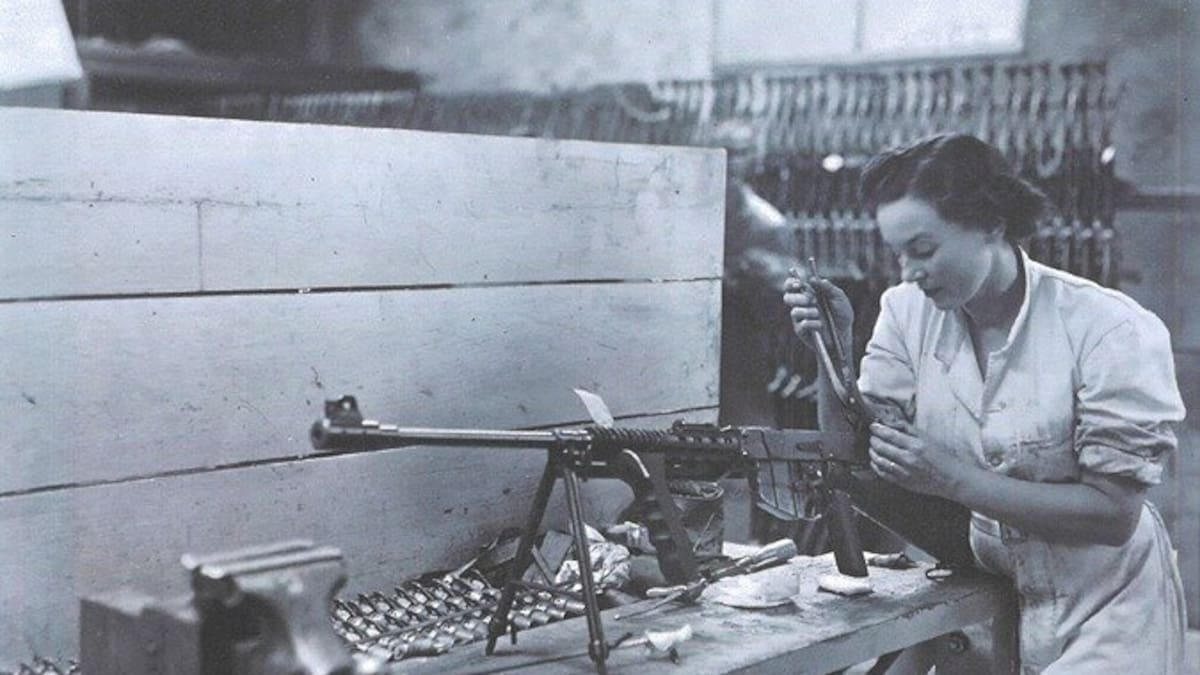
The gun’s designer Philip Charlton, Phil to his friends, invented a small, one-cylinder gas-powered engine that drove a mechanism that automated the bolt of the rifle so that the last round fired could be ejected and the next round reloaded.
Although many do remember the story of the gun and its production in Hawke’s Bay, Cooke said it is not widely remembered because Charlton himself “never had any desire to document the project” and much of what was kept was lost in a house fire in 1946.
Cooke spent the last 12 months writing the book after being contacted by the Waiōuru Army Museum, who had been in touch with a number of collectors who had completed their own research material, plus material found at Archives New Zealand.
He calls it “a very little-known subject” and said he wrote the book to make this important piece of Hawke’s Bay history accessible to everyone, not just gun enthusiasts.
Cooke said people don’t realise that the building where the Hastings Habitat for Humanity now sits was once an arms manufacturing plant that produced 1500 guns.
“It’s completely unique, this weapon,” he said.
“No other New Zealand-designed weapon was ever produced in more than a couple of prototypes.”
Women operating the bespoke press made to force the cooling rings down over a .303 tapering barrel for the Charlton automatic rifles. Photo / Lovell Smith of Hastings, Glover Collection
Cooke said that Charlton had not only the engineering brilliance to make these things without drawing a single plan, but he could also navigate the halls of power and encourage people like World War II Defence Minister Fred Jones to get it made en masse.
Although he never fired the gun himself, Cooke said it would have been a “terrifying experience”.
“If you’re lying down, for example, and you’re looking along the sights at the top of the weapon, which is flicking backwards and forwards very close to your face.”
He said soot and smoke would escape from various parts of the converted rifles and cover the shooter’s face.
Although the gun never made it to the front lines of the war, thanks to nearly all being destroyed in an accidental fire at an ordnance depot in Palmerston North in December 1944, several sit in museums and private collections around the world – including one at Te Papa and two at the Imperial War Museum in London.
Charlton died in 1978, but Cooke said he continued producing guns right up until his death, made from the wrecks of guns that were destroyed.
Despite the weapons never making it to the battlefield, Cooke believes the wartime population of Hawke’s Bay were very proud of what the Charlton Automatic Arms Company achieved, as well as the efforts of the families involved in its construction, like the Fields, the Dohertys and the Morrisons.
At the book launch on Sunday, Cooke will have representatives of all families involved with the guns’ production with examples of Charlton rifles on display, plus books available for purchase.
Jack Riddell is a multimedia journalist with Hawke’s Bay Today and has worked in radio and media in the UK, Germany, and New Zealand.