
Space is unforgiving to electronics. Beyond Earth’s protective magnetic field, satellites are bombarded by cosmic rays and high-energy particles that slowly chip away at delicate circuits.
Over time, these invisible strikes can corrupt data, damage components, and shorten a spacecraft’s life. To overcome this challenge, engineers usually add heavy shielding, but that extra weight increases launch costs and limits what a mission can carry.
Now, a team of researchers from Fudan University presents an interesting solution to this problem. They build the electronics from a material so thin and robust that radiation barely harms it in the first place.
When tested, their atom-thin communication system not only survived months in orbit—it is predicted to last centuries in harsher space environments.
Creating electronics from a single atomic layer
The researchers used molybdenum disulfide (MoS₂), a compound that can be made just one layer of atoms thick—about 0.7 nanometers. At that scale, there is very little material for incoming radiation to damage.
In theory, energetic particles pass through such thin sheets without creating the kinds of defects that typically cripple conventional silicon chips.
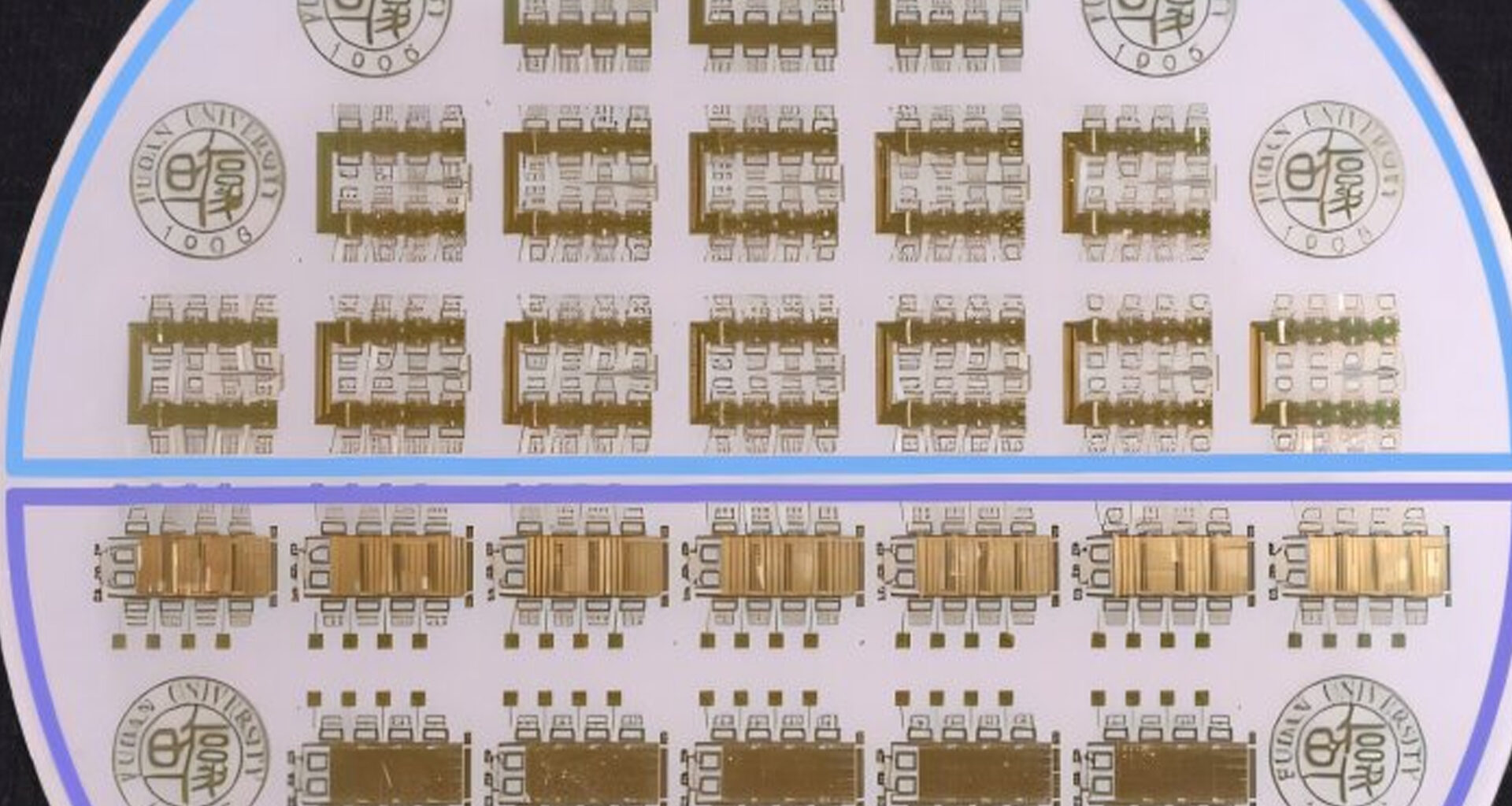
To turn this idea into something practical, the team first grew a large, uniform sheet of monolayer MoS₂ on a 4-inch wafer. From this wafer, they fabricated transistors—the basic building blocks of electronic circuits.
These transistors were then assembled into a fully working radio-frequency (RF) communication system operating between 12 and 18 gigahertz. More importantly, the system included both transmitters and receivers, meaning it could send and receive signals like those used in real satellites.
“On the basis of a 4-inch wafer-scale monolayer 2D MoS2 process, we implement an atomic-layer transistor-based radiation-tolerant radio frequency (RF, 12–18 GHz) system with both transmitters and receivers for spaceborne communication,” the study authors note.
Testing the system in real conditions
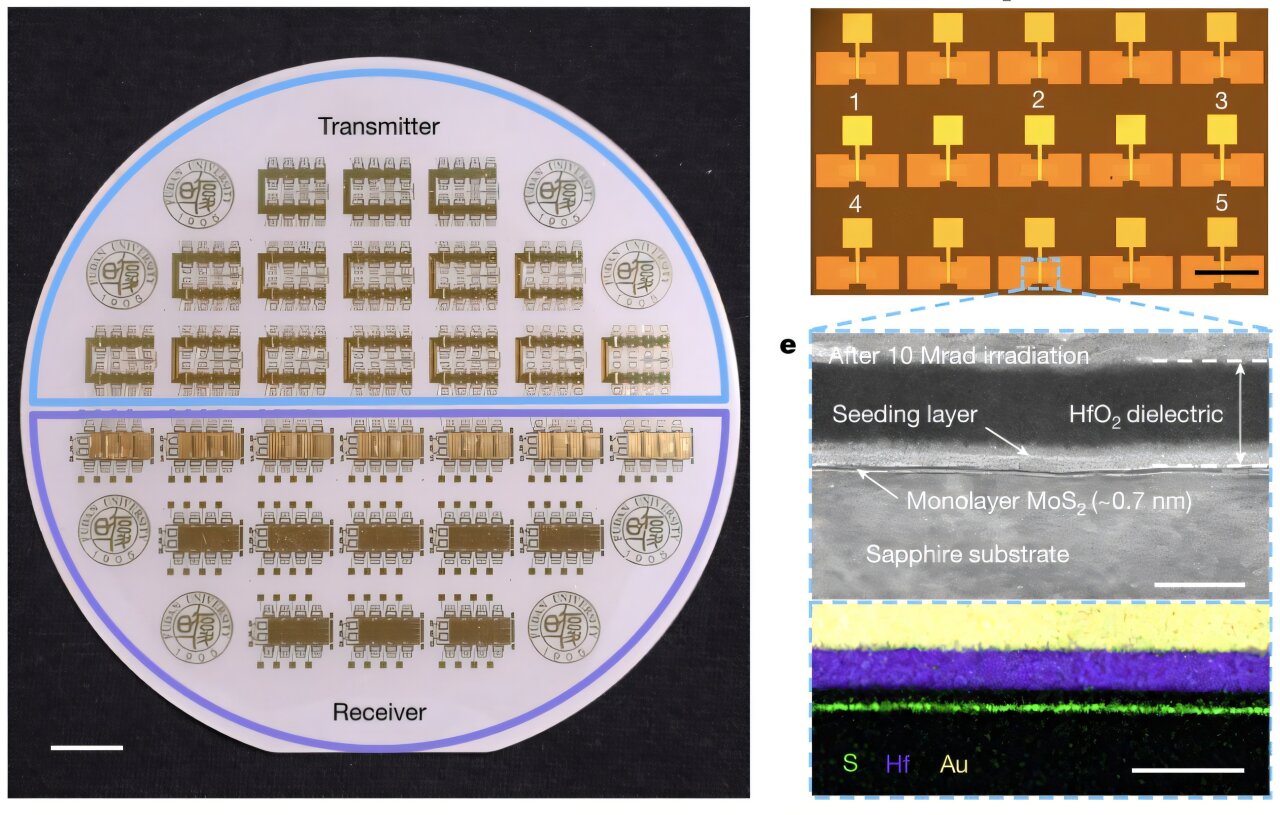 Structure of the atom-thick circuit. Source: Liyuan Zhu et al./ Nature (2025)
Before sending anything into space, the researchers stress-tested the circuits on Earth. They blasted the devices with intense gamma radiation to simulate what electronics experience in orbit. Then they examined the material in detail using advanced imaging tools.
Transmission electron microscopy allowed them to look at the atomic structure. Energy-dispersive spectroscopy checked whether the chemical composition had changed. Raman spectroscopy scanned multiple points across the film to detect structural damage.
The result was surprising. There were no clear signs of structural or chemical degradation in the atom-thin layer. Electrically, the devices behaved almost exactly as they had before irradiation. They kept ultra-high on–off ratios, showed very little current leakage, and consumed little power—an important feature for energy-limited spacecraft.
The ultimate test came in space. The team launched the MoS₂-based communication system into low Earth orbit at an altitude of about 517 kilometers. For nine months, the device operated in the harsh radiation environment of space.
“Notably, the system maintains a bit error rate (BER) of less than 10−8 in the transmitted data after 9 months of on-orbit operation, indicating substantial radiation tolerance and long stability,” the study authors said.
As a demonstration, the system successfully transmitted and received the full Fudan University anthem with perfect clarity.
Moreover, based on the radiation data collected in orbit and models of space environments, the researchers estimate that their system could survive a whopping 271 years in geosynchronous orbit, where radiation levels are much higher than in low Earth orbit.
Future of atom-thin electronics
If these results hold up in future missions, atom-thin electronics could transform spacecraft design. Instead of relying on bulky shielding, satellites could use circuits that are intrinsically resistant to radiation.
This would reduce weight, lower launch costs, and free up space for scientific instruments or communication payloads. Longer-lasting electronics could also extend the lifetime of satellites, deep-space probes, and high-orbit communication platforms.
However, there are challenges that remain. For instance, the current system demonstrates radio-frequency communication, but full spacecraft electronics involve many other components, including processors, memory systems, and power management units.
Scaling up production, integrating MoS₂ with existing technologies, and proving reliability over even longer missions will be the next important steps.
The study is published in the journal Nature.