
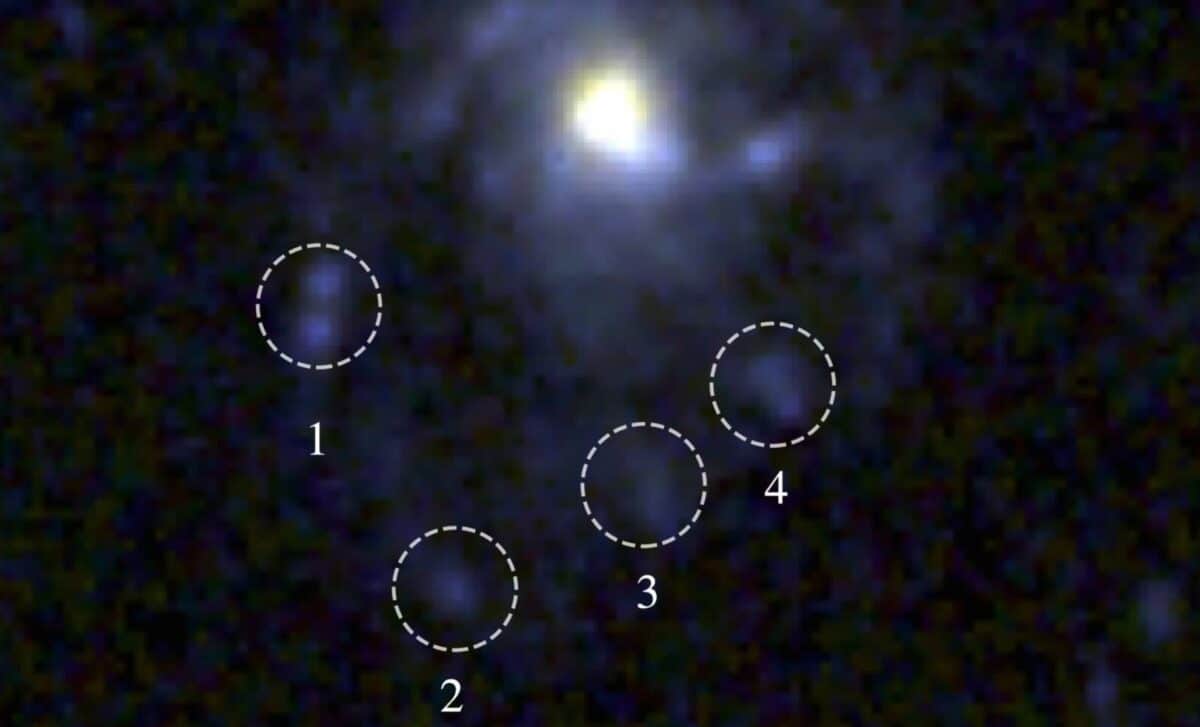
Spotted in deep observations of the Cosmic Evolution Survey Deep field, this distant galaxy shows dramatic trails of gas streaming behind it, features that astronomers link to powerful environmental forces inside galaxy clusters. Researchers believe this discovery may sharpen our understanding of galactic evolution during what is often described as the universe’s adolescence.
The finding centers on a class of objects called jellyfish galaxies, named for their trailing tendrils of gas that resemble the appendages of their ocean counterparts. In this case, those tendrils stretch outward from an otherwise familiar-looking galactic disk, creating an image that is both elegant and scientifically revealing.
A Distant Jellyfish in the Cosmos Field
The team identified COSMOS2020-635829 while combing through extensive JWST data gathered from the COSMOS field, a region of the sky favored by astronomers because it lies away from the plane of the Milky Way and is largely free of bright foreground obstructions. According to Space.com, this makes it particularly well suited for studying distant and ancient galaxies.
“We were looking through a large amount of data from this well-studied region in the sky with the hopes of spotting jellyfish galaxies that haven’t been studied before,” said Ian Roberts of the Waterloo Centre for Astrophysics in the Faculty of Science in the UK. “Early on in our search of the JWST data, we spotted a distant, undocumented jellyfish galaxy that sparked immediate interest.”
The galaxy appears as it existed roughly 5.3 billion years after the Big Bang. At that time, galaxy clusters were still forming, an important detail that makes what happens next especially intriguing.
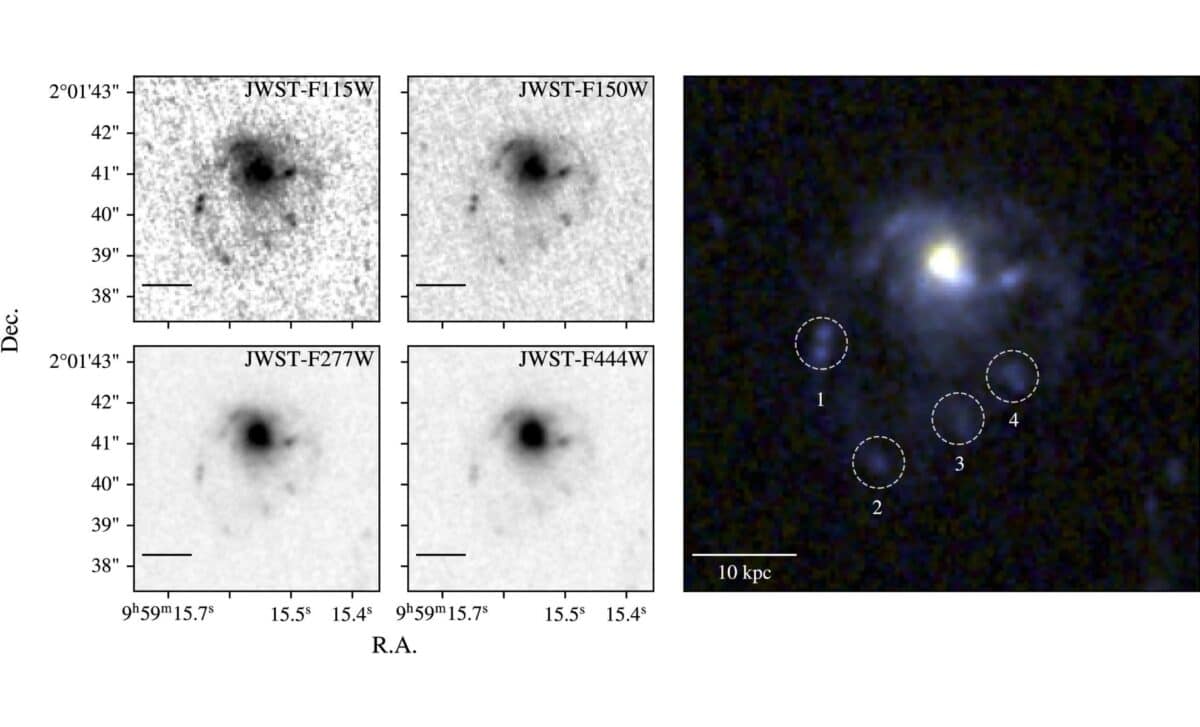 Thumbnail images of COSMOS2020-635829 for the four JWST filters used in this work. The red–green–blue image on the right is a combination of JWST F444W (red channel), F277W (green channel), and F115W + F150W (blue channel). The dashed circles mark the four extraplanar sources that are identified in the tail of COSMOS2020-635829 – © The Astrophysical Journal
Ram-Stripping and Newborn Stars in the Tendrils
Jellyfish galaxies earn their name from the long trails of gas that extend behind them. These features form through a process known as “ram-stripping.” As galaxies move through their cluster environments, strong winds push against them, forcing gas out of their disks.
In the JWST image, the galactic disk of COSMOS2020-635829 looks relatively normal, not dissimilar from our own modern-day galaxy, aside from its distinct gaseous tails. Within those tendrils, bright blue “knots” are visible. These knots represent groupings of young stars.
Their youth indicates that these stars were born outside the galaxy’s main disk, forming directly within the ram-stripped gas. Similar structures have been observed before, including in images from the Hubble Space Telescope of other jellyfish galaxies. Still, seeing such features at this distance, and at this stage of cosmic history, adds a new dimension to the picture.
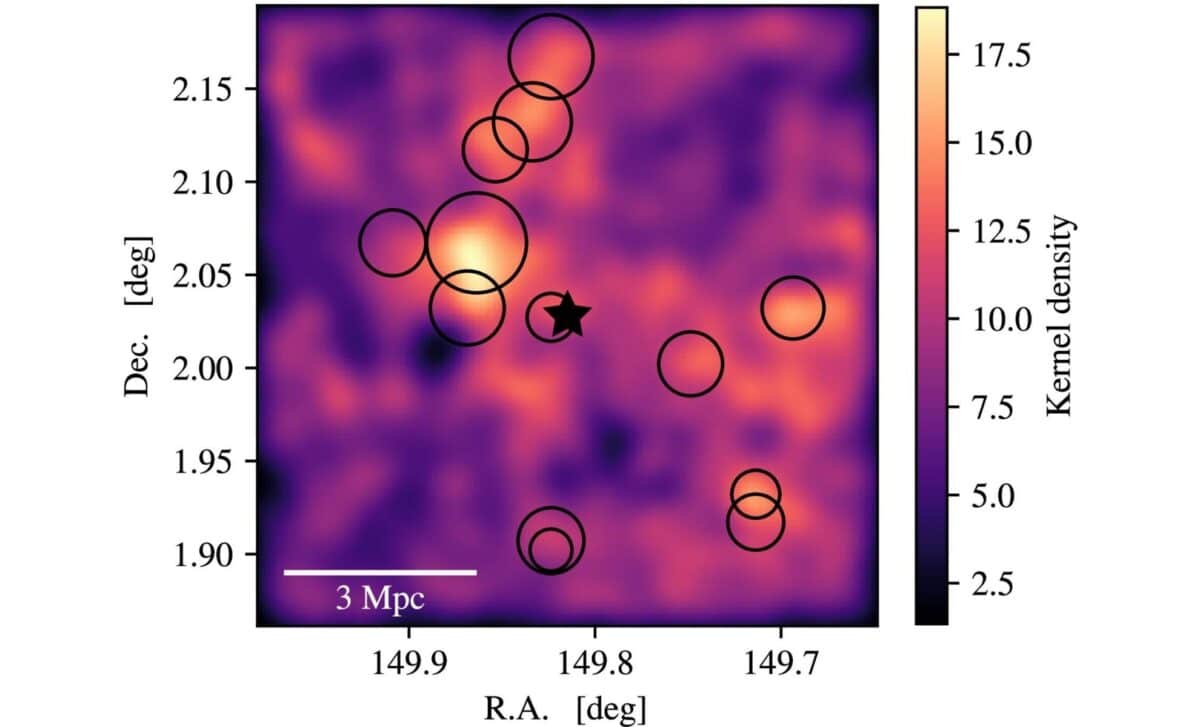 Large-scale structure around COSMOS2020-635829. The large star marks the position of COSMOS2020-635829. The color map shows a 2D kernel density estimate of all galaxies from the COSMOS2020 catalog within 10′ of COSMOS2020-635829 and with 1.0 < zphot < 1.3. Open circles correspond to groups or clusters from the AMICO-COSMOS catalog within 10′ of COSMOS2020-635829 and with 1.0 < zphot < 1.3 – © The Astrophysical Journal
A Surprise in the Early Universe
One of the most unexpected aspects of this discovery concerns timing. Researchers had previously thought that galaxy clusters 8.5 billion years ago would not commonly generate enough pressure to trigger widespread ram-stripping.
The new observation challenges that assumption. “The first is that cluster environments were already harsh enough to strip galaxies, and the second is that galaxy clusters may strongly alter galaxy properties earlier than expected,” Roberts explained. He added that these processes may have contributed to building the large population of “dead” galaxies observed in clusters today. “This data provides us with rare insight into how galaxies were transformed in the early universe,” Roberts said.
The team plans to continue studying COSMOS2020-635829 with the James Webb Space Telescope, hoping to untangle more of the mysteries surrounding jellyfish galaxies and the forces that shaped them billions of years ago.