
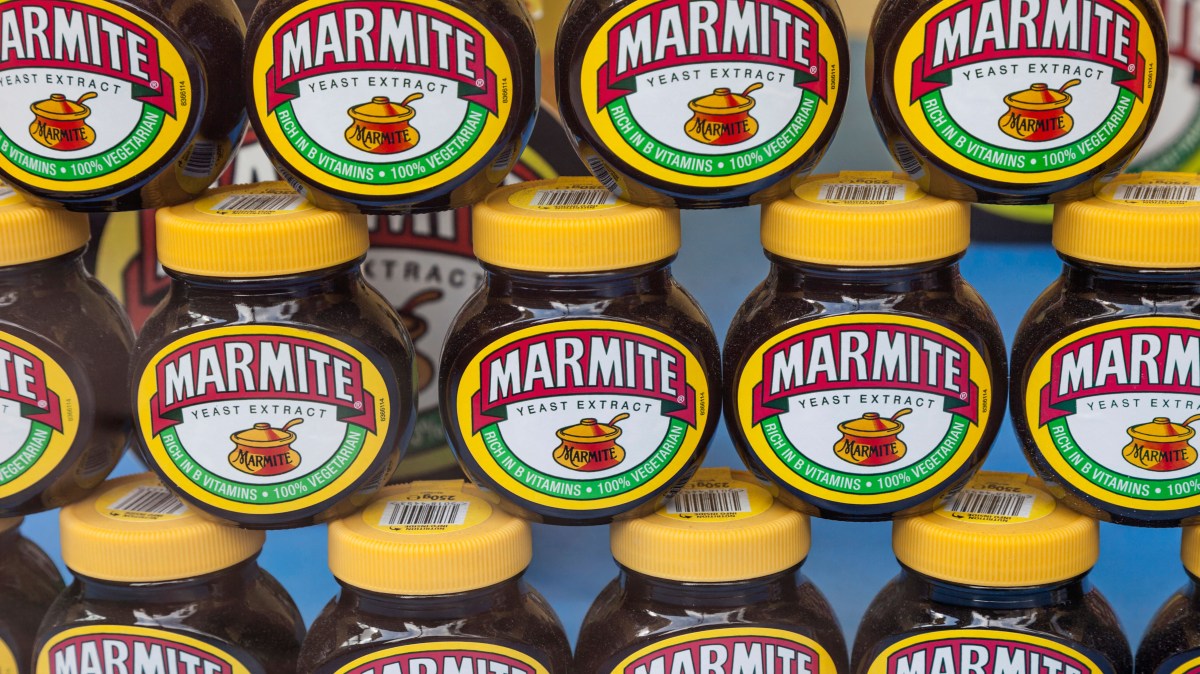
Marmite comes into its own at this time of year. When the mornings are dark and the evenings are long, a hot, salty slice of toast can feel more like emotional support than breakfast. But is it good for us?
Marmite is essentially yeast left over from beer-making; it has been produced since 1902 in Burton upon Trent, the British brewing capital. The yeast is concentrated, heated and filtered to produce a thick, intensely savoury — and low-calorie — paste. That distinctive umami punch comes from naturally occurring amino acids called glutamates, released when proteins break down during fermentation, and which provide that deceptively meaty flavour. A very British product, Marmite is rarely eaten outside the UK and Ireland, other than in New Zealand and South Africa. Antipodeans will debate endlessly whether Marmite beats its Australian counterpart, Vegemite, which is made in a similar way but with different seasoning, so it’s more bitter than its British cousin.
Nutritionally, Marmite’s reputation rests largely on one thing: B vitamins. “Marmite is rich in B1, B2, B3 and B12,” says the dietician Nichola Ludlam-Raine, author of How Not to Eat Ultra-Processed. “They are important for metabolism, red blood cell formation and the function of the nervous system.”
Not only do B vitamins help convert food into energy and play a role in reducing fatigue, but they also support brain health. Vitamin B12 in particular is harder to come by if you eat little or no animal produce, which makes Marmite appealing to vegans. According to the nutritional information on the brand’s website, a single thin spread (about 8g) of Marmite on toast can provide 76 per cent of your daily requirement.
Technically speaking, Marmite is classified as an ultra-processed food (UPF) — a term that has become dietary shorthand for “bad”. But the reality is more complicated. “It is classed as a UPF because of how it’s made,” Ludlam-Raine says, “but that doesn’t automatically make it unhealthy.”
• Seven UPFs the nutritionists say are actually good for you
The ultra-processing mostly refers to the fortification with B vitamins (B1, B2 and B3 occur naturally in the yeast but B12 is added), so it’s not exactly junk food. But nor is it a green salad. “I’d describe Marmite as a nutrient-dense condiment rather than a health food in its own right,” she says. “It can add nutritional value in small amounts, but it’s not something I’d suggest relying on as a significant part of your diet.”
The key phrase there is “small amounts”, because Marmite’s main nutritional drawback is also the thing that makes it so moreish: salt. An 8g serving contains 0.86g salt, which is 14 per cent of the NHS’s daily recommended limit for adults. “Marmite is very concentrated,” Ludlam-Raine says. “If it’s consumed frequently in large amounts, the salt can contribute to high blood pressure.”

An advert from the 1930s markets Marmite as a healthy choice
ALAMY
• Ultra-processed foods: 9 things you should never buy again
For most people, this isn’t a deal-breaker. Used sparingly, Marmite can sit happily in a balanced diet. But if you’re already eating a lot of salty foods, such as cheese, processed meats or ready meals, it’s not ideal to add more to your diet.
Which brings us to how we eat it. For many, the gold standard is spread on white toast with a generous slick of butter. Comforting, perhaps, but less than optimal from a health perspective. “How you use Marmite matters,” Ludlam-Raine says. “Using a small amount as a flavour enhancer in soups, stews or sauces can be a great way to add savoury depth.”
Stirred into a lentil stew, whisked into gravy, melted into mushrooms or used to boost a veggie chilli, Marmite behaves more like a seasoning than a spread. “Spreading it thickly on buttery toast, on the other hand, turns it into more of a ‘treat’ food because you’re combining it with refined carbs and saturated fat,” she says. The same goes for Nigella’s recipe for buttery Marmite spaghetti. “That changes the nutritional profile of the meal.”
The distinction between Marmite as seasoning and main ingredient becomes more pertinent as Marmite expands its empire. The 2022 arrival of a truffle-flavoured version, for instance, was marketed as a gourmet upgrade. Nutritionally, it’s much of a muchness. “The ingredient list suggests it’s still mostly yeast extract and salt, with added flavourings and carrot juice concentrate for colour and taste,” Ludlam-Raine says. “The ‘truffle’ element is more about flavour appeal than health benefits.”
And perhaps that gourmet flavour means it’s easier to overdo it. “I saw one reviewer saying they ate a jar in two days,” she says. “That’s 13g of salt a day — more than double the suggested daily limit.”
• The ultra-processed food Britain’s top nutritionist avoids
What about the growing range of Marmite-flavoured snacks — rice cakes, crisps, cheese puffs, even pinwheel pastries. “These use Marmite as a flavouring,” Ludlam-Raine says. But they can’t lay claim to its health benefits: “They tend to be more heavily processed, higher in salt and can be higher in fat or refined carbohydrates.”
So how does Marmite fit into a modern, health-conscious diet? If you hate it, don’t worry. B vitamins can also be found in eggs, dairy, wholegrains, legumes, leafy greens and fortified foods such as cereals or plant-based milk. And if you love it, perhaps use it more often in your cooking than on bread — though even Ludlam-Raine enjoys the occasional slice of Marmite on toast. So keep enjoying it, and know you’re in good company.